wayground logo

Free Printable Worksheets

NEW

Font size

S
M
L
XL
Worksheets

7 Waves Review

Total questions: 32

Worksheet time: 32mins

Name
Class
Date
1.
As the velocity of a wave increases, the frequency of the wave
a)
increases
b)
decreases
c)
remains the same
2.
A sound wave travelling eastward causes the particles to vibrate
a)
east to west
b)
north to south
c)
east, only
d)
west, only
3.
What is the period of a water wave if 4.0 complete waves pass a fixed point in 10. seconds?
a)
0.40 seconds
b)
2.5 seconds
c)
0.25 seconds
d)
4.0 seconds
4.

The number of wavelengths that pass a point each per second is:

a)

frequency

b)

period

c)

speed

d)

amplitude

5.
The type of waves that require medium to pass:
a)
Mechanical Waves
b)
Electromagnetic Waves
6.

When the frequency of a wave increases, what happens to the wavelength?

a)

They are unrelated

b)

The wavelength increases.

c)

The wavelength decreases.

d)

More information is needed

7.
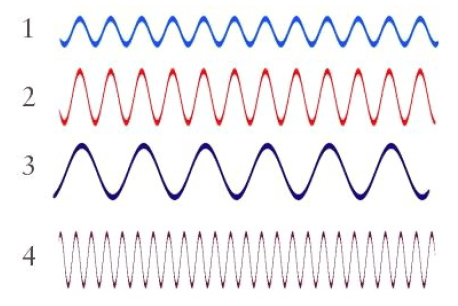
Which wave in the diagram has the greatest frequency?
a)
1
b)
2
c)
3
d)
4
8.
Which wave in the diagram has the greatest wavelength?
a)
1
b)
2
c)
3
d)
4
9.

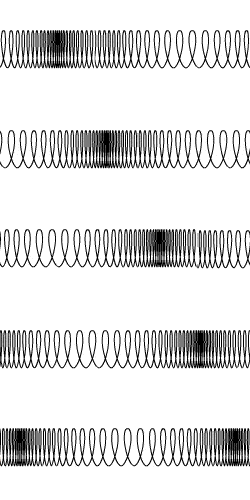
What kind of wave is pictured below?

a)

compressional wave

b)

transverse wave

c)

longitudinal wave

d)

mechanical wave

10.
What is a longitudinal wave?
a)
Waves that move the medium at right angles to the direction in which the waves are traveling.
b)
Waves that move the particles of the medium parallel to the direction that the waves are traveling.
c)
Waves that move the energy.
d)
There is no difference.
11.
What is a transverse wave?
a)
Waves that move the medium at right angles to the direction in which the waves are traveling.
b)
Waves that move the particles of the medium parallel to the direction that the waves are traveling.
c)
Waves that move the energy.
d)
None of the above.
12.

An electromagnetic wave is a __________ wave.

a)

Transverse

b)

Longitudinal

13.

A sound wave is a ___________ wave,

a)

Transverse

b)

Longitudinal

14.
Which vocabulary term is used to identify the distance between points C & G?
a)
Amplitude
b)
Crest
c)
Frequency
d)
Wavelength
15.

What type of wave is this?

a)

Longitudinal

b)

Transverse

c)

Electromagnetic

d)

x ray

16.
How would a person measure the wavelength on this sound wave?
a)
dense to less dense
b)
trough to crest
c)
compression to compression
d)
beginning of illustration to the end
17.

What type of interference is represented in this diagram?

a)

Constructive

b)

Destructive

18.

What type of interference is represented in the diagram?

a)

Constructive

b)

Destructive

19.

What is wave interference?

a)

When a wave bounces off an object

b)

When more than one wave overlap in the same medium

c)

When a wave bends around a corner

d)

When a wave increases its frequency

20.

The crest of a 2m tall wave collides with a trough of a 1m tall wave. What will be the amplitude of the resulting wave?

a)

1 meter

b)

2 meters

c)

3 meters

d)

4 meters

21.

The crest of a wave with an amplitude of 5m crashes into the crest of another wave with an amplitude of 3m. What will the amplitude of the resulting wave be?

a)

2 meters

b)

6 meters

c)

8 meters

d)

12 meters

22.

Look at the diagram. At which positions will the overlapping waves have the most constructive interference?

a)

Positions #1 & #5

b)

Positions #2 & #3

c)

Positions #3 & #4

d)

Positions #4 & #5

23.

Look at the diagram. At which positions will the overlapping waves have the most destructive interference?

a)

Positions #1 & #5

b)

Positions #2 & #3

c)

Positions #3 & #4

d)

Positions #4 & #5

24.

Standing waves are created by

a)

Two identical waves reflecting off each other

b)

Two identical waves being diffracted together

c)

Two identical waves move through each other in opposite directions

d)

Two identical waves are diffracted from two identical sources

25.

In the diagram which letters represent the nodes?

a)

A B C

b)

A C E

c)

B D

d)

B D E

e)

A C D

26.

The stationary dot is called:

a)

node

b)

anti-node

c)

amplitude

d)

equilibrium line

27.
What wave has rarefaction and compression?
a)
longitudinal 
b)
surface
c)
heat
d)
transversal
28.
 A wave has frequency of 50 Hz and a wavelength of 10 m. What is the speed of the wave?
a)
500 m/s
b)
50 m/s
c)
5 m/s
d)
0.5 m/s
29.
 A wave has frequency of 5 Hz and a speed of 25 m/s. What is the wavelength of the wave?
a)
25 m
b)
125 m
c)
5 m
d)
25 m/s
30.
A wave has wavelength of 10 m and a speed of 340 m/s. What is the frequency of the wave?
a)
34 m/s
b)
3400 Hz
c)
3400 m/s
d)
34 Hz
31.
The blue-throated hummingbird flaps its wings 300 times a minute.  What is its frequency?
a)
5 hz
b)
300 hz
c)
300/60 
d)
a lot?
32.

The time it takes for one wavelength to pass a certain point is:

a)

frequency

b)

period

c)

speed

d)

amplitude