
 Worksheets
Revolutions Practice Quiz
Total questions: 102
Worksheet time: 53mins
Why were Europeans interested in India?
Because of it's culture
Because it had a lot of resources
Which one was a mutiny fought by Indian soldiers against British rule in India in the mid 1800s?
Sepoy Rebellion
Boer War
Opium War
Who controlled India before the Sepoy Mutiny?
Great Britain
Britain East India Company

What was the result of the Rebellion?
India became an independent nation
Great Britain stopped the rebellion and took full control of India
What did they call the Indians who served in the British East India Company's army?
Raja
Viceroy
Sepoy

Which term describes the white colonizers' belief that they had to impose their civilization on inhabitants of their colonies?
“White Man’s Burden”
“White Man’s Disappointment”
Why did the Sepoy Rebellion occur?
They wanted revenge for all the starvation occurring throughout India
Hindus and Muslims feared that ammunition was greased with animal fats that were against their religion
What religious divide existed in India (and still does)?
Hindus v. Christians
Muslims v. Hindus
Christians v Muslims
Hindus v. Buddhists
During the Sepoy Mutiny, only the ....... remained loyal to Britain.
Sikhs
Muslims
Hindus
Buddhists
The city that the Sepoys captured during their mutiny was .........
Mumbai
Calcutta
Madras
Delhi
The British rule after India came under the British crown during the reign of Queen Victoria is known as ......
Sikh
Ram
Raj
Mughal

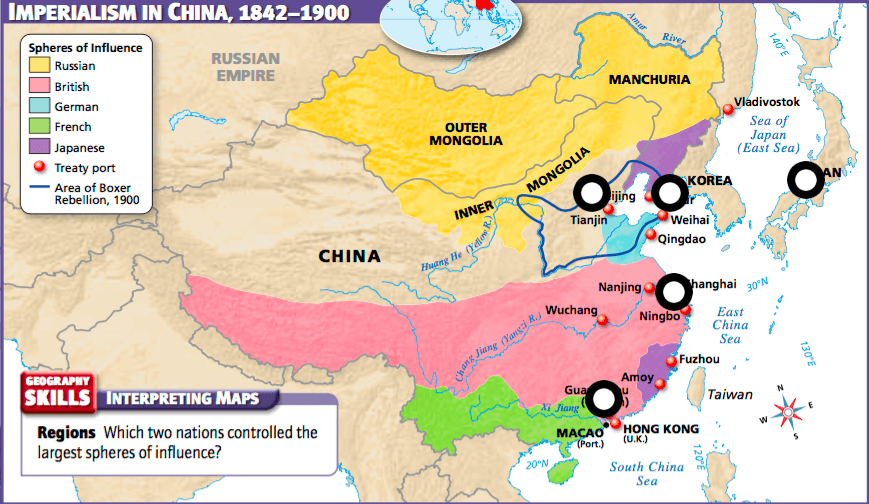

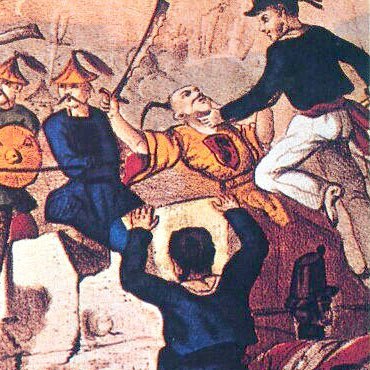
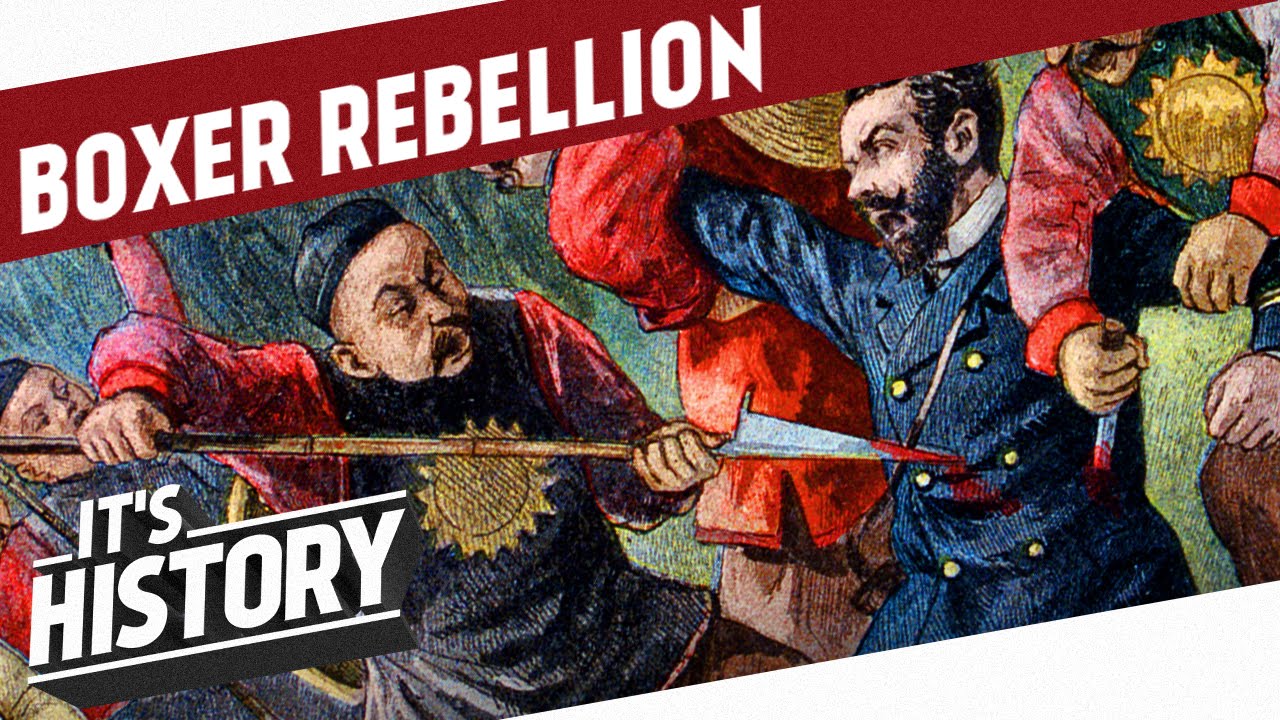

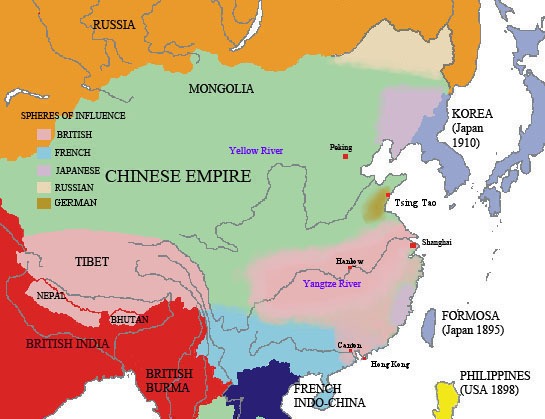

What was the Boxer Rebellion?
An uprising in Great Britain over the price of tea, because of the American Revolution
A militant uprising within India that lasted from 1898 to 1900.
A militant uprising within China that lasted from 1898 to 1900.
Dog only, uprising at local dog parks.
Who did the Boxers kill?
Members of the Fists of Harmony and Justice
Chinese Muslim
All Qing nobels
Christian missionaries and Western diplomats
What was the name of the leading force of the Boxer Rebellion
Fist of the Golden Monkey
Righteous and Harmonious Fists
Freedom Fighters Forever (FFF)
Zìyóu zhànshì
Which of the following are causes of the Boxer Rebellion?
Humiliating military defeats at the hands of Western powers.
China had been forced to concede trading rights to European and US commercial interest.
The violent ideas for independence from Gandhi
The resentment of the spread of Christian missionaries and their influences
What powerful figure supported the Boxers?
Queen Victoria
Emperor Nicholas II
President William McKinley
Empress Dowager Cixi
What was the name of the alliance that fought the Boxers
League of Nations
Industrialized Alliance of Nations
Eight-Nation Alliance
Righteous and Harmonious Fists
The Manchu empire in China was overthrown in
1925
1921
1911
1919
_______ initiated by Sun Yat Sen.
Three principles
Federal policy
Ping Lao policy
Welfare policy of China
The founder of modern China
Mao
Chiang
KenSaro
Sun Yat Sen
Who established a republic in China in 1911?
ccp
Britain
Sun Yet Sen
war lords
After sun yat sen who was the leader of KMT party
Chiang Kaishek
Mao zedong
Xi Jinping
Jiang Zemin
I helped establish the Republic of China based on three principles for the people: nationalism, Democracy, and the people's livelihood.
Mao Zedong
Chiang Kai Shek
Sun Yat Sen
The 1911 Revolution led to the end of the
Ming Dynasty
Song Dynasty
Qing (Ch'iang) Dynasty
After the Nationalists seized power in 1926, who did they have to defeat?
Peasants rebels
Warlords
Pu Yi's army
Sun Yat-sen accomplished all of the following, except
organized the Revolutionary Alliance (Tongmenghui)
wrote the Three Principles of the People
organized support for a revolution from the Chinese Diaspora
led the victory of the New Army over Imperial forces
Which one is true?
The Nationalists (KMT) lost elections for the National Assembly
Yuan Shikai joined the Nationalist (KMT) party
Yuan Shikai betrayed the Republic and declared himself emperor
China was divided up by the Western Empires & Japan
He is one of the founders of the Communist Party
Mao Tse-Tung/Mao Zedong
Yuan Shi-kai
Sun Yat-Sen

Which is not included in the 3 principles of the Kuominatang/Nationalist Party?
Nationalism
Democracy
Colonialism
Livelihood
Which of these dynasties was the last to rule over China?
Qin
Han
Tang
Qing
To reestablish order in China, the Kuomintang had to ally with the __________ ____________ _____________.
Bolshevik Soviets Party
Democratic-Republican Party
New Democratic Party
Chinese Communist Party

[p2] "In October (a) (year), followers of Sun Yat-sen launched an uprising in central China."

[p2] Sun Yat-sen was unable to establish a stable government because...
his party did not have enough strength to govern.
Yuan Shigai had control of the military.
Western influences were too strong to overcome.
foreign powers intervened and took over the government.

[p3] "Few peasants supported Sun Yat-sen's party. In effect, the events of 1911 were less a revolution than...
a collapse of the old order."
an end to 2,000 years of imperial rule."
a new political and social order."
The deal between Yuan Shikai and the Xinhai Revolutions called for
the relocation of the capital to Beijing
the Presidency to go to Yuan Shikai
the execution of the Emperor
free elections for a National Assembly
Following the death of Yuan Shikai in 1916, China was best described as
a monarchy led by the child emperor, Puyi
a stable, prosperous republic led by Sun Yat-sen
a republic in name ruled by various warlords and regional cliques
an authoritatian military government under the centralized control of a Generalissimo in Beijing
Daimyo had to adapt to the Emperor's new rule by...
surrendering their land
collecting taxes
moving permanently to Edo
killing their Samurai
Which of the following was not a change related to the Meiji period?
Spread of Education
Growth of the Samurai class
Wealth of the merchant class
Increase in Commerce
Which of the following is a political change during the Meiji period?
Technology was developed
Peasants were allowed to own land
No more rules about dress
The Shogunate was abolished
Who was Saigo Takamori?
The founder of SEGA
The accidental leader of the Satsuma Rebellion
Sun Yat-Sen's best friend.
A Samurai who defended the Shogun.
Saigo is known for owning what kind of pet?
A cat
A frog
A fish
A dog
The Satsuma Rebellion was begun because...
Samurai were upset about losing their rights and privledges.
The Samurai wanted to overthrow the Shogun
The Samurai wanted more foreigners in the country.
The Samurai wanted to fight China.
Why did the Japanese government turn Saigo into a national hero?
The Japanese government hated their own soldiers and Saigo killed many.
Saigo died fighting for the Emperor.
Saigo's extreme behavior was a good role model for the increasingly violent/loyal Japanese military.
Saigo had defended Japan from Chinese invasion.
What had been Saigo Takamori's hope for Japan when he supported the Meiji restoration?
Saigo hoped that Japan would modernize and conquer all of Japan's neighbors.
Saigo hoped that Japan's cities would modernize but that the coutnry side would stay much the same with the Samurai in charge.
Japan would not develop or change at all.
Japan would develop new technology for playing games. This was apart of his Nin Ten Doh plan.
How did Saigo Takamori die?
He chopped his own head off.
Like a boss.
He cut his stomach open and his friend chopped off his head.
He was shot by a gun.

Who is this?
Groot
Thor
Steve
Tony
Which One Is Tony Stark


Who killed Thanos?
Iron Man
Thor
Nebula
Steve Rogers

the black panther is the king of which country?
Wakanda
america (north)
Uganda

Who was the first avenger
Iron Man
Captain America
Ant Man
Hulk
Who has the Time stone?
Iron Man
Thanos
Doctor Strange
Proxima Midnight

Who has the Time stone?
Iron Man
Thanos
Doctor Strange
Proxima Midnight
Which avengers died in Endgame ?
Iron man, Black widow
captain america
Black panther
none

Which character is this?
Wong
Ned
Dr. Strange
Superman

Which Avenger is that
Ant man
Wasp
Nick Fury
Captain Marvel

Is he an Avenger
no
yes
maybe
I don't know
Has Ant man been to jail
yes 3 times
no
never
yes but only once
Is Loki adopted?
Yes
No he is Thor's brother
I do not know
He is his half brother
Who rescued Ant man
An ant
rat
pig
me
What was/were not a cause of the Sepoy Mutiny
Economic crisis among the Indians
Urge to capture British territories
Social discrimination between black and white [ Racism ]
Revenge for loss of Soldiers during WW 1
What were some of the positive impacts of British Imperialism on India?
There was a large amount of food for all people
Religious divisions ended
The poor had more opportunities to rise out of poverty
New infrastructure was created along with schools
Devotion to a nation, through shared language, culture, or religion
Nationalism
Culturalism
Imperialism
Socialism
A group of people in one place who are ruled by a parent country elsewhere.
Colony
Sphere of Influence
Protectorate
Trade Inbalance
A foreign region in which a nation has control over trade and other economic activities.
Colony
Sphere of Influence
Protectorate
Trade Inbalance
Reestablishment of the Japanese Emperor, Reaction to Western Influence and led to rapid Industrialization in Japan, to match Western Powers.
Meiji Restoration
Quing Dynasty
Middle Kingdom
Hong Kong
1899 rebellion in Beijing, China started by a secret society of Chinese who opposed the "foreign devils". The rebellion was ended by Multi-National troops.
Opium War
Treaty of Nanking
Taiping Rebellion
Boxer Rebellion
Was the ruler of China during the Boxer Rebellion. Attempted reforms
Commissioner Lin
Queen Victoria
Empress Dowager Cixi
Queen of England during Victorian Era.
Commissioner Lin
Queen Victoria
Empress Dowager Cixi

