

wayground logo

Free Printable Worksheets

Font size

S
M
L
XL
Worksheets

Unit 7: The Great Depression

Total questions: 20

Worksheet time: 20mins

Name
Class
Date
1.

What is Tuesday October 29th 1929, referred to as?

a)

Red Tuesday

b)

Blue Tuesday

c)

Black Tuesday

d)

Bankrupt Tuesday

2.

During the Great Depression, small, dirty, communities called "Hooversvilles" popped up across the country. Why were the called "Hooversvilles"?

a)

The Great Depression wasn't real, it's based of a Dr. Seuss Book called "Hooverville" staring Cindy-Loo-Hoo.

b)

They were named after a President

c)

The were established just outside Hooverville Chicago, where thousands of people were laid off, and lost their homes.

3.

Which of the following events was NOT a causation of the Great Depression?

a)

The Stock Market Crash of 1929

b)

Bank Failures (closings) of the early 1930's

c)

The Dust Bowl

d)

Dropping of the Atomic Bomb

4.

What US President helped bring America out of the Great Depression with the creation of the "New Deal"?

a)

FDR

b)

Truman

c)

Hoover

d)

Kennedy

5.

What were the 3 R's of FDR's plan to solve the economic crisis?

a)

Relief, Relationships, Rehabilitation

b)

Relief, Recovery, and Reform

c)

Rehabilitation, Reform, Relationships

d)

Recovery, Rehabilitation, Relationships

6.

What 2 events led to the Great Dust Bowl?

a)

Rise of Hitler

b)

Long Drought

c)

Over farming the land

d)

Election of Roosevelt

7.

Which New Deal Program helped make people more confident to put their money in banks again?

a)

The Federal Deposit Insurance Corporation

b)

The Federal Securities Act

c)

The Securities and Exchange Commission

d)

The National Industrial Recovery Act

8.

What ended the Great Depression?

a)

The USA joining the conflict of World War II

b)

The New Deal created by FDR

c)

The hands off approach of President Hoover

d)

The private market eventually worked it out without government assistance
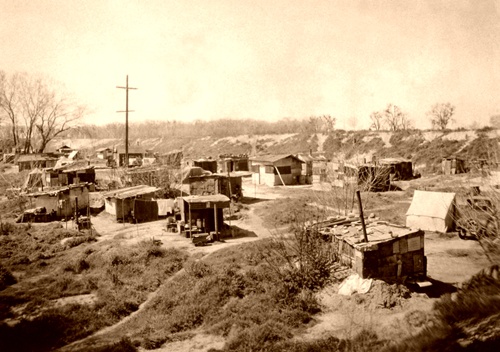
9.
What was the main reason for the emergence of “Hoovervilles” like the one shown in the photograph?
a)
Many Americans had lost jobs during the Great Depression.
b)
Thousands of homes had been destroyed by the effects of the Dust Bowl.
c)
Housing projects could not keep up with the demand for homes needed by the poor.
d)
Preparations for World War I had created a shortage of building materials.
10.
A major difference between the philosophies of President Herbert Hoover and President Franklin D. Roosevelt in responding to the Great Depression is that Roosevelt
a)
wanted to rely on private charities to provide assistance
b)
stressed the need for individual rugged individualism
c)
supported direct relief to people out of work
d)
thought the government should not be involved in economic reform
11.
FDR addressed the American public in weekly broadcasts known as:
a)
FDR Hour
b)
Hangin' With Franklin
c)
Fireside Chats
d)
Around the Fire
12.
What was a guiding principle of the New Deal economic policies?
a)
Pro-business tax breaks would solve the problems associated with urban poverty.
b)
Antitrust legislation would destroy the free market economy of the United States.
c)
Rugged individualism must be allowed to solve social inequality.
d)
Government must assume more responsibility for helping the poor.
13.
The Civilian Conservation Corps (CCC) and the Works Progress Administration (WPA) were both New Deal programs developed to address the problem of
a)
excessive stock market speculation
b)
high unemployment
c)
increased use of credit
d)
limited income of senior citizens
14.
The Fair Labor Standards Act of addressed what labor issue?
a)
Workplace safety
b)
Health insurance
c)
Collective bargaining
d)
Minimum wage
15.
Passage of the Social Security Act (1935) helped American workers by 
a)
creating jobs for the unemployed
b)
guaranteeing a minimum wage
c)
legalizing the right to join labor unions
d)
providing financial assistance after retirement
16.
What was the name of the region in the U.S. where topsoil was blown into black blizzards by wind erosion?
a)
Pacific North West
b)
Dust Bowl 
c)
The Sandbox
d)
Eastern Seaboard 
17.
What was/ is the purpose of the Securities and Exchange Commission?
a)
Regulate the Stock Market and protect investors from dishonest trading practices
b)
Founded projects in arts, literature, music and theatre
c)
allowed students to work and remain in school
d)
provided money for local and state welfare agencies
18.
Hoover's philosophy on the start of the Great Depression was that
a)
government intervention was absolutely necessary
b)
the Stock Market will make people enough money to get by
c)
the economy will eventually repair itself
d)
the problems of the Depression would destroy the economy
19.

What is the purpose of a conclusion sentence?

a)

To show supporting evidence to your claim (topic)

b)

To give your opinions that explain why you have chosen specific evidence.

c)

To summarize your topic and opinions based on the evidence you have provided.

d)

To introduce the topic and claim you will be writing about.

20.

What does "repatriated" mean?

a)

Move back to one's country of origin.

b)

To blend a recipe from two cultures such as "Tex-Mex".

c)

To re-enlist in the military

d)

To remove all your money and assets from banks, and hold on to them personally.
