
 Worksheets
4.1.1 quiz
Total questions: 20
Worksheet time: 24mins
A bungee rope has a spring constant of 5N/m. How much a person must weigh in Newton if we want it to extend (stretch) 10m?
20N
22cm
50N
50cm
21N
What force should be applied to compress a spring by 0.5m if its spring constant is k = 1500 N/m?
1880 N
750 N
1500 N
3000 N
What is potential energy?
The energy an object has due to its position or condition.
The energy an object has due to its motion.
The energy an object has due to its chemical composition.
The energy as object has due to its atomic structure.
Gravitational potential energy depends on which two factors?
mass and height above the ground
distance and speed
speed and height above the ground
mass and speed

You throw a ball into the air as shown in the diagram. At what point does the ball have the most potential energy?
W
X
Y
Z
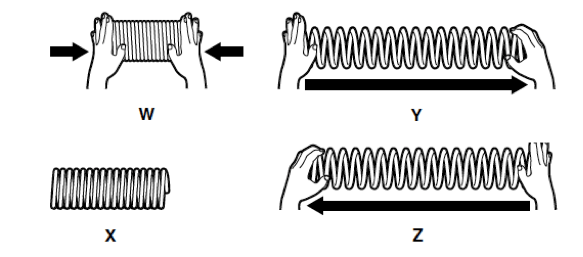
Elastic potential energy is energy stored in an object, such as a spring, due to the object being stretched or compressed. In which position is it most likely that the spring has lost its elastic potential energy?
W
Y
X
Z
The energy of moving matter is called ____________.
gravitational potential energy
elastic potential energy
kinetic energy
potential energy

This type of potential energy can be found in rubber bands and springs.
Chemical
Elastic
Gravitational

The diagram shows the same spring being stretched at different lengths using different masses. At which length does the spring have the MOST potential energy?
length A
length B
length C
length D

All of the pictures are examples of what type of energy?
gravitational potential energy
elastic potential energy
chemical potential energy
kinetic potential energy

The spring constant of an object tells you?
What type of spring you are dealing with
How long the spring will stretch or compress
It gives you a value on how easy or hard it is to change the objects length.
A spring constant gives you a number which tells you what material the spring is made of.

Calculate the elastic potential energy Leo puts into the trampoline mat when he stretches the mat (k= 473 Nm-1) by 0.35 m.
2.887 J
28.97 J
82.775 J
12.76. J

Ben has a mass of 37 kg and is stretching the trampoline mat by 0.30 m. Calculate the elastic potential energy he stores in the mat.
54.39 J
246.67 J
3.87 J
83 J
All energy can be classified into which 2 types of energy . (Note do not write the word energy in your answer only list the 2 types of energy)
(a)
Object A and B have the same mass. Object B is moving 5 times faster then object A. Object B has
The same energy as A
Less energy than A
5 times the amount of energy as A
25 times the amount of energy as A
Object A and B have the same speed. Object B has 5 times the mass of object A. Object B has
The same energy as A
Less energy than A
5 times the amount of energy as A
25 times the amount of energy as A
A history book and a math book, are both on the top edge of a shelf that is 6m high. Both books have the same mass
If the math book falls it will land on a 2m high table. If the history book falls it will land on the ground. Which book has more potential energy
The Math book
The History book
The book have the same height and same mass so the energy is the same for both
A bird is flying 10 M in the air. If he climbs up and starts
to fly at 20M what happens to his potential energy
It goes up by 10
It doubles
it stays the same, because gravity did not change
It goes down
A 10kg Rock is dropped in the open air from a height of 20m As it falls its energy
Stays constant but changes from Kinetic to Potential
Stays constant but changes from Potential to Kinetic
Changes from potential to kinetic but decreases due to air resistance/ Friction
Changes from Kinetic to potential but increases due to air resistance/ Friction

