wayground logo

Free Printable Worksheets

Font size

S
M
L
XL
Worksheets

Cyber Security

Total questions: 24

Worksheet time: 9mins

Name
Class
Date
1.

An Antivirus protects you from all attacks

a)

True

b)

False

2.

Can you stop looking over my shoulder? That's _ _ _ _ _ _ _ _ _ _ _

(a)  

3.
The attempt to acquire sensitive information such as usernames, passwords, and credit card details (and sometimes, indirectly, money) by masquerading as a trustworthy entity in an electronic communication is known as?
a)
Converting
b)
Hacking
c)
Phishing
4.

Is this a legitimate email?

a)

True

b)

False

5.

Types of Social Engineering

a)

malware

b)

trojan horses

c)

pharming

d)

blagging

6.

How many reported incidents of Phishing happened in 2020? Source: FBI

a)

241,324

b)

300,875

c)

19,765

d)

956,321

7.
How does malware get onto your computer?
a)
Email attachments or links
b)
By visiting dodgy websites
c)
On USB sticks
d)
All of the above
8.

Which is NOT a type of malware?

a)

Virus

b)

Worm

c)

Trojan horse

d)

phishing

9.

What is adware?

a)

Various pop-ups advertisements that show up on your computer, persuading the user to click it

b)

Adjectives that float across your screen

c)

conceals its true content to fool someone into clicking it

d)

When your computer starts to wear down

10.
Can spyware be seen on your computer?
a)
Yes
b)
No
c)
Sometimes
d)
With specialist software
11.
What is a virus?
a)
Malware hidden in another file
b)
Any type of malware
c)
A cookie
d)
A breed of gecko
12.
What does DDoS Stand for?
a)
Distributed Denial of Service
b)
Delayed Destruction of Server
c)
Delayed Denial of Style
d)
Delayed Denial of Service
13.
What is gaining unauthorised access to a computer system also known as?
a)
Hacking
b)
Spamming
c)
Phishing
d)
Logging on
14.
Which of the following is NOT an offence under the Computer Misuse Act?
a)
unauthorised access to someone else's files
b)
unauthorised access to someone else's files with intent to commit further criminal offences
c)
copying software and trying to sell it to someone for a profit
d)
writing and distributing a virus
15.

Storing customer data insecurely. Which law would be broken?

a)

Data Protection Act 1998

b)

Computer Misuse Act 1990

c)

Copyright Designs and Patents Act 1988

d)

General Data Protection Regulation Act 2018

16.
Why do we use flowcharts?
a)
To represent algorithms in an easy way
b)
To use different maths shapes
17.
What does this symbol represent?
a)
Start
b)
Sub
c)
Decision
d)
Process
18.
What is this symbol used for in a flowchart?
a)
A decision/question
b)
A task to carry out
19.
What does this shape represent?
a)
Input/Output
b)
Decision
c)
Process
d)
Start/Stop
20.

Which symbol shows input?

a)

oval

b)

parallelogram

c)

rectangle

d)

diamond

21.
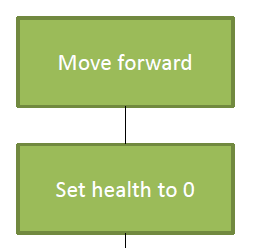
What's missing from this part of a flowchart?
a)
An Arrow
b)
A Line
c)
A Square
d)
A Diamond
22.
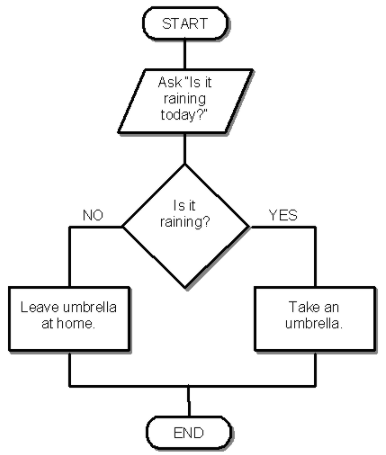
What is the Output if the user enters:
Yes
a)
Leave umbrella at home
b)
Take an umbrella
23.
What is the Output if the temperature is:
19
a)
Below Freezing
b)
Above Freezing
24.

What will happen if the user's book return is late?

a)

Sends them an SMS (text)

b)

Does not send them an SMS (text)