
 Worksheets
Unit 8 Electricity (2025)
Total questions: 34
Worksheet time: 36mins

Electricity is caused by _________.

What is the build up of electrical charges in one place called?
Causes by friction EX: -- static cling clothing from the dryer. --lightening. --hair to raise when rubbed by ballon.
--shocked when you touch a handle after walking across surface
electrical current flowing electricity
Electrostatic
static electricity
Electrical grounding
frictional conductor/insulator
Electronics

Particles _______ to one another causing electrostatic to occur
attract
repel
nothing changes

Items that have opposite charges ______ causing the 2 to pull toward on another
EX: Na+ Cl-
--Aluminum coke can rolling toward a charged rod
attract
repel
cancel out
sing song

Items that have like charges ______ causing the 2 to push away from one another
EX: Na+ Li+
--a packing peanut can push away from a charged rod
attract
repel
cancel out
sing song

If the distance between two electric charges is reduced what happens to the electrostatic attraction/re[ulsion force?
increases
decresase
is unchanged
distane and force are unrelated

If the charges _____________ what happens to the electrostatic attraction/re[ulsion E force?
Remember the size of the charge works like the size of a sun or planet, mass affects attracting G force.
increases charge increase force
decrease charge decrease force
increases charge decrease force
decrease charge increase force
increases or decrease charge no change to force
The Bigger they are the harder they fall.

Building up of charge due the the transferring of electrons when 2 objects rub together
friction
grounding
conduct
induct

The removing of excess charges
required by law of safety when wiring a house
friction
grounding
conduct
induct

potential difference
resistor

the power source
provides the “push” of charges
wires -current
potential difference (battery)
circuit
resistor

current -wire
potential difference voltage
resistance

Limits flow of electrical current
converts electrical energy into another form
of primary light and heat
current -wires
switch -circuit
potential difference (battery)
resistors -resistance

In a circuit diagram, this symbol represents a
switch
resistor
potential difference (battery)
wire

diagram symbol for
switch
resistor
potential difference (battery)
lamp

diagram symbol for
switch
resistor
potential difference (battery)
lamp

wire
lamp
battery
voltmeter

This is the symbol for a...
measures current
Bulb
Voltmeter
Ammeter
Motor

The unit for potential difference is the

Volts (V)
Amperes (A)
Ohms (Ω)
Watts (W)

What is the unit for current?
Watts


grounder

____________ allows the flow of electricity.
grounder
Which of the following is a conductor?
wood
rubber
metal
plastic
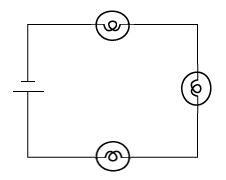
Voltage drops after each resistor/bulb (V1 + V2 + V3 ...)
Current is constant (I1 = I2 = I3 ...)
Equ. Resistance adding up restors (R1 + R2 + R3 ...)
when one light is off the rest will not stay on
Series circuit
Parallel circuit
I have no idea
grapes

Voltage is delivered equally to each branch (V1 = V2 = V3 ...)
Current is altered based on resistor (I1 + I2 + I3 ...)
Resistance, adding the inverse of each resistor (1/R 1 +1/R2 +1/R3...)
when one light is off the others remain on
Series circuit
Parellel circuit
Neight
Nor the other

Current flowing in one direction
(flashlight, device not plugged in ie phone or laptop using battery)
Alternet
Direct
Indiferent
Transverse

Current changes direction
(appliance plugged in to the wall. the house to power lines)par
Alternet
Direct
Indiferent
Transverse

Levels up and down as needed
why you can use the same block for iphone, ipad, and laptop
Coils tightly wound on one side and loser spread out on the other
Transformer
Deformer
magic
blahhh

The equivalent resistance in this series circuit is

P=VI

If the battery produced 12.6 Volts and what would be the current flow be for a 6 Ohm resistor
2.1 Amps

An electrical device with a resistance of 3.0 Ω will allow a current of 4.0 A to flow through it if a voltage drop of ________ Volts is impressed across the device.
24
0.75
1.3
12

