Wayground logo

Free Printable Worksheets

Font size

S
M
L
XL
Worksheets

photosynthesis

Total questions: 26

Worksheet time: 18mins

Name
Class
Date
1.

Photosynthesis occurs in:

a)

Mitochondria

b)

Chloroplasts

c)

Humans

d)

Animals

2.

In cellular respiration, carbon starts out in the glucose molecule, but ends up in a(n)

a)

oxygen molecule

b)

water molecule

c)

CO2 molecule

d)

C6H12O2 molecule

3.

In photosynthesis, what kind of molecule does hydrogen start in?

a)

water

b)

oxygen

c)

glucose

d)

carbon dioxide

4.

In what process does ATP get created?

a)

photosynthesis

b)

cellular respiration

c)

radiation

d)

chemical

5.

How do humans get glucose so they can live?

a)

breathe it in

b)

photosynthesis

c)

eat food

d)

drink liquids

6.

Mitochondria and Chloroplasts are:

a)

organelles

b)

cells

c)

only in humans

d)

only in plants

7.

Cellular respiration happens

a)

only in plants

b)

only in animals

c)

only in humans and animals

d)

in plants and animals

8.

For photosynthesis, a plant needs water, sun, and...

a)

oxygen

b)

carbon dioxide

c)

glucose

d)

mitochondria

9.

For humans to live, we need energy. What is the name of the energy that the body makes in cellular respiration?

a)

sugar

b)

glucose

c)

ATP

d)

fructose

10.

What is a product of photosynthesis AND a reactant for cellular respiration?

a)

oxygen

b)

water

c)

carbon dioxide

d)

Doctor Pepper

11.
____________________ provides the energy necessary for photosynthesis.
a)
water
b)
sunlight
c)
glucose
d)
soil
12.
the products of photosynthesis are...
a)
glucose and sunlight
b)
carbon dioxide and water
c)
glucose and chlorophyll
d)
oxygen and glucose
13.
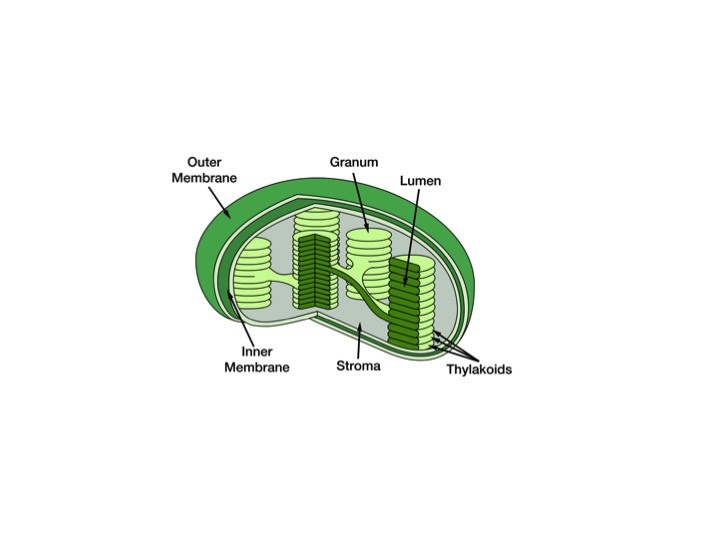
The chloroplast has stacked membranes, what is the purpose of the stacked membranes in doing photosynthesis?
a)
water absorption for photosynthesis
b)
increased CO2 absorption
c)
increase surface area
d)
support of the plant
14.
This is ...
a)
mitochondria
b)
chloroplast
c)
cell
d)
phloem
15.
The reactant of photosynthesis are...
a)
sunlight and chlorophyll
b)
glucose and oxygen
c)
carbon dioxide and water
d)
sunlight and water
16.
What is the pigment in chloroplasts that performs photosynthesis?
a)
Chlorosynthesis
b)
Chlorophyll
c)
ADP
d)
Electron Transport
17.
Chloroplasts are...
a)
Structures of animal cells to produce ATP
b)
Organelles where lipids are elaborated
c)
Specialized structures of plants where food is made
d)
Waste organelle of plants
18.
Leaves look green because.....
a)
they eat their vegetables
b)
to blend into their environment
c)
they contain a molecule named chlorophyll
d)
they are sick
19.
Use the diagram to answer the question. Between which parts of the molecule must the bonds be broken to form an ADP molecule?
a)
A and B
b)
A and C
c)
B and C
d)
C and D
20.
Plants need carbon dioxide from their environment to produce glucose during which stage of photosynthesis? 
a)
The light-dependent stage
b)
The light-independent stage (The Calvin Cycle)
c)
The electron transport chain
d)
ATP formation
21.
Where do the light-dependent reactions occur? 
a)
thylakoid membrane
b)
stroma
c)
mesophyll
d)
mitochondria
22.
Where does the Calvin Cycle occur?
a)
thylakoid
b)
stroma
c)
lumen
d)
mitochondria
23.
True or False.   The calvin cycle can happen at night.
a)
true
b)
false
24.
TRUE or FALSE.  The calvin cycle can happen during the day.
a)
True
b)
false
25.
What is the name of the simple sugar that is produced in photosynthesis?
a)
Sucrose
b)
Dextrose
c)
Glucose
d)
Lactose
26.
Which term is the part of photosynthesis when light energy is captured and transferred to a molecule, such as ATP?
a)
light- independent reactions
b)
cellular respiration
c)
light- dependent reactions
d)
 photosynthesis