wayground logo

Free Printable Worksheets

NEW

Font size

S
M
L
XL
Worksheets

TEST Biology Review Make Up

Total questions: 20

Worksheet time: 40mins

Name
Class
Date
1.
How do the muscular system and the skeletal system work together?
a)
The muscular system allows the body to stand up while the skeletal system allows the body to move
b)
The muscular system allows the body to move and the skeletal system gives the body a structure 
c)
The muscular system gives the body nutrients while the skeletal system gives the body blood
d)
The skeletal system makes cells whilte the muscular system eats them.
2.
What three systems work together to move the body?
a)
Skeletal, Muscular, Nervous
b)
Skeletal, Respiratory, Digestive
c)
Nervous, Circulatory, Skeletal
d)
Circulatory, Respiratory, Digestive
3.
A student studying interactions between body systems constructs this table. The student plans to fill out the table with phrases that describe an interaction between each pair of systems. 
Which of these phrases could be placed in the position marked with an X? 
a)
Provides nutrients to kidney cells
b)
Provides nutrients to brain cells
c)
Provides nutrients to nerve cells
d)
Provides nutrients to muscle cells 
4.

What is the vascular tissue that transports water up the plant?

a)

Xylem

b)

Phloem

c)

Roots

d)

Shoot

5.

The plant hormone response to light

a)

Transpiration

b)

Thigmotropism

c)

Geotropism

d)

Phototropism

6.
Several structures work together to allow flowering plants to reproduce. The diagram shows a typical flower.
Which table correctly identifies the function of each structure or group of structures in the reproduction of the plant?
a)
X Pollen production
Y Pollen transfer
Z Production of eggs
b)
X Attraction of pollinators
Y Production of male sex cells
Z Egg production and embryo development
c)
X Protection for embryo
Y Supply nourishment to embryo
Z Place of embryonic development
d)
X Photosynthesis
Y Production of cells that protect internal organs
Z Production of egg and sperm
7.
Viruses are...
a)
prokaryotic
b)
eukaryotic
c)
non-living
d)
endospores
8.
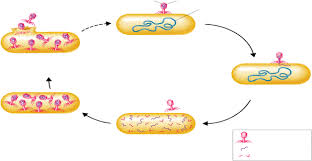
What is shown here?
a)
Lysogenic Cycle
b)
Lytic Cycle
c)
Binary Fission
d)
Conjugation
9.

A person infected with the human immunodeficiency virus (HIV) may not have any symptoms for a period of time. During this period the virus affects the body by doing which of the following?

a)

the virus produces toxins that weaken immune cells and prevent them from reproducing

b)

the virus damages immune cells while using their machinery to produce copies of itself

c)

the virus uses nutrients meant for immune cells to fuel its own cellular respiration

d)

the virus changes the identity of the nucleotides of immune cells to prevent the immune system from functioning normally

10.
Solutes move with the concentration gradient, therefore no energy is used. 
a)
Passive Transport
b)
Active Transport
11.
Solutes move against the concentration gradient, therefore energy is needed
a)
Passive Transport
b)
Active Transport
12.

A type of cellular transport is shown. Which description best identifies this type of cellular transport?

a)

active transport, because energy is being used to move molecules against the concentration gradient

b)

facilitated diffusion, because energy is being used to move molecules with the concentration gradient

c)

osmosis, because energy is not being used to move molecules with the concentration gradient

d)

endocytosis, because energy is not being used to move molecules against the concentration gradient

13.
Which of the following monomers are repeatedly joined together to form a strand of DNA?
a)
amino acids
b)
nucleotides
c)
fatty acids
d)
polysaccharides
14.
X outlines a(n) ___________.
a)
amino acid
b)
nitrogen base 
c)
nucleotide
d)
nitrogen base pair
15.
What determines the code, or information, of a DNA molecule?
a)
the shape (structure) of the nitrogen bases
b)
the order (sequence) of the nitrogen bases
c)
the color of the nitrogen bases
d)
the frequency (number) of nitrogen bases
16.
What are the nucleotides made of?
a)
Sugar, Phosphate, nitrogen base
b)
Phosphate, Adenine, nitrogen base
c)
Thymine, Adenine, Cytomine
d)
Phosphate, Nitrogen, Adenine
17.
What are the 4 nitrogen bases?
a)
adenine, thymine, cytoplasm, and guanine
b)
adenine, thymine cytosine, and guanine
c)
adenine, thymine, cytosine, and gylcerol
d)
adenine, thymine, cytosine, and glucose
18.

A mutation that changes only one small area or one nucleotide in a gene

a)

insertion mutation

b)

point mutation

c)

silent mutation

d)

nondisjunction mutation

19.

A mutation that occurs when the number of nucleotides inserted or deleted causes a misreading of amino acids from that point

a)

point mutation

b)

silent mutation

c)

missense mutation

d)

frameshift mutation

20.

This mutation occurs when a part of the chromosome breaks off, flips around, and becomes reattached.

a)

nondisjunction

b)

translocation

c)

inversion

d)

duplication