
 Worksheets
Unit 5 Exam Review
Total questions: 33
Worksheet time: 30mins
What does a wave carry from place to place?
energy
matter
people

The part in a longitudinal wave where the particles are spread apart.
amplitude
compression
frequency
rarefaction

How many wavelengths separate point A and point B?
1.5
2.0
2.5
3.0

Label number 1 in the picture:
peak (crest)
wavelength
trough
amplitude

Label number 2 in the picture:
peak (crest)
wavelength
amplitude
trough

Label number 3 in the picture:
peak (crest)
wavelength
amplitude
trough

Label number 4 in the picture:
peak (crest)
wavelength
amplitude
trough
What happens when a mechanical wave travels through a medium?
waves are tranferred
mass is transferred
energy is transferred
particles are transferred
The unit of period is the _________, and represents __________
meters, the length of one wave
m/s, how fast the wave travels through the medium
seconds, the amount of time for one wave cycle or vibration
hertz, the number of wave cycles or vibrations per second

This color in the visible part of the spectrum has the lowest frequency.
Blue
Green
Red
Violet
The amplitude of a wave is...
The total distance a wave will travel through a medium
The height of a wave from the origin to a crest or trough
The height of a wave from crest to trough
The horizontal distance between two crests or troughs of a wave
Which has the LONGEST wavelength and, therefore, the LOWEST frequency/energy
Gamma Rays
Ultraviolet
Visible Light
Infrared rays
What is the Doppler Effect
Where the wavelength of a wave is shifted due to the source moving
When a wave is shifted when a body pushes the wave
Where the apparent wavelength of a wave is shifted due to the source moving

Electromagnetic waves vary in
the speed they travel in a vacuum.
wavelength and frequency.
the way they reflect.
the orientation of their electric and magnetic fields.
Light acts like
a wave.
a particle.
Both a wave and a particle
neither a wave nor a particle.
Cellular telephones utilize
radar waves.
very high frequency waves.
very low frequency waves.
microwaves.
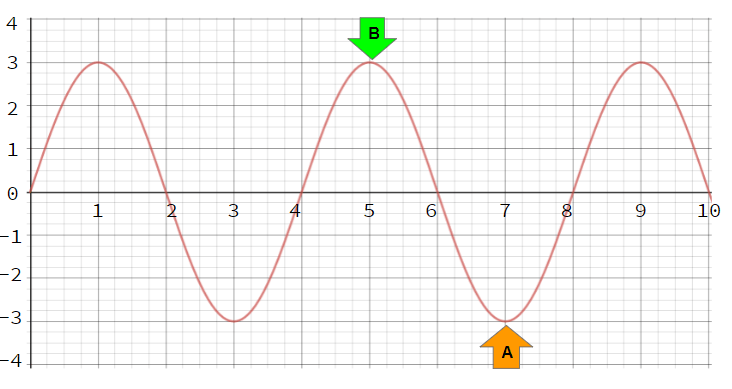
What is the amplitude of this wave?
2
3
6
10
What is the wavelength of this wave?
1
2
3
4

A student listed some properties of waves.
Which properties did the student list incorrectly?
3 and 2
4 and 1
2 and 4
1 and 3

What can you use to see all the different colors in white light?
A flashlight
A shadow
A camera
A prism


What is this wave's amplitude?
20
30
50
can not be determined from this picture
15
____________________ need a medium to travel through.
Mechanical waves
Compressional waves
Transverse waves
Ocean waves
The unit of wavelength is the _________, and represents __________
meters, the length of one wave
m/s, how fast the wave travels through the medium
seconds, the amount of time for one wave cycle or vibration
hertz, the number of wave cycles or vibrations per second
Newton’s prism experiments showed that white sunlight is made up of
the full electromagnetic spectrum.
only blue light.
all the colors of the visible spectrum.
only the longest wavelengths.
The prisms used in spectroscopy separate electromagnetic waves on the basis of:
size
energy
speed
frequency

