wayground logo

Free Printable Worksheets

NEW

Font size

S
M
L
XL
Worksheets

Sound Review Physics

Total questions: 53

Worksheet time: 2hrs 47mins

Name
Class
Date
1.
How is sound produced?
a)
By the vibration of particles
b)
By the transfer of particles 
2.
The reflection of sound waves off of a hard surface can create ______.
a)
A wave
b)
An echo 
3.
Soft surfaces _______ sound waves. 
a)
Reflect
b)
Absorb
4.
___________ measures  how close or  far particles are.
a)
Amplitude
b)
Frequency 
5.
________ describes how LOUD a sound is. 
a)
Amplitude
b)
Frequency 
6.
____________ is determined by sound wave's frequency. 
a)
Compression
b)
Pitch 
7.
_______ is the number of waves that pass a certain point at an specific time. 
a)
Frequency 
b)
Pitch
c)
Amplitude
d)
I don't know
8.
Sound waves travel farther through ________ media, like water or steel. 
a)
Dense 
b)
Light
9.
_______ is how high or low we listen/perceive  a sound. 
a)
Pitch
b)
Frequency
c)
Amplitude
d)
I don't know
10.

Sound is a form of energy produced by ______________.

a)

Vibrations

b)

Distances

c)

Prisms

d)

Forces

11.

Sound waves travel the FASTEST through _____________.

a)

Gases

b)

Liquids

c)

Solids

12.

An object that does not vibrate cannot produce

a)

Sound

b)

Light

c)

Heat

d)

Electricity

13.

A place where no sound exists is...

a)

in the air.

b)

under water.

c)

space.

d)

all of the above

14.

When people speak their ________ vibrate.

a)

Ear drums

b)

Vocal chords

c)

Ears

d)

Tongue

15.

What is Pitch?

a)

How loud or soft a sound is.

b)

Muscle that holds vocal cords.

c)

Movement back and forth.

d)

How high or low a sound is.

16.

A sound with a high frequency has a _____ pitch. A sound with a ____ frequency has a low pitch.

a)

high, low

b)

low, high

c)

medium, high

d)

high, medium

17.
__________ means to move back and forth quickly.
a)
Pitch
b)
Amplitude
c)
Vibration
d)
Echo
18.
Sounds travels slowest through...
a)
space
b)
solids/metals
c)
gas
d)
liquids
19.
Why can't we hear sound in space?
a)
can't take our helmet off to hear
b)
Space has no mass / no gas/ solids/ liquids
c)
because it's dark
d)
Don't know, I've never been to space
20.
A sound with a low frequency and low amplitude would be....
a)
Loud with a high pitch
b)
Loud with a low pitch
c)
Quiet with a high pitch
d)
Quiet with a low pitch
21.
How LOUD or quiet a sound is...
a)
Pitch
b)
Fequency
c)
Volume
d)
Echo
22.
Energy that you can hear? 
a)
Sound
b)
Light 
c)
Heat 
d)
pitch
23.
The lowest part of the wave is?
a)
trough
b)
crest
c)
point of origin
d)
compression point
24.
The highest point of a wave is?
a)
crest
b)
trough
c)
point of origin
d)
comppression point
25.
What is the measure of how many waves pass a point in a certain amount of time?
a)
frequency
b)
wavelength
c)
midpoint
d)
crest and trough
26.
A _____________________ is the distance between a point on one wave and the identical point of the next wave.
a)
amplitude
b)
wavelength
c)
frequency
d)
compression
27.
Which wave has a greater frequency?
a)
A
b)
B
28.
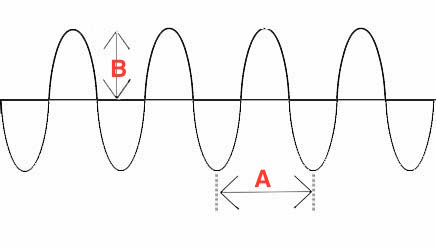
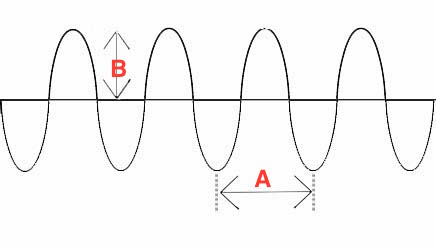
What property of this wave is represented by the letter "A"
a)
amplitude
b)
crest
c)
trough
d)
wavelength
29.
What property of the wave is represented by the letter "B"?
a)
amplitude
b)
crest
c)
trough
d)
wavelength
30.
What do waves carry from place to place?
a)
Energy, but not matter or particles
b)
Energy and matter or particles
c)
Matter or particles but not energy
d)
Neither energy nor matter or particles
31.
Sound needs a medium to travel through.  What is a medium?
a)
solid, liquid, gas
b)
open space
c)
waves
d)
nothing
32.
When the frequency of a wave increases, what happens to the wavelength?
a)
The wavelength is not directly affected by the frequency of a wave.
b)
The wavelength increases.
c)
The wavelength decreases.
d)
More specific information is needed to form a conclusion about the wavelength.
33.
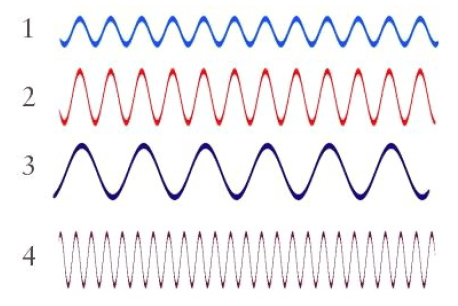
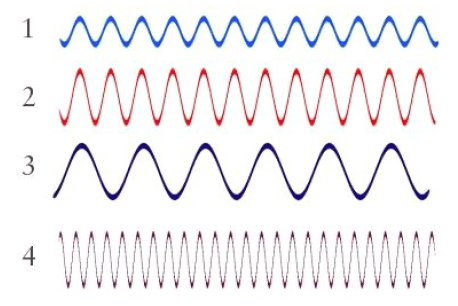
Which wave in the diagram has the greatest frequency?
a)
1
b)
2
c)
3
d)
4
34.
Which wave in the diagram has the greatest wavelength?
a)
1
b)
2
c)
3
d)
4
35.

What type of interference is represented in this diagram?

a)

Constructive

b)

Destructive

36.

What type of interference is represented in the diagram?

a)

Constructive

b)

Destructive

37.

What type of interference do noise cancelling headphones use?

a)

Constructive Interference

b)

Destructive Interference

38.

Sound waves in musical instruments or tubes create standing waves that enhance which type of interference to make louder sounds?

a)

Constructive

b)

Destructive

39.

True or False? Two waves cannot exist in the same space or in the same medium at the same time.

a)

True

b)

False

40.

When a crest and a trough interfere, what occurs?

a)

They combine to create a higher amplitude wave.

b)

They counteract and the wave either lessens or stops completely.

c)

The wave changes into a longitudinal wave.

41.

What creates the Doppler Effect?

a)

The bunching of waves, then the spreading out of waves creating a change in pitch.

b)

The spreading of sound waves, then the bunching up of sound waves creating a change in pitch.

c)

A consistent frequency that creates the same pitch.

42.

An ambulance is driving towards you as you stand on the sidewalk. What happens to the pitch of the siren as it comes towards you?

a)

It increases

b)

It decreases

43.

You are driving in a car and honk the horn at a person standing in the street. As you approach the person, what happens to the pitch of the horn according to you in the car?

a)

It increases

b)

It decreases

c)

It stays the same because you are in the car moving with the sound.

44.

You are standing on the side of the road when a police car races past you with its siren on. After the police car passes you, what happens to the pitch of the siren?

a)

It increases

b)

It decreases

c)

It turns red

45.

A car is not moving but the horn is on. You run towards the car to investigate what's going on. As you approach the car, what happens to the frequency of the sound waves from the horn?

a)

They increase

b)

They decrease

46.

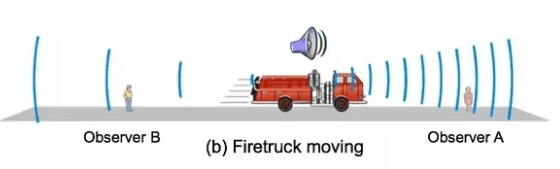
Look at the picture. Who is experiencing a higher pitched sound?

a)

Observer A

b)

Observer B

c)

There's no difference

47.

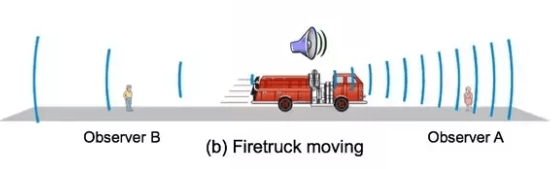
Look at the picture. Who is experiencing a lower pitched sound?

a)

Observer A

b)

Observer B

c)

There is no difference

48.

In the diagram which letters represent the nodes

a)

A B C

b)

A C E

c)

B D

d)

B D E

e)

A C D

49.
The moving black dot is called:
a)
a node
b)
an anti-node
c)
an anti-amplitude
d)
the wangy bit
50.
The stationary dot is called:
a)
a node.
b)
an anti-node.
c)
the amplitude.
d)
the not moving bit.
51.

How many antinodes does this standing wave have?

a)

5

b)

6

c)

7

d)

8

52.
When two waves combine to form a new wave with a smaller amplitude, it is called 
a)
Refraction
b)
Constructive Interference
c)
Resonance
d)
Destructive Interference
53.
What does it mean to reflect?
a)
bounce off
b)
bend
c)
refract
d)
energy