
Font size
 Worksheets
The Water
Total questions: 57
Worksheet time: 46mins
The three types of water movement...
Waves, rivers and glaciers
Currents, tides and waves
Tides, upper course and tides
Currents, waves and fresh water
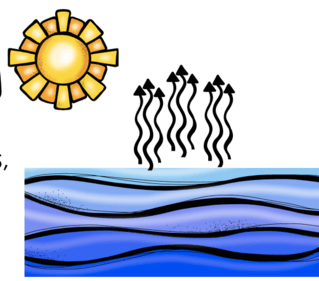
When warm, evaporated air rises, it cools and begins to turn into liquid again. This part of the water cycle is called:
a: transpiration
b: precipitation
c: runoff
d: condensation

Examine the illustration of the water cycle. Use it to answer the question. Look at the arrows. Which arrow shows the evaporation stage of the water cycle?
a: 1
b: 2
c: 3
d: 4
What does condensation look like in the sky?
It looks like rain
It looks like clouds
It looks like a tornado
I see it on my windows

What process is happening in number 6?
transpiration
evaporation
condensation
accumulation
Approximately what percentage of Earth's water is FRESH water?
97%
71%
30%
None of the Above

Check ALL of the following that contain salt water
Lake
Aquifer
Sea
Ocean
Groundwater
About the Earth's fresh water, which of the following stores more?
Rivers
Groundwater
Glaciers
Icebergs
Where do we find meanders?
In the river mouth
In the upper course
In the middle course
In the lower course
A river's ________________ is the starting point of the river.
source
triutaries
mouth
drainage basin
The Rhine and Danube Rivers are located on the continent of Europe.
True
False

What landform can you see in this picture?
Waterfall
V Shaped Valley
Meander
Ox-bow lake

What landform can you see in the picture?
Meanders
Rapids
Estuary
V shaped valleys

What river is the longest river in the world?
Ob River
Nile River
Yellow River
Mississippi River
What are some ways rivers are useful to people all over the world?
Drinking water
Bathing
Travel
Irrigation for crops

What is the world's second longest river running through the a rain forest?
Yangtze River
Ganges River
Yellow River
Amazon River
Where is the Murray River located?
Australia
Africa
Asia
Europe

The river is at its highest altitude
Upper course
Lower Course
Middle Course
The river is wider, but not at its widest
Upper course
lower course
Middle Course


What is Earth's major water storage, home to 97.5% of all water on Earth?
rivers
glaciers
ocean
lakes

Where is most freshwater on Earth located?
Most of Earth's freshwater is found in lakes, rivers and streams.
Most of Earth's freshwater is found in snow, ice caps and glaciers.
Most of Earth's freshwater is found in the oceans and seas.
Most of Earth's freshwater is found in groundwater.
What is the main cause for the making of waves?
The warm currents
The gravitational energy of the moon and sun
The water cycle
The wind
Which of the following lakes is found in America?
Caspian Sea.
Great Lakes
Constanza
Victoria
Aral Sea
What is a current?
A constant movement of water in the oceans and seas
A constant flow of underground water
The different types of tides
The movement caused by the wind
A large mass of ice that moves from the high part of a mountain...
Iceberg
Glacier
Snowed mountain
Ice island
Difference between an ocean and a sea...
The ocean is larger and contains more fresh water
The sea is smaller and contains divides the continents
The oceans divide the continents and contains, in proportion less salt
The seas are partly surrounded by land and contains, in proportion less salt.
In there upper section of a river, we find...
Estuaries
Waterfalls
Source
Meanders
Alluvial plains

Which letter represents the Caribbean Sea?
P
Q
R
S
Which ocean is between North America and Europe?
Pacific Ocean
Atlantic Ocean
Indian Ocean
Southern Ocean
Which ocean is largest?
Atlantic Ocean
Pacific Ocean
Indian Ocean
Arctic Ocean

What body of water is letter X?
North Sea
Red Sea
Baltic Sea
Mediterranean Sea


What ocean is the red triangle in?
Arctic
Indian
Atlantic
Pacific
In which section of a river, the water flow goes faster?
Middle course
Upper course
Lower course
In all of them
In which part of the river can we find more sediments?
In the middle course
In the upper course
In the lower course
In all of them
When water is described as potable, it is
clouded with sediments
low in oxygen
safe to drink
saturated with salts
What controls the tides?
The Wind
The Waves
The Moon
The Stars

Water in the ocean is always
Moving
Still
Warming up
Cooling down
Which type of ocean movement can be described as the rise and fall of sea level, mostly due to the gravitational influence of the moon?
Current
Wave
Tide
Which type of tides happen twice every day in most places?
High/Low
Spring
Neap
Tides are the regular rise and fall of ocean water.
True
False
_______________ are flowing streams of water that move continually through the ocean in a specific direction.
Carrots
Breakers
Currents
Tides

Is the California current a warm or cold?
warm current
cold current

