

wayground logo

Free Printable Worksheets

NEW

Font size

S
M
L
XL
Worksheets

The Vietnam War

Total questions: 40

Worksheet time: 40mins
Name
Class
Date
1.
What was the United States' policy towards communism during the early years of the Cold War?
a)
Containment
b)
Extermination
c)
Isolationsim
d)
Elimination
2.
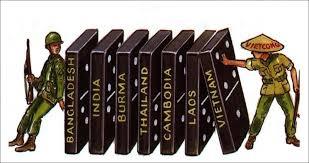
What did the United States fear would happen if all of Vietnam became communist?
a)
Domino Theory
b)
Communism would not spread
c)
The Iron Curtain Theory
d)
Soviet Scare
3.
Who were the communists in South Vietnam?
a)
Vietminh
b)
Vietcong
c)
Ho Chi Minhions
4.
What resolution passed that gave Lyndon Johnson broad powers to defend South Vietnam from communism?
a)
Gulf of Tonkin Resolution
b)
Gulf of Maddox Resolution
c)
USS Tonkin Resolution
d)
Gulf of Vietnam Resolution
5.
What style of warfare did the Vietcong use?
a)
Guerilla
b)
Trench
c)
Aerial
d)
Traditional
6.
Who was elected president in 1968?
a)
Nixon
b)
Johnson
c)
Kennedy
d)
Eisenhower
7.
Plan to replace US troops with Vietnamese troops to end US involvement in Vietnam
a)
Vietnamization
b)
Gulf of Tonkin Resolution
c)
Maddox Resolution
d)
Agent Orange
8.
Which university saw four students die during violent protests against the Vietnam War?
a)
Kent State
b)
Ohio State
c)
Miami of Ohio
d)
Dayton
9.
What law limits the president's ability to send troops without a declaration of war?
a)
War Powers Act
b)
War Production Act
c)
Military Involvement Act
d)
War Involvement Act
10.
Was the US successful in containing communism in Vietnam?
a)
Yes
b)
No
11.
What country controlled Vietnam before Ho Chi Minh's communist revolution?
a)
France
b)
Germany
c)
United States
d)
Britain
12.
Who "won" the Vietnam War?
a)
North Vietnam
b)
United States of America
c)
South Vietnam
d)
North Korea
13.
What was the plan for replacing US soldiers with Vietnamese soldiers to decrease US involvement called?
a)
Gulf of Tonkin Resolution
b)
Vietnamization
c)
Maddox Strategy
d)
Agent Orange
14.
Hostility between the Soviet Union and the United States but without military action was known as ______.
a)
Marshall Plan
b)
Iron Curtain
c)
Cold War
d)
Brinkmanship
15.
The ____ granted the president broad military powers in Vietnam
a)
Geneva Accords
b)
Tonkin Gulf Resolution
c)
Marshall Plan
d)
Operation Rolling Thunders
16.
Lyndon Johnson did which of the following?
a)
Decreased American Involvement 
b)
Increased American Involvement
17.
The idea that if South Vietnam fell to communism, other nations would soon follow...
a)
Vietnamization 
b)
Communism
c)
Domino Theory
d)
Imperialism
18.
Allowed the public to be negatively influenced concerning the  Vietnam war?
a)
Television and media bias
b)
Radio 
c)
Telegraph
d)
Internet
19.
Which side ended up winning the war, if not militarily, politically due to the lack of support of the civilian population?
a)
United states
b)
South Vietnam
c)
North Vietnam
d)
North korea
20.
What were the problems of fighting in Vietnam?
a)
Identifying the enemy 
b)
Jungle/Location provided cover and a place to transport enemy supplies
c)
Weather and climate
d)
all of these
21.
What rule was Vietnam unified under 
a)
Democratic
b)
Communist
c)
Socialist 
d)
Monarchy
22.
Shifting the burden of actual combat from American troops to S. Vietnamese forces.
a)
Vietminization
b)
Vietcong
c)
Internationalism
d)
Linkage
23.
What event sparked significant protests in the United States during the 1960's?
a)
WWII
b)
Vietnam War
c)
Cuban Missile Crisis
d)
WWI
24.
What provided congressional support for escalating military action in Vietnam? 
a)
Cuban Missile Crisis
b)
Battle Of Midway
c)
Gulf of Tonkin Resolution 
d)
Bay of Pigs Invasion
25.
What provided congressional support for escalating military action in Vietnam? 
a)
Cuban Missile Crisis
b)
Battle Of Midway
c)
Gulf of Tonkin Resolution 
d)
Bay of Pigs Invasion
26.
When the French pulled out of Southern Vietnam, what country entered to try and help stop communism from spreading? 
a)
United States
b)
Great Britain
c)
Germany
d)
China
27.
What United States president decided to pull American troops out of Vietnam?
a)
John F. Kennedy
b)
Lyndon B. Johnson 
c)
Dwight Eisenhower
d)
Richard Nixon
28.
What 1964 event led to a rapid expansion of U.S. involvement in Vietnam?
a)
The French lost control of Vietnam to the Vietcong
b)
A group of South Vietnamese army officers killed Ngo Dinh Diem
c)
U.S. ships off the North Vietnamese coast reported being attacked
d)
Laos and Cambodia fell to Ho Chi Minh’s fascist rule
29.
What does the word “escalation” mean with respect to President Johnson’s policy toward Vietnam between 1965 and 1968?
a)
slow withdrawal
b)
increased involvement
c)
frequent surprise attacks
d)
full disclosure of information
30.
What law limits the president's ability to send troops without a declaration of war?
a)
War Powers Act
b)
War Production Act
c)
Military Involvement Act
d)
War Involvement Act
31.

Where was the United States Navy allegedly attacked in 1964?

a)

Gulf of Thailand

b)

Gulf of Tonkin

c)

Pearl Harbor

d)

South China Sea

32.

The United States experience in the Vietnam War supports the idea that the outcome of a war

a)

is determined mainly be technological superiority.

b)

is dependent on using the greatest number of soldiers.

c)

is assured to countries dedicated to democratic ideals.

d)

can be strongly affected by public opinion.

33.

Which of the following was not a reason for the Vietnam War?

a)

The Domino Theory

b)

Containment

c)

Gulf of Tonkin Incident

d)

Vietnamization

34.

Which American president escalated the Vietnam War and did not run for re-election as a result of anti-war activities in the United States?

a)

Kennedy

b)

Nixon

c)

Truman

d)

Johnson

35.

US troop reduction in Vietnam; transfer of combat operations from American to South Vietnamese troops

a)

Domino Theory

b)

Kent State University

c)

Tet Offensive

d)

Vietnamization

36.
Shifting the burden of actual combat from American troops to S. Vietnamese forces.
a)
Vietminization
b)
Vietcong
c)
Internationalism
d)
Linkage
37.

The American people strongly supported U.S. involvement in the war

a)

True

b)

False

38.

In 1968, this president came to office promising to end the war with "peace with honor

a)

Richard M. Nixon

b)

John F. Kennedy (JFK)

c)

Lyndon B. Johnson (LBJ)

d)

Dwight D. Eisenhower

39.

Vietnamization means

a)

turning the war over to South Vietnam so the US could leave

b)

invading North Vietnam and overthrowing Ho Chi Minh

c)

getting Vietnam to annex Cambodia and Laos

d)

bombing South Vietnam

40.

This country surrendered to the communists at the end of the war

a)

South Vietnam

b)

North Vietnam

c)

United States
