
 Worksheets
Organic Chemistry (Comb Sci)
Total questions: 22
Worksheet time: 11mins
name the group that has a single bond
alkenes
alcohols
alkanes
ethers
the name of this compaund C4H10
METHANE
HEXENE
BUTANOIC ACID
BUTANE
the MP and BP increases as the molecular structure increases
hydrocarbons
ethers
ketones
Macromolecule that is made up of repeated structure called monomers
protein
amino acids
polymer
Which homolgous series contains a C=C double bond?
alkanes
alkenes
alcohols
carboxylic acids

What is fractional distillation?
a process used to separate crude oil
a process used to burn up fuels
a way to make different products
how oil is extracted from the ground
Fractional distillation separates crude oil based on the different __________ of the molecules in the mixture
melting point
boiling point
freezing point
chemical reactivity
A fraction of crude oil is made up of:
Hydrocarbons of similar chain lengths
Numbers
Large hydrocarbons
Alkenes only
Crude oil is made up of:
Ethane
Butane
A mixture of different hydrocarbons
Extremely large hydrocarbons which are broken up once extracted
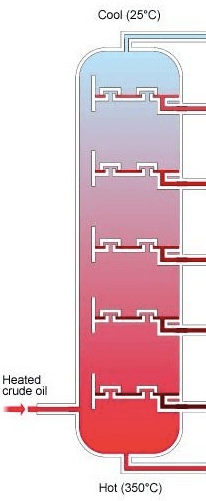
What process happens at each level in the fractionating column?
Evaporation
Condensation
Combustion
What process happens as the crude oil enters the fractionating column?
Evaporation
Condensation
Combustion

Where do short chain hydrocarbons collect?
At the top
In the middle
At the bottom
Shorter hydrocarbons have:
Higher boiling points
Lower boiling points
What is the general formula for the ALKANES?
CnH2n
CnHn
C2nHn
CnH2n+2
What happens in the process of CRACKING?
long chain hydrocarbons are joined together to make even longer ones
short chain hydrocarbons are joined together to make longer ones
long chain hydrocarbons are broken into shorter ones
long chain hydrocarbons are separated into fractions
Why is CRACKING useful?
It produces short chain alkanes and alkenes, which are more useful than long alkanes
It produces longer alkanes which are the most useful hydrocarbons
It uses up the alkenes for which there is only a low demand
There is a greater demand for long chain alkanes than can be met by crude oil only
What can be used to distinguish (tell the difference between) ALKANES and ALKENES?
a flame
limewater
bromine water
distilled water
Which of the following is a type of combustion that occurs when there is plenty of oxygen; it produces carbon dioxide and water vapour only?
incomplete combustion
complete combustion
burning
oxidation
Which of the following is a type of combustion that occurs when there is insufficient oxygen; it produces water vapour and carbon monoxide and/or carbon particulates?
incomplete combustion
complete combustion
burning
oxidation
Which of the following is a toxic gas produced during incomplete combustion that reduces the oxygen-carrying capacity of the blood?
carbon dioxide
oxides of nitrogen
sulfur dioxide
carbon monoxide
What are the products of the complete combustion of hydrocarbons? Tick all that apply.
carbon particulates
carbon dioxide
carbon monoxide
water
What are the products of the incomplete combustion of hydrocarbons? Tick all that apply.
carbon particulates
carbon dioxide
carbon monoxide
water

