Worksheets
Resistance in Series and Parallel Circuits
Total questions: 10
Worksheet time: 16mins
Four unequal resistors are connected in series with each other. Which one of the following statements is correct about this combination?
The equivalent resistance is equal to that of any one of the resistors.
The equivalent resistance is equal to average of the four resistances.
The equivalent resistance is less than that of the smallest resistor.
The equivalent resistance is less than that of the largest resistor.
The equivalent resistance is more than the largest resistance.
Four unequal resistors are connected in a parallel with each other. Which one of the following statements is correct about this combination?
The equivalent resistance is less than that of the smallest resistor.
The equivalent resistance is equal to the average of the four resistances.
The equivalent resistance is midway between the largest and smallest resistance.
The equivalent resistance is more than the largest resistance.
None of the other choices is correct.
Draw a circuit with a battery connected to four resistors, R1, R2, R3, and R4, as follows. Resistors R1 and R2 are connected in parallel with each other, resistors R3 and R4 are connected in parallel with each other, and both parallel sets of resistors are connected in series with each other across the battery.


When unequal resistors are connected in series across an ideal battery,
the same power is dissipated in each one.
the potential difference across each is the same.
the current flowing in each is the same.
the equivalent resistance of the circuit is less than that of the smallest resistor.
the equivalent resistance of the circuit is equal to the average of all the resistances.
As more resistors are added in series to a constant voltage source, the power supplied by the source
increases.
decreases.
does not change.
increases for a time and then starts to decrease.
As more resistors are added in parallel across a constant voltage source, the power supplied by the source
increases.
decreases.
does not change.
increases for a time and then starts to decrease.
The lamps in a string of decorative lights are connected in parallel across a constant-voltage power source. What happens if one lamp burns out? (Assume negligible resistance in the wires leading to the lamps.)
The brightness of the lamps will not change appreciably.
The other lamps get brighter equally.
The other lamps get brighter, but some get brighter than others.
The other lamps get dimmer equally.
The other lamps get dimmer, but some get dimmer than others.

A 9-V battery is hooked up to two resistors in series using wires of negligible resistance. One has a resistance of 5 Ω, and the other has a resistance of 10 Ω. Several locations along the circuit are marked with letters, as shown in the figure. Which statements about this circuit are true? (There could be more than one correct choice.)
The current is exactly the same at points A, B, C, and D.
The current at A is greater than the current at B, which is equal to the current at C, which is greater than the current at D.
The current at A is greater than the current at B, which is greater than the current at C, which is greater than the current at D.
The potential at B is equal to the potential at C.
The potential at D is equal to the potential at C.
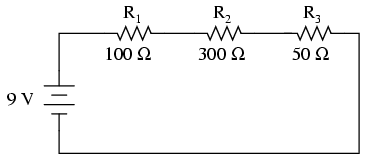
The total resistance in this circuit is
100 ohms
450 ohms
400 ohms
30 ohms