Wayground logo

Free Printable Worksheets

Font size

S
M
L
XL
Worksheets

Evolution week 1 review

Total questions: 28

Worksheet time: 18mins

Name
Class
Date
1.
Alternative forms of a gene are called
a)
Alleles
b)
Homozygous
c)
DNA
d)
Genetics
2.
The physical appearance of an organism based on traits
a)
Genotype
b)
Phenotype
c)
Meiosis
d)
Genetics
3.
The allele combinations
a)
genetics
b)
mitosis
c)
genotype
d)
phenotype
4.
This trait will always be expressed if present because it will mask the expression of others
a)
stem cells
b)
heterozygous
c)
dominant
d)
recessive
5.
Hair colour is an example of
a)
genotype
b)
phenotype
6.
Having the genes for baldness is an example of
a)
genotype
b)
phenotype
7.
How tall you are is an example of
a)
genotype
b)
phenotype
8.
Being a carrier of a genetic disorder is an example of
a)
genotype
b)
phenotype
9.
The sex of a child is determined by
a)
whether the father's sperm contains an x or y chromosome
b)
whether the mother's egg contains an x or y chromosome
c)
the age of the parents
10.
When we say that a woman is a carrier for a genetic disease or disorder it means that
a)
she has 1 gene, but not the disorder
b)
she has 2 genes for the disorder
c)
she can pass the gene only to male children
d)
she can pass the gene only to female children
11.
Why are men 16 times more likely to be color-blind than women?
a)
to be color-blind, you must have a Y chromosome
b)
to be color-blind, all of your X chromosomes must have the gene
c)
color-blindness is caused by testosterone
d)
color-blindness is caused by the same gene as baldness
12.
If a gene is found only on the X chromosome and not the Y chromosome, it is said to be 
a)
sex-linked trait
b)
polygenic trait
c)
codominant trait
d)
incomplete dominance trait
13.

Who is most closely related to Taxidea taxus?

a)

Lutra lutra

b)

Panthera pardus

c)

Canis latrans

d)

Canis lupus

14.

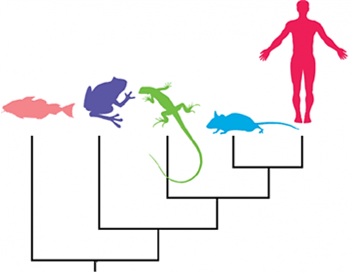
According to this phylogenetic tree, which creature is the least related out of all pictured?

a)

Fish

b)

Frog

c)

Salamander

d)

Human

15.

According to this image, when did the ancestors of Indohyus and Pakicetus diverge?

a)

52 million years ago

b)

56 million years ago

c)

25 million years ago

d)

47 million years ago

16.

Which group of animals on this tree are most closely related to birds?

a)

Saurischian dinosaurs

b)

Ornithischian dinosaurs

c)

Crocodiles

d)

None of these are related to birds

17.

According to this tree, which of these animal phyla are most closely related?

a)

Arthropoda & Mollusca

b)

Arthropoda & Chordata

c)

Chordata & Mollusca

18.

Phylogeny is usually represented by a tree diagram called a _________ - _____

a)

Genetic Line

b)

Phylogenetic Tree

c)

Photographic Queue

d)

Future Babies

19.

What number is the common ancestor of C and D

a)

1

b)

2

c)

3

d)

4

20.

What is the common ancestor of Letters A, B, C, D, E?

a)

1

b)

2

c)

3

d)

4

21.
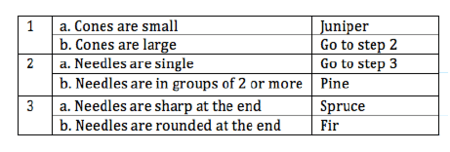
A dichotomous key for trees is provided. Hikers found a tree that has large brown cones and single sharp needles. What species of tree have the hikers found?
a)
Juniper
b)
Pine
c)
Spruce
d)
Fir
22.
A dichotomous key for insects is given. To what order does an insect with two pairs of scaly wings belong?
a)
Coleoptera
b)
Heteroptera
c)
Diptera
d)
Lepidoptera
23.
Using this dichotomous key, identity the name of the circled fish.
a)
band-tail puffer
b)
spotted goat fish
c)
peacock flounder
d)
trumpet fish
24.
When using a dichotomous key to identify organisms, what do we look at?
a)
physical features
b)
weather patterns
c)
environment
d)
diet
25.
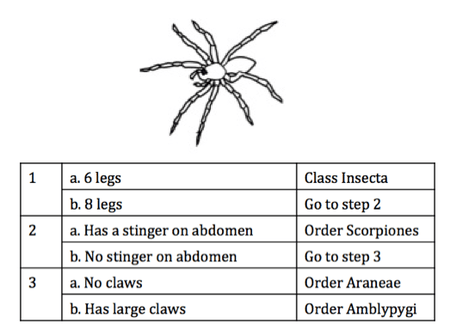
An illustration and a dichotomous key are given. What is the correct classification for this organism?
a)
Class Insecta
b)
Order Amblygygi
c)
Order Araneae
d)
Order Scorpiones
26.
A table of arachnid and insect characteristics is shown. Which characteristic could be used to distinguish between
arachnids and insects?
a)
Jointed legs
b)
Body segments
c)
Presence of eyes
d)
Presence of antennae
27.

Which of the following is an accurate description of the fiddler crab?

a)

3 Paris of walking legs on both sides

b)

Two propodus

c)

3 Chelipeds

d)

A pair of eyes

28.

A student discovers an arachnid without a segmented abdomen, and legs longer than its body. The student uses the dichotomous key below to identify it. Which arachnid has the student found?

a)

Whip Scorpion

b)

Wind Scorpion

c)

Daddy long legs

d)

Scorpion