
 Worksheets
Thermochemistry Test Review
Total questions: 20
Worksheet time: 13mins
A sample of water with a specific heat of 4.186 joules/gram is cooled from 65° C to 15° C by the removal of 275 joules of heat.
What is the mass of the water?
0.043 g
1.31 g
57,557.50 g
3.04 x 10⁻⁴ g

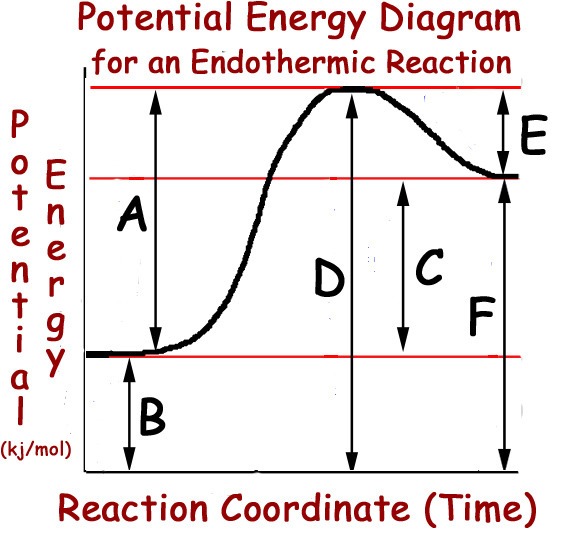
This is a potential energy diagram.
What can be concluded from the potential energy diagram?
The reaction was endothermic.
The reaction was exothermic.
The reaction was at equilibrium.

A garbage disposal chops waste food into tiny pieces that move easily through sewage pipes.
The garbage disposal converts electrical energy to _________.
heat energy
radiant energy
chemical energy
mechanical energy
Which object, by itself, produces a large amount of both heat and light energy?


The temperature of 15 grams of water increased by 3.0° Celsius (specific heat of water is 4.186 J/g•°C).
How much heat was absorbed by the water?
20.90 J
50.23 J
75.34 J
188.37 J

A solid object at 30°C is placed inside a container of liquid at 60°C. What most likely will be observed?
temperature of the liquid will remain the same
temperature of the solid object will decrease
temperature of the liquid will increase
temperature of the solid object will increase
As the average kinetic energy of a substance increases, the temperature of the sample
decreases
increases
remains the same
An ice cube, a cup of hot soup, and a quarter are put into a closed container. What happens?
Everything in the container will reach the temperature of the quarter
Everything in the container will reach thermal equilibrium
Everything in the container will reach the freezing point of water
Everything in the container will remain at its original temperature
Substances can be made to change phase by adding or taking away _____________.
specific heat
energy
particles
mass

The diagrams shown represent two solids and the temperature of each.
What occurs when the two solids are placed in contact with each other?
Heat energy flows from solid A to solid B. Solid A decreases in temperature.
Heat energy flows from solid A to solid B. Solid A increases in temperature.
Heat energy flows from solid B to solid A. Solid B decreases in temperature.
Heat energy flows from solid B to solid A. Solid B increases in temperature.
When an exothermic reaction occurs in a water solution, the temperature of the solution _______.
increases because energy is released by the reaction
increases because energy is absorbed by the reaction
decreases because energy is released by the reaction
decreases because energy is absorbed by the reaction
Which of the following best describes exothermic chemical reactions?
They never release heat.
They always release heat.



The reaction of calcium chloride and water in the hot pack _______.
releases water
releases heat
absorbs water
absorbs heat

Cold pack is an example of a ______.
endothermic reaction
exothermic reaction

