Wayground logo

Free Printable Worksheets

Font size

S
M
L
XL
Worksheets

Planets Solar System

Total questions: 60

Worksheet time: 32mins

Name
Class
Date
1.

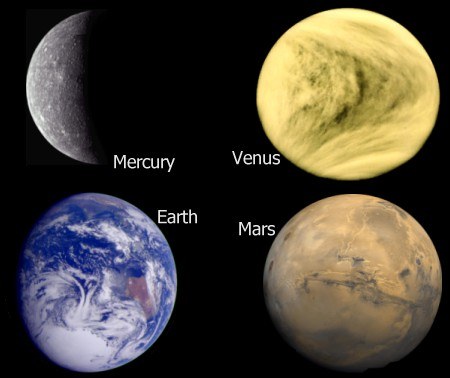
What Is The First Planet

a)

Mercury

b)

Venus

c)

Earth

d)

Mars

2.

What is the second planet?

a)

Mercury

b)

Venus

c)

Earth

d)

Mars

3.

What is the third planet?

a)

Mercury

b)

Venus

c)

Earth

d)

Mars

4.

What Is The forth Planet.

a)

Mercury

b)

Venus

c)

Earth

d)

Mars

5.

The center of our solar system is the....

a)

Earth

b)

Sun

c)

Moon

d)

Asteroid belt

6.

The closest four planets are called the ________ planets.

a)

inner

b)

outer

7.

Mercury, Venus, Earth, and Mars are known as _____________ planets.

a)

rocky

b)

gaseous

8.
What is an astronomical unit?
a)
distance between the moon and earth
b)
distance between the earth and pluto
c)
distance between the earth and sun
d)
distance between NJ and Cali
9.
Which movement creates years?
a)
rotation
b)
revolution
10.
Which of the following is a common characteristic of outer planets?
a)
have rings
b)
shorter years
c)
terrestrial
d)
less than 5 satellites
11.
What is located between the inner and outer planets.
a)
Sun
b)
Asteroid belt
c)
Uranus
d)
Moons
12.
What characteristics do Earth and Venus share? 
a)
They rotate in the same direction
b)
They are both similar size and density
c)
They have the same gases in their atmospheres
d)
They were born at the same time
13.
Which is the largest object in our solar system?
a)
Sun
b)
Jupiter
c)
Earth
d)
Pluto
14.
Which movement creates day/night?
a)
rotation
b)
revolution
15.
What keeps a planet moving on its path around the sun
a)
gravity & inertia
b)
heat & pressure
c)
inertia & pressure
d)
gravity & heat
16.
Which planets are terrestrial planets
a)
Inner planets
b)
Outer planets
c)
Both
d)
Asteroid belt
17.
What is the definition of orbit?
a)
the spinning of the earth on its axis
b)
when the lit part of the moon increases
c)
all of the planets, moon, and other space objects going around the sun
d)
the imaginary line that goes through the north and south poles that the earth spins on
18.
What is the center of our solar system?
a)
moon
b)
earth
c)
sun
d)
Jupiter
19.
What describes the earth going around the sun?
a)
rotation
b)
revolution
20.

This is the first planet from the Sun; it is very hot in the day and very cold in the night.

a)

Mercury

b)

Neptune

c)

Earth

d)

Jupiter

21.

These are the four planets the Sun; Jupiter, Saturn, Uranus, and Neptune are classified as

a)

terrestrial planets

b)

gas giants

c)

solar planets

d)

the best planets

22.

Where is the Asteroid Belt located in the Solar System?

a)

near Neptune

b)

between Mercury and Venus

c)

between Mars and Jupiter

d)

around the Sun

23.
Earth and the other planets closest to the Sun are made mostly of _______
a)
gas
b)
metal
c)
water
d)
rock
24.
The moon is a natural  ______ of Earth.
a)
comet
b)
axis
c)
satellite
d)
space probe
25.
One full orbit of an object around another object is called a ________.
a)
axis
b)
rotation
c)
revolution
d)
satellite
26.
What planet is eighth in the Solar System?
a)
Uranus
b)
Jupiter
c)
Neptune
d)
Mars
27.

Which planet is NOT one of the

"Gas Giants"?

a)

Uranus

b)

Venus

c)

Neptune

d)

Saturn

28.
Select the order from smallest to largest.
a)
Sun, Milky Way, solar system, universe
b)
Sun, Milky Way, universe, solar system
c)
Sun, solar system, Milky Way, universe
d)
Sun, solar system, universe, Milky Way
29.

How long ago was our solar system formed?

a)

10 million years ago

b)

4.6 million years ago

c)

4.6 billion years ago

d)

2 billion years ago

30.
Which planet is the hottest planet?
a)
Mercury
b)
Mars
c)
Venus
d)
Saturn
31.

a large planet composed mostly of gases, such as hydrogen and helium, with a relatively small rocky core. The gas giants of our solar system are Jupiter, Saturn, Uranus and Neptune

a)

terrestrial planets

b)

planetesimals

c)

nebula

d)

gas giant planets

32.

________is made up of a star and the planets and other space objects that revolve around it.

a)

star

b)

sun

c)

solar system

d)

asteriod

33.

What is a common characteristic of the inner planets?

a)

farthest from the sun

b)

gas giant

c)

closest to the sun

d)

coldest planet

34.

Which statement explaining the relationship between stars and planets is true?

a)

the sizes of the planets are same to the sizes of nearby stars

b)

planets create light

c)

planets orbit the sun

d)

D. stars orbit some moon

35.

Which of the following is a complete list of the inner planets?

a)

Venus, Earth, Mars, Jupiter

b)

Mercury, Venus, Earth, Mars

c)

Jupiter, Saturn, Uranus, Neptune

d)

Mercury, Venus, Earth, Jupiter

36.

A large object orbiting a star

a)

Planet

b)

Moon

c)

Asteroids

d)

Sun

e)

Comet

37.

How can you tell the difference between moons and planets?

a)

moons are smaller than planets

b)

planets have life, moons do not

c)

planets orbit around stars, moons orbit around planets

d)

planets have rings

38.

A large object orbiting a star

a)

Planet

b)

Moon

c)

Asteroids

d)

Sun

e)

Comet

39.

Masses that orbit around a planet

a)

Planet

b)

Moon

c)

Asteroids

d)

Sun

e)

Comet

40.

Which of the following is a complete list of the inner planets?

a)

Venus, Earth, Mars, Jupiter

b)

Mercury, Venus, Earth, Mars

c)

Jupiter, Saturn, Uranus, Neptune

d)

Mercury, Venus, Earth, Jupiter

41.

Which of the following is a complete list of the inner planets?

a)

Venus, Earth, Mars, Jupiter

b)

Mercury, Venus, Earth, Mars

c)

Jupiter, Saturn, Uranus, Neptune

d)

Mercury, Venus, Earth, Jupiter

42.

Which of the following is a complete list of the outer planets?

a)

Venus, Earth, Mars, Jupiter

b)

Mercury, Venus, Earth, Mars

c)

Jupiter, Saturn, Uranus, Neptune

d)

Mercury, Venus, Earth, Jupiter

43.

If someone is building a scale model of our solar system which characteristic would be the most difficult to build into the model?

a)

The relative sizes of the objects

b)

The colors of the objects

c)

The distances between objects

d)

The composition of the objects

44.

Which of the following are in our solar system?(pick more than one answer)

a)

planets

b)

multiple stars

c)

moons

d)

asteroids

e)

comets

45.

What are the characteristics of the inner planets in the solar system?

a)

Giant balls of gas and ice

b)

Hard and rocky

c)

Very Large

d)

Smaller

e)

Have many moons

46.

What are the characteristics of the outer planets in the solar system?

a)

Giant balls of gas and ice

b)

Hard and rocky

c)

Very Large

d)

Smaller

e)

Have many moons

47.

A large object orbiting a star

a)

Planet

b)

Moon

c)

Asteroids

d)

Sun

e)

Comet

48.

Masses that orbit around a planet

a)

Planet

b)

Moon

c)

Asteroids

d)

Sun

e)

Comet

49.

Large metallic objects that are clustered in bands called belts

a)

Planet

b)

Moon

c)

Asteroids

d)

Sun

e)

Comet

50.

What holds celestial objects in orbit?

a)

Centripetal Force

b)

Gravity

c)

Mass

d)

Luck

51.
A large mass of billions of stars, dust, and planets
a)
solar system
b)
planet
c)
galaxy
d)
universe
52.
A huge burning ball of hot gas
a)
moon
b)
planet
c)
star
d)
solar system
53.
Planets that are rocky, have no rings, are cold, very small, have few or no moons, can't clear their paths, have long orbits, and short days are known as...
a)
Inner planets
b)
Outer planets 
c)
Dwarf planets
54.
Which is the closest planet to the sun?
a)
Earth
b)
Mercury
c)
Venue
d)
Neptune
55.
What are comets mostly made of?
a)
Rusty metal
b)
Hot, liquid rock
c)
Poisonous liquid
d)
Dirty ice and dust
56.
What is the Great Red Spot on Jupiter?
a)
A volcano
b)
A crater
c)
A lake
d)
A massive storm
57.
Which of these best describes the atmosphere surrounding Venus?
a)
Hot and poisonous
b)
Cold and wet
c)
Bright and sunny
d)
Cold and snowy
58.
Which of these best describes the atmosphere surrounding Venus?
a)
Hot and poisonous
b)
Cold and wet
c)
Bright and sunny
d)
Cold and snowy
59.
How many moon does Mars have?
a)
2
b)
1
c)
13
d)
50
60.

solar system

a)
b)
c)