
 Worksheets
Biogeochemical Cycles
Total questions: 25
Worksheet time: 29mins
Name
Class
Date
1.
How do animals get nitrogen?
a)
the atmosphere
b)
eating other organisms
c)
rainwater
d)
lightning
2.

Organisms require nitrogen to make which of the following?
a)
glucose and starch
b)
lipids and nucleic acids
c)
proteins and nucleic acids
d)
carbohydrates and proteins
3.

Identify the cycle pictured.
a)
The Water cycle
b)
The Carbon cycle
c)
The Nitrogen cycle
d)
The Phosphorus cycle
4.
This process is responsible for most environmental problems of excess nitrogen and phosphorus entering streams, lakes and oceans.
a)
decomposition
b)
emissions from automobiles
c)
agriculture and house hold runoff
d)
photosynthesis
5.
Where is carbon stored in the environment?
a)
Fossil fuels
b)
Wood of trees
c)
Calcium carbonate (shells and bones)
d)
All of the above
6.
A particular golf course is using large amounts of nitrogen fertilizer. What process could move this nitrogen into a local stream?
a)
volatilization
b)
nitrogen fixation
c)
runoff
d)
ammonification
7.
What converts nitrogen into a useable form for plants and animals?
a)
bacteria
b)
fungi
c)
rain
8.
What is the largest reservoir for water?
a)
the ocean
b)
rocks and minerals
c)
the atmosphere
d)
glaciers
9.
What is the largest reservoir for nitrogen?
a)
the ocean
b)
rocks and minerals
c)
the atmosphere
d)
bacteria
10.
Carbon dioxide is added to the atmosphere by
a)
Burning fossil fuels
b)
Cellular respiration
c)
Decomposing organic matter
d)
All answers are correct
11.
Where are denitrifying bacteria found?
a)
In the soil
b)
Root nodules
c)
In dead things
d)
In the atmosphere
12.
Which is NOT a way that nitrogen compounds are added to the soil?
a)
Decay of dead organisms
b)
Denitrification
c)
Animal waste
d)
Nitrogen-fixation
13.
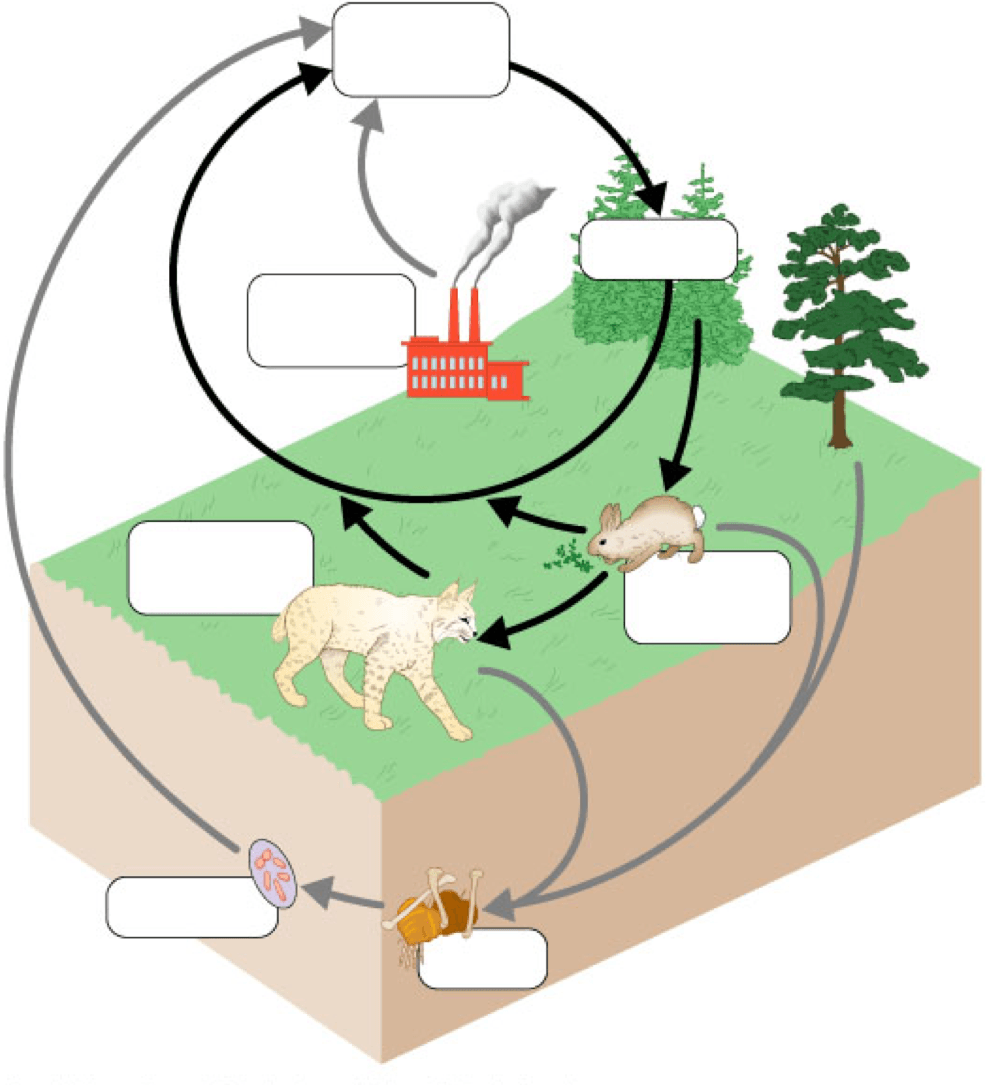
In what process is Carbon transformed into chemical energy?
a)
Photosynthesis
b)
Respiration
c)
Primary Production
d)
Secondary Production
14.
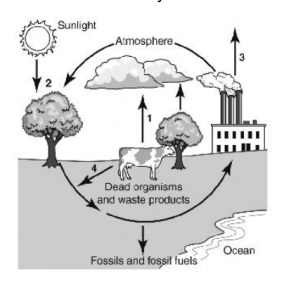
What is happening at 1?
a)
respiration: releasing CO2
b)
decomposing CO2 in the soil
c)
photosynthesis: absorbing CO2
d)
turning CO2 from the atmosphere into organic molecules
15.
In what process is Carbon transformed into chemical energy?
a)
Photosynthesis
b)
Respiration
c)
Primary Production
d)
Secondary Production
16.
Which of the following is true of carbon as it cycles in nature?
a)
Carbon dioxide is released during photosynthesis
b)
Carbon compounds rarely exist in the gaseous state
c)
Carbons sinks include forests and oceans
d)
The carbon dioxide concentration in the atmosphere is reduce by cutting trees
e)
Carbon is concentrated in igneous rocks
17.

Organisms that break down dead plants & animals and release nitrogen back into atmosphere...
a)
bacteria
b)
plants
c)
animals
d)
producers
18.
Which of the following describes the role of nitrogen-fixing bacteria in the nitrogen cycle? Nitrogen-fixing bacteria convert
a)
nitrates intro nitrogen gas
b)
ammonia into proteins
c)
nitrogen gas into ammonia
d)
proteins into nitrates
19.
Denitrifying bacteria convert
a)
NH4+ to N2
b)
NH4+ to NO3
c)
N2 to NH4+
d)
none of these
20.

How does carbon in a grass plant get into a lion?
a)
The lion eats the grass
b)
Carbon from grass doesn't end up in a lion.
c)
The carbon ends up in the food the lion eats.
d)
The lion breathes in carbon given out by the plant
21.
Organisms that do not decompose can be buried and become what?
a)
water
b)
nutrients
c)
air
d)
fossil fuels
22.
If the plant population decreased, the amount of carbon in the atmosphere would ____________________.
a)
Increase
b)
Decrease
c)
Stay the same
23.
Combustion is another word for _______________.
a)
a train
b)
a bus
c)
a dog
d)
burning
24.
Which is an example of a carbon sink?
a)
b)
c)
d)
25.

Process where excess nutrients enter body of water causing overgrowth of aquatic plants and algae...
a)
Eutrophication
b)
Acid Precipitation
c)
Nitrogen Fixation
d)
Decomposition
100 %

