
 Worksheets
Spring Final Review
Total questions: 205
Worksheet time: 2hrs 43mins
In eukaryotes, DNA
Is located in the nucleus
Floats freely in the cytoplasm
is located in the ribosomes
is circular
DNA is copied during a process called
Translation
transformation
Transcription
replication
RNA contains the sugar
Deoxyribose
glucose
Ribose
lactose
Which RNA molecule carries amino acids?
Messenger RNA
ribosomal RNA
Transfer RNA
RNA polymerase
What is made during transcription?
RNA molecules
RNA polymerase
DNA molecules
proteins
What happens during translation?
Messenger RNA is made from DNA
The cell uses information from messenger RNA to make proteins
Transfer RNA is made from messenger RNA
Copies of DNA molecules are made
Genes contain instructions for assembling
Purines
proteins
Nucleosomes
pyrimidines
A mutation that involves a single nucleotide is called a(n)
Chromosomal mutation
point mutation
Inversion
translocation
After introns are cut out of an RNA molecule, the remaining are put back together to make the final messenger RNA (the parts that are expressed)
Introns and exons
introns and nucleotides
Exons
nucleotides
Which of the following is a nucleotide found in DNA?
Ribose, phosphate group, and thymine
Ribose, phosphate group, uracil
Deoxyribose, phosphate group, uracil
Deoxyribose, phosphate group, cytosine
DNA replication results in two DNA molecules
Each with two new strands
One with two new strands and the other with two original strands
Each with one new strand and one original strand
Each with two original strands
Unlike DNA, RNA contains
Adenine
phosphate groups
Uracil
thymine
Which type(s) of RNA is/are involved in protein synthesis?
Transfer RNA only
Messenger RNA only
Ribosomal RNA and transfer RNA only
Messenger RNA, ribosomal RNA, and transfer RNA
How many codons are needed to specify three amino acids? (think about how many codons you need for one amino acid)
3
6
9
12
Which of the following is NOT a gene mutation?
Inversion
deletion
Insertion
substitution

The figure shows a structure of a(n)
DNA molecule
RNA molecule
Amino acid
Protein

What structure is shown in the picture?
mRNA
rRNA
tRNA

What structure is shown in the picture?
mRNA
rRNA
tRNA

What structure is shown in the picture?
mRNA
rRNA
tRNA
Darwin’s voyage on the HMS (blank) led him to propose a revolutionary hypothesis about life.
Collie
Cheetah
Beagle
Lion
Darwin’s hypothesis about how life changes over time is now called the Theory of
Evolution
Variation
Derived characteristic
use and disuse
A well supported, testable explanation of phenomena that has occurred in the natural world is called a
Hypothesis
theory
Law
prediction
Of all of the places he visited, the (blank) Islands influenced Darwin’s ideas about evolution the most
Hawaiian
Aleutian
Beagle
Galapagos
In addition to observing living organisms, Darwin studied the preserved remains of ancient organisms called
Fossils
homologous structures
Adaptations
vestigial organs
On the Galapagos Islands, Darwin observed that the characteristics of many animals and plants
All looked alike
varied from island to island
Were acquired through use
began to disappear
What type of evolution occurs within a species and can occur in a relatively short time?
Malthusian
horizontal
vertical
adolescent
Because of its similarities to artificial selection, Darwin referred to “survival of the fittest” as
Use it or lose it
Homologous structures
Natural selection
Struggle for existence
Scientists thinking that there are similarities in vertebrates in the early stages of life is called the study of
Descent with modification
Artificial selection
geographic distribution
embryology
When farmers select the largest hogs, the fattest horses, or the cows that produce the most milk for breeding, it is called
Natural selection
Artificial selection
Survival of the fittest
Homologous variation
An inherited characteristic that increases an organism’s ability to survive and reproduce in its specific environment is called a(n)
Homologous structure
Vestigial organ
Adaptation
Speciation
A human appendix and whale hipbones are body parts that may or may not be used anymore. These are examples of
Vestigial organs
Embryonic mates
Homologous structures
Artificial selection
Competition for food, space, and other resources among members of a species is called
Common descent
Survival of the fittest
Artificial selection
Struggle for existence
The ability of an individual to survive and reproduce in a specific environment is called
Fitness
Survival of the fittest
Common descent
Struggle for existence
Stressed that scientists can explain past events in terms of processes occurring that they can observe happening now
God
Thomas Malthus
Charles Darwin
Charles Lyell
James Hutton
Predicted the human population will grow faster than the space and food needed to sustain it
God
Thomas Malthus
Charles Darwin
James Hutton
Jean-Baptiste Lamarck
Proposed that organisms acquired or lost traits during their lifetime by selective use or disuse of organs
God
Thomas Malthus
Jean-Baptiste Lamarck
James Hutton
Charles Darwin
Proposed that the Earth was shaped by geological forces that took place over millions of years
God
Jean-Baptiste Lamarck
Charles Darwin
James Hutton
Thomas Malthus
Showed that every other scientist on this list was simply not qualified to comment on where life originated because He gave us the Bible which tells us where life came from
God
Thomas Malthus
Charles Darwin
James Hutton
Charles Lyell
Proposed a hypothesis to explain how living things change over time (evolve)
God
Charles Darwin
James Hutton
Jean-Baptiste Lamarck
Charles Lyell

According to this cladogram, sharks are MOST closely related to which organism?
Amphibians
Crocodiles
Ray finned fish
Birds

Which two organisms have hair?
Sharks and Ray finned fish
Birds and crocodiles
Primates and rodents
Rabbits and birds
The scientific name for an organism is written as the
Class and family name
genus and species name
Domain and kingdom name
kingdom and phylum name
Which domain is capable of living in extreme environments like hot springs, geysers, or very salty waters?
Bacteria
Eukarya
Archaea
What branch of biology classifies and assigns each organism a universally accepted name?
Biology
Binomial nomenclature
Naming-ology
Taxonomy
Organisms that can mate and produce fertile offspring are put into which category?
Genus
Species
Order
Family
Bacteria reproduce by
Mitosis
Binary fission
Budding
Meiosis
How do bacteria cause disease?
By entering and bursting cells
by maintaining homeostasis
By reproducing very quickly
by destroying cells and releasing toxins
What are the two major parts of a virus?
Protein coat and nucleic acid
Nucleic acid and ribosomes
Protein coat and cell membrane
Cell membrane and nucleic acid
The term given to describe the two-name naming system is
Binomial key
Two scientific names
Dichotomous key
Binomial nomenclature
Prokaryotes that break down dead organisms and wastes are called
Nodules
Producers
Nitrogen fixers
Decomposers
The first person to sort organisms classified them into what two groups?
Animals and fungi
Fungi and plants
Animals and plants
Animals and bacteria
The 8 levels of classification from broad to specific is
Domain, Kingdom, Phylum, Class, Order, Family, Genus, Species
Domain, Species, Kingdom, Genus, Phylum, Family, Class, Order
Order, Class, Family, Phylum, Genus, Kingdom, Species, Domain
Species, Genus, Family, Order, Class, Phylum, Kingdom, Domain
What is the genus name here: Canis lupis
Canis
lupis
Canis lupis
How many species have been described and named?
10 million
1.5 billion
10 billion
1.5 million
Who was the FIRST person to classify organisms into groups?
Aristotle
Carl Linnaeus
Charles Darwin
Alfred Wallace
Which two kingdoms belonged to Monera before it was split?
Fungi and Plantae
Fungi and Eubacteria
Eubacteria and Plantae
Eubacteria and Archaebacteria
Viral infections can be prevented by vaccines, which are
Chemicals that destroy viral DNA
Drugs that control the growth and reproduction of viruses
Preparations of weakened or killed viruses
Substances that cause viral proteins to misfold
Bacteria play an important role in ecosystems as
Parasites
producers and consumers
Anaerobes
plasmids
During what process do prokaryotes exchange genetic material?
Cell division
conjugation
Binary fission
endospore formation
What three characteristics are used to classify prokaryotes?
By size, where they live, and whether they need air
Whether they have cell walls, flagella/cilia, and nuclei
How they reproduce, where they get food, and whether they have DNA
By shape, how they move, and how they get energy
What is the basic structure of a virus?
DNA or RNA surrounded by a protein coat
A capsid surrounded by a protein coat
A bacteriophage surrounded by a membrane
A tiny cell surrounded by a cell wall
Which of the following can survive with oxygen or without it?
Obligate aerobes
facultative anaerobes
Obligate anaerobes
bacteriophages
Some prokaryotes are able to survive unfavorable conditions by forming
Flagella
cocci
Capsids
endospores
An unknown disease or well-known disease that suddenly becomes harder to control is called
A pathogen
an antibiotic
An emerging disease
a viral disease
Classification based on structures
Bacteriophage
Binomial nomenclature
Phylogeny
Morphology
Evolutionary history of an organism
Bacteriophage
Homologous structure
Phylogeny
Analogous structure
Physical features that have the same function but different structure – not related
Vestigial structure
Analogous structure
Homologous structure
Morphology
System of assigning a scientific name that consists of two parts
Phylogeny
Bacteriophage
Binomial nomenclature
Analogous structure
Structure that is reduced in size and seems to be “left over” from a previous ancestor
Vestigial structure
Analogous structure
Morphology
Homologous structure
Virus that infects bacteria
Bacteriophage
Binomial nomenclature
Phylogeny
Morphology
Physical features that have the same structure, but different function – are related
Vestigial structure
Analogous structure
Homologous structure
Phylogeny
Having a pair of the same genes for one trait is a (blank) condition.
Monohybrid
homozygous
heterozygous
dihybrid
In guinea pigs, black hair is dominant over white hair. If a homozygous black guinea pig was crossed with a homozygous white guinea pig, the F1 offspring will have a phenotypic probability would be
All white
All black
½ black & ½ white
unable to predict
The phenotypic ratio of the offspring TT, Tt, tt, TT is
2:1:1
2:1:2
2:2
3:1
If an organism has two different genes for one trait, the organism is said to be
Homozygous
heterozygous
monohybrid
dihybrid
A chart that allows you to visualize gene pairings is called a
Mendel square
phenotype chart
genotype chart
Punnett Square
A condition in which both alleles of a heterozygous condition are blended AND expressed (an in-between phenotype)
Crossing over
incomplete dominance
transformation
sex-linked
When looking at two sets of traits, you’re dealing with a
Diploid condition
monohybrid cross
dihybrid cross
triploid condition
The possible number of different gametes that can be formed from a cell with genotype CcDD is
2
4
6
8
Blood type is an example of which of the following
Multiple alleles
simple alleles
local alleles
recessive alleles
A trait carried only on the X-sex chromosome is
Sex-limited
sex-linked
sex-influenced
sex-determined
The blood type that is always evidence of a homozygous condition is
A
B
AB
O
A genetic cross dealing with only one set of characteristics
Phenotype
Genotype
Monohybrid cross
The physical expression of an organism’s genes, what it looks like
Phenotype
Genotype
Monohybrid cross
The genetic make-up of an individual organism; the actual genes that are present
Phenotype
Genotype
Monohybrid cross
When one plant is fertilized by another plant
Dominant
Recessive
Cross pollinate
The trait which, when in the presence of a contrasting trait, expresses itself
Dominant
Recessive
Cross pollinate
The trait which, when in the presence of the opposing trait, will not be expressed
Dominant
Recessive
Monohybrid cross
One plant fertilizes a flower on the same plant
codominance
self pollinate
P1
sex chromosomes
The offspring that are the result of the crossing of the parent plants
P1
F1
F2
sex chromosomes
When both alleles are expressed, but with NO blending
codominance
self pollinate
sex chromosomes
Gregor Mendel
The first plants crossed in a studied cross
P1
F1
F2
sex chromosomes
Determines the sex of the offspring
sex chromosomes
codominance
self pollinate
Gregor Mendel
The offspring resulting from the crossing of the first filial plants
F1
F2
P1
sex chromosomes
Monk is known as the father of modern genetics for his work with pea plants
codominance
self pollinate
sex chromosomes
Gregor Mendel
Meiosis results in (blank) (remember diploid means twice and haploid means half)
2 haploid daughter cells
2 diploid daughter cells
4 haploid daughter cells
4 diploid daughter cells
Crossing over occurs during
Anaphase 1
Metaphase 1
Prophase 1
Prophase 2
An organism that is permanently attached to the ground is
dormant
motile
active
sessile
The phylum that has organisms with harpoon like nematocysts is
Cnidaria
Nematoda
Porifera
Mollusca
The usually sessile stage of a cnidarian life cycle is the
Hydra
Planula
Medusa
Polyp
If a midline divides and organism into two equal side-by-side segments, the organism has
Bilateral symmetry
spherical symmetry
Radial symmetry
asymmetry
What percentage of animals are invertebrates?
50%
75%
90%
95%
What is the study of the structure of organisms/organs?
Physiology
Anatomy
Zoology
Biology
Being an herbivore falls into which of the 7 essential functions of animals?
Feeding
Respiration
Response
Reproduction
What kind of symmetry does coral have?
Asymmetry
Radial symmetry
Bilateral symmetry
Isosymmetry
What is the main organ for excretion?
Lungs
Anus
Kidney
Bladder
Which of the following animals have radial symmetry?
Sponges
Starfish
Insects
Humans
What does it mean to be ventral?
Backside
Toward the tail
Belly side
Toward the head
What does it mean to be dorsal?
Back side
Toward the tail
Belly side
Towards the head
What does it mean to be anterior?
Back side
Toward the tail
Belly side
Toward the head
What does it mean to be posterior?
Back side
Toward the tail
Belly side
Toward the head
The elimination of waste products from the body is a function of which body system?
Endocrine
Respiratory
Excretory
Digestive
Which type of symmetry does a sponge have?
Radial
Bilateral
Asymmetry
Isosymmetry
An animal is which of the following (multiple answers are correct)
Multicellular
Autotrophic
Heterotrophic
Eukaryotic
Animals that have no backbone are called
Vertebrates
Ecoderms
Deuterostomes
Invertebrates
What does the word Porifera mean?
"soft animal"
"hollow gut"
"pore bearer"
"non-motile"
Which of the following is the specialized sponge cell that contains flagella and is used to help power the flow of water through the sponge?
Amoebocyte
Spicule
Collar cell
Pore cell
Sponges that are soft are most likely composed of what skeletal component?
Spicules
Spongin
Gemmules
Osculum
Which of the following best describes the feeding habits of sponges?
Predators
Filter feeders
Parasites
Detritivores
Which of the following are members of Phylum Cnidaria? (multiple choices are correct)
Coral
Jellyfish
Sea Anemone
Sponge
What is a nematocyst?
Stinging cell
A tentacle
Digestive enzyme
A birth defect in hydra
Cnidocytes help a cnidarian survive by
Storing food
Forming colonies
Paralyzing prey
Providing movement
What phylum does the Earthworm belong to?
Nematoda
Cnidaria
Platyhelminthes
Annelida
A major characteristic of earthworms, involves repeating body units is referred to as
Cephalization
Segmentation
Conjugation
Linear division
These crystalline structures are found in certain sponges. They provide a rigid and brittle structure for the sponge.
Collagen
spicule
Spongin
choanocyte
Which of these statements BEST describes why sponges are considered to be one of the simplest animals in the animal kingdom?
Sponges lack a brain, muscles, nervous system, and appendages
Sponges do not hunt for prey
Sponges are sessile (cannot move)
Sponges are considered to be one of the oldest living organisms
Which of the following statements about corals is NOT true?
Corals exhibit the medusa body form
Corals are colonial animals that live together and cooperate with each other
Corals are predatory animals
Coral reefs are made from thousands of coral animals
Which of these is NOT a function of tentacles?
capturing prey
fighting other cnidarians
helping the animal swim
storing and using toxin
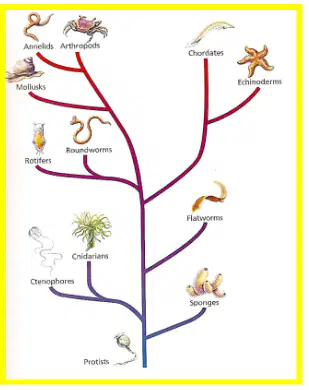
Which organisms are most closely related to Chordates based on the phylogenetic tree?
Flatworms
Mollusks, Annelids, Arthropods
Echinoderms
Sponges

