wayground logo

Free Printable Worksheets

Font size

S
M
L
XL
Worksheets

5th Grade Science Review- THE ULTIMATE QUIZIZZ

Total questions: 230

Worksheet time: 4hrs 27mins

Name
Class
Date
1.

Some constellations or patterns of stars are visible from different places on Earth only during a part of the year. Why are certain patterns of stars not visible everywhere on Earth all year long?

a)

Sun's rotation

b)

Earth's rotation

c)

Sun's revolution

d)

Earth's revolution

2.
Which will most likely result from a low-pressure weather system?
a)
warm temperatures
b)
cloudy conditions
c)
clear conditions
d)
cool temperatures
3.
Which is the best explanation for how air masses move across the United States?
a)
The prevailing westerlies move air masses from west to east across the United States but may be deflected by the jet stream.
b)
The trade winds move air masses from west to east across the United States.
c)
The jet stream moves air masses from the Pacific Ocean across the United States.
d)
The warm air of the Gulf Stream causes air masses to move from the Atlantic Ocean to the Pacific Ocean.
4.
What is the cause of rising surface temperatures of the Pacific Ocean, drought in the western United States, and flooding on the Pacific coast of South America?
a)
the Gulf Stream
b)
the jet stream
c)
El Nino
d)
La Nina
5.
Which has the greatest effect of wind speed?
a)
precipitation
b)
cloud cover
c)
wind direction
d)
air pressure
6.
On a cold, cloudy day, the local weather forecaster predicts that a high-pressure system will be moving into the area in the next 24 hours.  Which weather conditions will this system most likely bring to the area?
a)
stormy
b)
sunny
c)
rainy
d)
snowy
7.
In a grassland ecosystem, if the population of eagles suddenly decreased, what will most likely be the effect on the rest of the ecosystem?
a)
The ecosystem will become overpopulated with snakes.
b)
There will be a decrease in the population of snakes in the ecosystem.
c)
The nutrition of the soil in the ecosystem will decrease
d)
More types of plants will begin growing in the ecosystem.
8.
Which gets all its energy from the sun?
a)
consumer
b)
producer
c)
decomposer
d)
no living organism
9.
How are lakes and estuaries similar?
a)
They both have salt water.
b)
They both have freshwater.
c)
They both are located in the same area.
d)
They are not the same.
10.
How are the tropical rain forest and pond ecosystems similar?
a)
They both have large amounts of trees.
b)
They both have producers and consumers.
c)
They both have the same plants and animals.
d)
They are not the same at all.
11.
Which ecosystem would most likely contain fish that can only survive in freshwater?
a)
lake
b)
estuary
c)
ocean
d)
outer space
12.
Which is most responsible for the uneven heating of the air in the atmosphere?
a)
radiation
b)
conduction
c)
convection
d)
condensation
13.
Which best explains why a pan placed on a hot stove top will begin to warm?
a)
conduction
b)
convection
c)
radiation
d)
evaporation
14.
Water is being boiled on the stove. What is the change that is taking place?
a)
A solid is changing into a gas.
b)
A liquid is changing into a gas
c)
A solid is changing into a liquid
d)
There is no change occuring
15.
Which material is most likely to expand if exposed to freezing temperatures?
a)
iron
b)
wood
c)
water
d)
plastic
16.
A ball was rolling fast and then slowed. Which most likelycaused the ball to slow?
a)
heat
b)
wind
c)
friction
d)
momentum
17.
Which statement best describes how winter weather can damage roads?
a)
Snow and ice can cause car accidents, which damage roads.
b)
Rain, ice, and snow can cause the painted lines on roads to fade.
c)
Cold temperatures can cause road materials to expand, creating potholes.
d)
Water can get into cracks in roads, then freeze and expand, making the cracks worse.
18.
Which is true when equal and opposite forces are applied to an object?
a)
The forces combine.
b)
There is forward movement.
c)
There is no change in motion.
d)
The speed of the object increases.
19.
A train travels 150 miles in 2 hours. What is the average speed of the train? (average speed = distance ÷ time)
a)
30 miles per hour
b)
50 miles per hour
c)
75 miles per hour
d)
80 miles per hour
20.
Which will most likely increase the speed of an object?
a)
applying a faster force
b)
applying a slower force
c)
applying a weaker forcer
d)
applying a stronger force
21.
A car is moving at a constant speed. What is the speed of the car if it moves 100 miles in 2 hours? (speed = distance ÷ time)
a)
25 miles per hour
b)
50 miles per hour
c)
75 miles per hour
d)
100 miles per hour
22.

Complete the table.

a)

Cirrus

b)

Stratus

c)

Cumulus

d)

Cumulonimbus

23.

Complete the table

a)

cirrostratus

b)

stratus

c)

cumulonimbus

d)

cirrocumulus

24.

Complete the table.

a)

Plants: grass, small shrubs

Animals: prairie dogs, coyotes

b)

Plants: cactus

Animals: lizards, rats, insects

c)

Plants: lily pads, cattails

Animals: catfish, bass, turtle

d)

Plants: kapok tree, vines, orchids

Animals: monkeys, panthers, macaw

25.

Which of the following could be placed in the "Evaporation" box?

a)

plants release water vapor into the air

b)

happens when fronts form

c)

removing heat causes water vapor to return to liquid form

d)

adding heat causes liquid water to turn to vapor

26.

Choose the correct sentence to complete the "friction" box.

a)

Moving an elephant is much more difficult than moving a mouse.

b)

Stopping a truck requires more force than stopping a skateboard.

c)

A car rolling down a ramp is pulled by this force.

d)

Kicking a ball in grass is more difficult than kicking a ball on a sidewalk.

27.

Complete the table.

a)

reads music

b)

red hair

c)

speaks English

d)

bows after a performance

28.

Which temperature is the best estimate for January's daily average temperature?

a)

60

b)

50

c)

45

d)

35

29.

Complete the table with an appropriate temperature.

a)

24°

b)

40°

c)

50°

d)

60°

30.

What with Thursday's weather be?

a)

clear

b)

rainy

c)

snowy

d)

sleeting

31.

Apples hanging from tree branches eventually fall to the ground. Which force most likely causes the apples to fall to the ground?

a)

gravity

b)

friction

c)

collision

d)

magnetism

32.

Which will slow an object in motion?

a)

speed

b)

friction

c)

gravity

d)

momentum

33.

Juan goes for a run. After running for 20 minutes, he takes a 5­ minute break, then continues his run. Which graph best represents this?

a)
b)
c)
d)
34.

Which graph depicts an object whose speed is increasing?

a)
b)
c)
d)
35.

How do plants contribute to the water cycle?

a)

Plants cool the air and create condensation.

b)

Plants warm the air and create precipitation.

c)

C. Plants give off water through transpiration.

d)

Plants give off water in the form of runoff or groundwater.

36.

Which part of the water cycle is occurring when warm, moist air cools and begins forming clouds?

a)

condensation

b)

evaporation

c)

precipitation

d)

transpiration

37.

What is the process by which a liquid becomes a gas?

a)

evaporation

b)

condensation

c)

precipitation

d)

absorption

38.

A group of students weighed a sealed jar full of heavy cream. Then they shook the jar until the cream separated, and then they weighed the jar again. Which of the following would best describe its weight?

a)

The jar will have gained weight because some liquid changed to a solid.

b)

The jar will have gained weight because shaking added energy to it.

c)

The jar will have lost weight because of friction from shaking the liquid.

d)

The jar will have kept the same weight because it did not gain or lose any matter.

39.

Which change would result in a new substance being formed?

a)

sugar dissolving in water

b)

a glass bottle breaking

c)

ice melting in a bowl

d)

a metal can rusting

40.

Which best describes the flow of heat?

a)

from a larger object to a smaller object

b)

from a smaller object to a larger object

c)

from a warmer object to a cooler object

d)

from a cooler object to a warmer object

41.

Which is an example of heat being transferred by conduction?

a)

a furnace heating the air in a school

b)

an ice cube melting in a person’s hand

c)

a pot of water on a stove boiling

d)

the sun heating water in a swimming pool

42.

Which is an example of convection?

a)

the heat coming from a campfire

b)

a spoon in a bowl of soup becoming warmer

c)

warmer water at the surface of a swimming pool

d)

getting a sunburn

43.

Which is the best example of heat transfer by radiation?

a)

cooling off in a pool on a hot day

b)

burning your hand on a hot stove

c)

getting warm by sitting near a campfire

d)

melting ice by dropping it into boiling water

44.

Sara wants to keep drinks cold during an afternoon sports

game. Which container would most likely keep her drinks cold for several hours?

a)

metal, because it will conduct heat

b)

plastic, because it will conduct heat

c)

metal, because it will insulate from heat

d)

plastic, because it will insulate from heat

45.

How is weather on a cloudy night most likely to differ from the weather on a clear night?

a)

The temperature will be cooler.

b)

The temperature will be humid.

c)

The temperature will be warmer.

d)

The temperature will be unchanged.

46.

Which describes how wind speed is affected by weather?

a)

Rainy weather causes greater wind speeds.

b)

Warmer weather causes greater wind speeds.

c)

Differences in air pressure cause greater wind speeds.

d)

Small temperature changes cause greater wind speeds.

47.

Which is the best indicator that precipitation is on the way?

a)

low pressure

b)

low humidity

c)

low temperature

d)

low self esteem

48.

The graphic shows a sea breeze. What will most likely happen to the wind after the sun goes down?

a)

The wind will continue to blow in the same direction.

b)

The wind will blow in the opposite direction.

c)

The wind will increase in speed.

d)

The wind will stop blowing.

49.

In which direction do prevailing westerlies flow?

a)

from east to west

b)

from west to east

c)

from north to south

d)

from south to north

50.

Which most likely produces clear, cool weather?

a)

zero air pressure

b)

stable air pressure

c)

a low pressure system

d)

a high pressure system

51.

What impact does the Gulf Stream have on North Carolina’s coastal climate?

a)

The cold water from the Gulf Stream current cools the land.

b)

The warm water from the Gulf Stream current warms the land.

c)

The cold water from the Gulf Stream current decreases inland wind speeds.

d)

The warm water from the Gulf Stream current increases inland wind speeds.

52.

What guides the cold arctic air that enters North Carolina in the winter months?

a)

jet stream

b)

trade winds

c)

subtropical air mass

d)

maritime polar air mass

53.

When the Pacific Ocean cools down near the coast of South America, and causes weather changes around the world, this in known as

a)

El Niño

b)

La Niña

c)

The Gulf Stream

d)

The Jet Stream

54.

Which characteristic best describes both amoebas and bacteria?

a)

abiotic

b)

multi-­celled

c)

single-­celled

d)

producers

55.

Which best explains why humans are multi-cellular organisms?

a)

Human cells are too small to function alone.

b)

Human cells join together to form one large cell.

c)

Humans need many cells to carry out life processes.

d)

Humans have many systems that perform the same function.

56.

Which system is most closely associated with the brain?

a)

nervous

b)

muscular

c)

circulatory

d)

respiratory

57.

How does the circulatory system work with the digestive system?

a)

Blood is used to build muscle strength.

b)

Food waste is filtered by the heart and blood vessels.

c)

Food is broken down into usable nutrients that are transported throughout the body.

d)

Food is transported throughout the body.

58.

How are estuary and ocean ecosystems similar?

a)

They both have little biodiversity.

b)

They both contain salt water.

c)

They both contain only freshwater.

d)

They both have extremely cold temperatures.

59.

Bacteria are released into the Gulf of Mexico to help clean up an oil spill. What role do the bacteria serve in the marine ecosystem?

a)

decomposers

b)

consumers

c)

producers

d)

predators

60.

Which gets all of its energy from the sun?

a)

herbivore

b)

producer

c)

consumer

d)

scavenger

61.

Which population is the primary cause of habitat reduction?

a)

humans

b)

predators

c)

scavengers

d)

decomposers

62.
Hot coffee is stirred with a spoon; the spoon gets hot due to
a)
conduction
b)
convection
c)
radiation
63.
A chair is several feet from a fireplace. The side of the chair facing the fireplace gets warm due to
a)
conduction
b)
convection
c)
radiation
64.
In a swimming pool, water near the surface is slightly warmer. The warm water rises because of
a)
conduction
b)
convection
c)
radiation
65.
Which is NOT an insulator.
a)
Wool
b)
Plastic
c)
Copper
d)
Glass
66.
What is the difference between a conductor and an insulator?
a)
An insulator allows electricity to flow through it easily and a conductor does not
b)
A conductor allows electricity to flow through it easily and an insulator does not.
c)
An insulator is magnetic and a conductor is not
d)
A conductor is magnetic and an insulator is not
67.
An object that doesn't conduct heat well is known as:
a)
a conductor
b)
an insulator
68.
What is heat?
a)
a basketball team
b)
thermal energy
c)
electricity
d)
light energy
69.
The water that falls from the sky can be _______ or collected, and stored in rivers, lakes, and oceans.
a)
accumulated
b)
runoff
c)
ground water
d)
transpiration
70.
The process by which plants release water through the pores in their leaves is called...
a)
accumulation
b)
dormancy 
c)
photosynthesis 
d)
transpiration
71.
The transformation of water vapor back into liquid water by cooling is called...
a)
condensation
b)
evaporation
72.
Is melting butter for popcorn a chemical or physical change?
a)
chemical
b)
physical
73.
Which of the following is NOT an example of a physical change?
a)
crumpled paper
b)
pencil sharpening
c)
shrunken clothing
d)
rust
74.
Fizzing, foaming, and burning are all examples of
a)
Chemical change
b)
Physical change
75.
Freezing Juice?
a)
Physical Change
b)
Chemical Change
76.
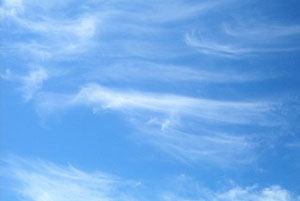
This type of cloud is thin, wispy, and made of ice crystals
a)
cumulus cloud
b)
stratus cloud
c)
cirrus cloud
d)
cumulonimbus cloud
77.
Nimbostratus and cumulonimbus clouds can signal what type of upcoming weather?
a)
fair skies
b)
hot, sunny weather
c)
windy weather
d)
rainy weather
78.
Cumulus and cirrus clouds can signal what type of upcoming weather?
a)
fair skies
b)
hot, sunny weather
c)
windy weather
d)
rainy weather
79.
What happens to the temperature when a warm air mass replaces a cold air mass?
a)
Temperature rises.
b)
Temperature drops.
c)
Temperature stays the same.
d)
Temperature will drop; then rise.
80.
Which best describes the type of weather associated with low air pressure?
a)
clear and dry
b)
sunny and cold
c)
sunny with high winds
d)
cloudy with precipitation
81.

What is the jet stream?

a)

Precipitation in North Carolina

b)

Weather over a long period of time

c)

Strong winds above the Earth's surface

d)

Football flying over the Earth

82.
Which has the greatest effect on the movement of the jet stream? 
a)
size of clouds
b)
amount of precipitation
c)
differences in air temperatures
83.

What will most likely result when the jet stream moves south of North

Carolina?

a)

North Carolina will experience tropical weather conditions.

b)

North Carolina will experience hot, dry weather.

c)

North Carolina will experience mild weather.

d)

North Carolina will experience cold weather.

84.
How does the jet stream affect the weather?
a)
The jet stream transports weather systems that affect us.
b)
The jet stream does not affect the weather.
c)
The jet stream releases oxygen so we can breathe.
d)
The jet stream brings only bad weather.
85.
How does the Gulf Stream affect weather conditions along the eastern coast of the United States?
a)
The Gulf Stream causes temperatures to decrease.
b)
The Gulf Stream causes temperatures to increase.
c)
The Gulf Stream causes more overcast skies.
86.

Which best describes the Gulf Stream?

a)

an ocean current which originates in the Gulf of Mexico and causes warm water to travel up the east coast of the United States

b)

an ocean current which originates in the Gulf of Mexico and causes cool water to travel up the east coast of the United States

c)

an ocean current which originates in the Gulf of Mexico and causes warm water to travel down the east coast of Mexico

d)

an ocean current which originates in the Gulf of Mexico and causes cool water to travel down the east coast of Mexico

87.
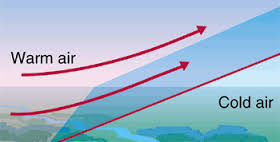
A rapidly moving cold air mass runs into a warm air mass. The cold air slides under the warm air. This is called a(n)  .....
a)
cold front
b)
warm front
c)
stationary front
d)
occluded front
88.
When a warm air mass gently slides on top of a cold air mass, and you have drizzly rain and then warmer weather, what type of front is it?
a)
warm front
b)
cold front
c)
occluded front
d)
stationary front
89.
A front is
a)
where warm air is cooling at earth's surface
b)
a line where hot and cold air are separating
c)
a line where two different air masses meet
d)
where cold air is rising and forming rain clouds
90.
Which most likely produces clear, cool weather?
a)
zero air pressure
b)
stable air pressure
c)
a low pressure system
d)
a high pressure system
91.
Which type of front is pictured?
a)
Cold front
b)
Warm front
c)
Occluded front
d)
Stationary front
92.
What symbol is this?
a)
warm front
b)
cold front
c)
stationary front
d)
occluded front
93.
What type of air mass is the highlighted arrow?
a)
cold/dry
b)
cold/humid
c)
warm/dry
d)
warm/humid
94.
This weather instrument is a...
a)
anemometer
b)
barometer
c)
wind vane
d)
thermometer
95.
This weather instrument is a...
a)
anemometer
b)
Christmas ornament
c)
wind vane
d)
barometer
96.
What instrument measures wind speed?
a)
thermometer 
b)
wind vane
c)
barometer
d)
anemometer 
97.
What instrument measures air pressure?
a)
barometer
b)
hydrometer 
c)
rain gauge
d)
anemometer 
98.
What instrument measures the humidity?
a)
anemometer
b)
rain gauge 
c)
barometer
d)
hydrometer 
99.
What trait might Juan have inherited from his parents?
a)
Scar on cheek
b)
Blue eyes
c)
Ability to play basketball
d)
Enjoying cooking
100.
Similarities are passed from parents to offspring through ___________
a)
Touch
b)
Genes
c)
Blood
d)
Learning
101.
Why do most animals look similar to the parents?
a)
Traits are learned from parents.
b)
Traits are adapted to the environment.
c)
Traits are inherited from their parents.
d)
They do not look similar to their parents.
102.
Why might Nigel have curly black hair like his mother, but not be able to cook as well as her?
a)
Hair color is an inherited trait, but cooking is an acquired trait.
b)
Hair color is an acquired trait, but cooking is an inherited trait.
c)
Nigel chose to have black hair but not to learn to cook.
d)
Nigel will eventually be just as good a cook as his mother; he hasn't grown into it.
103.
Which characteristic is NOT inherited?
a)
Hairline (straight or widow's peak)
b)
Spoken language (English, Spanish, etc...)
c)
Earlobes (attached or detached)
d)
Hair type (straight or curly)
104.
How does the muscular system depend on the nervous system?
a)
The nervous system transports blood to the muscles.
b)
the nervous system provides support for the muscles.
c)
The nervous system supplies food and oxygen to the muscles.
d)
The nervous system send signals to the muscles to cause movement.
105.
Which of the following best describes the job of the skeletal system?
a)
Gives shape and support to the body.
b)
Sends messages from the stomach to the brain.
c)
Brings in and breaks down all nutrients for the body.
106.
Which is a cardiovascular muscle?
a)
lung
b)
heart
c)
stomach
d)
diaphragm
107.
Karlie accidentally touches a hot surface and then quickly pulls her hand away.  Which two systems in the human body were involved with her action and reaction?
a)
nervous and muscular
b)
skeletal and circulatory
c)
nervous and respiratory
d)
muscular and respiratory
108.
How are multi-celled organisms different from single-celled organisms?
a)
Multi-celled organisms must reproduce.
b)
Multi-celled organisms must obtain energy.
c)
Multi-celled organisms have microscopic body structures.
d)
Multi-celled organisms have specialized cells to perform life functions.
109.
A unicellular organism is best described as being
a)
a complex organism.
b)
a microorganism.
c)
an organism with specialized cells.
d)
an organism with different types of tissues.
110.
Which statement would most likely be found in an article about multi-celled organisms like plants?
a)
Plants have a simple structure.
b)
Plants contain only one cell that performs all functions.
c)
Plants do not need to ear, remove waste, or reproduce.
d)
Plants contain many specialized cells that perform different functions.
111.
Which is an example of a single-celled organism?
a)
acorn
b)
amoeba
c)
honey bee
112.

Which is a function of the cardiovascular system?

a)

to move water throughout the body

b)

to provide structural support for the body

c)

to eliminate waste from the body

d)

to transport gases throughout the body

113.

Which body system sends electrical signals to all other body systems?

a)

circulatory system

b)

digestive system

c)

muscular system

d)

nervous system

114.

Which example best shows structures that make up the digestive system in the human body?

a)

heart, blood, vessels

b)

nose, trachea, lungs

c)

brain, spinal cord, nerves

d)

esophagus, stomach, intestines

115.

Which body system processes foods into a useable source of energy?

a)

circulatory

b)

digestive

c)

nervous

d)

skeletal

116.
Which organism performs all life processes in one cell?
a)
grass
b)
bacteria
c)
mushroom
d)
butterfly
117.
Which best explains why humans are multicellular organisms?
a)
Human cells are too small to function alone.
b)
Human cells join together to form one large cell.
c)
Humans need many cells to carry out life processes.
d)
Humans have many systems that perform the same function.
118.
How are algae able to survive?
a)
The algae get energy from other algae.
b)
The algae do not require energy to survive.
c)
The single cell controls all the algae’s life processes.
d)
Other multi-celled organisms provide food for the algae.
119.
How are multi-celled and single-celled organisms different?
a)
Multi-celled organisms need energy to survive, while single-celled organisms need no energy to survive.
b)
Single-celled organisms can be seen without using a microscope, while multi-celled organisms are microscopic.
c)
Multi-celled organisms have large numbers of specialized cells to perform a variety of life functions, while single-celled organisms complete life functions with one cell.
d)
Single-celled organisms have large numbers of identical cells that all perform the same function, while multi-celled organisms have cells that are all different and perform different life functions.
120.
Fungi and bacteria are both single-celled organisms. What do they most likely have in common?
a)
Both fungi and bacteria are large organisms.
b)
Both fungi and bacteria can carry out all life functions in their one cell.
c)
Both fungi and bacteria need sunlight and nutrients from the soil to be able to grow.
d)
Both fungi and bacteria are highly specialized to do only one job so they must work with other cells to obtain food.
121.
What is a PUSH or PULL of an object?
a)
Motion
b)
Force
c)
Friction
d)
Gravity
122.
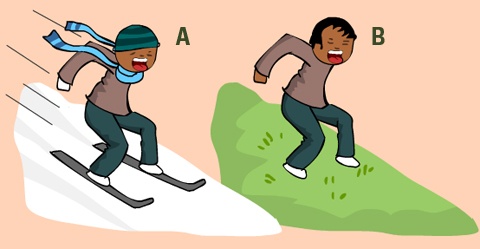
Why is it harder for the boy in Image B to get down the hill?
a)
Motion
b)
Friction
c)
Work
d)
Displacement
123.
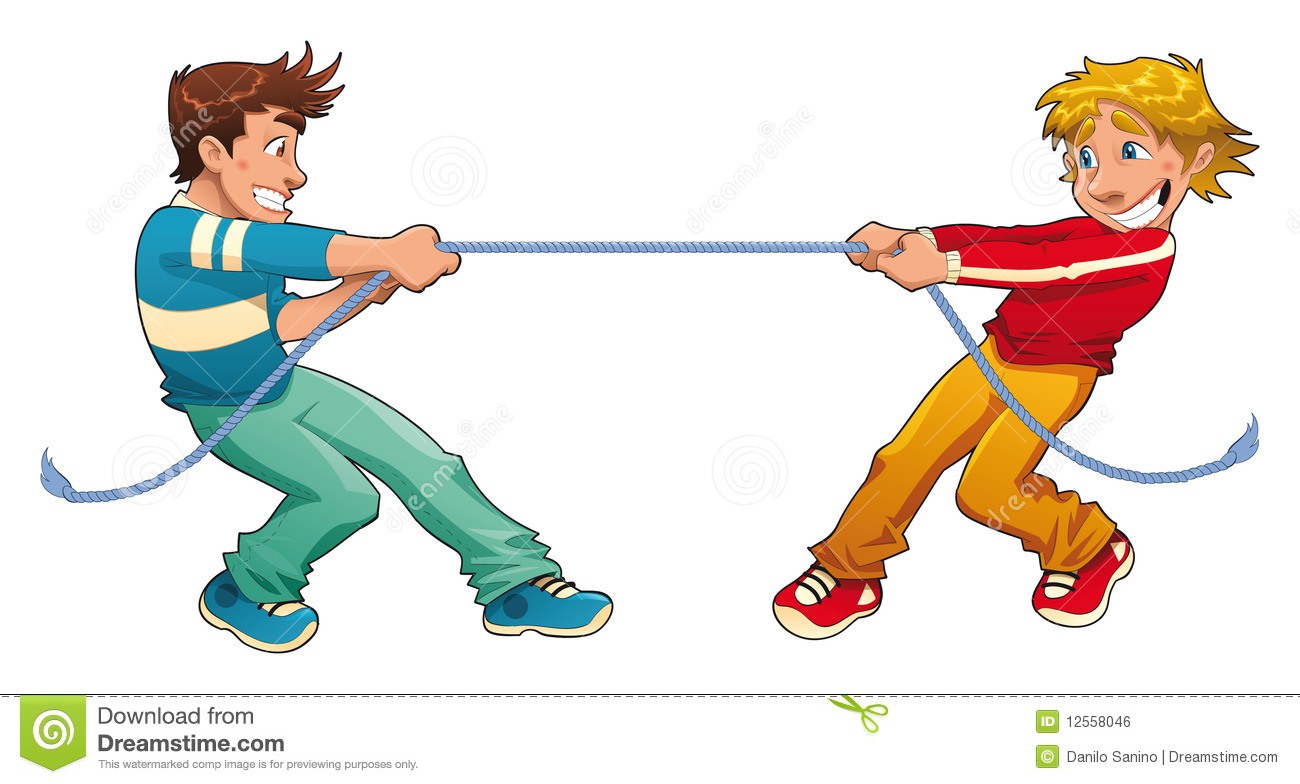
If these boys are pulling with the same amount of force.  What will happen?
a)
The boy in blue will win.
b)
They will not move at all.
c)
The boy in red will win.
d)
Both will fall down.
124.
Speed can be found my calculating...
a)
acceleration/velocity
b)
friction/gravity
c)
momentum/time
d)
distance/time
125.
When an object is getting faster, it is called....
a)
potential energy
b)
kinetic energy
c)
acceleration
d)
deceleration 
126.
Inertia is....
a)
for every action, there is an equal and opposite reaction
b)
larger objects take more force to move 
c)
an object in motion tends to stay in motion unless acted on by an opposite force
d)
a push that acts in the opposite direction and it slows down.
127.
If the forces are the same in Scenario A and Scenario C, which ball would move the fastest?
a)
both balls would move at the same speed
b)
there is no way to determine which ball would move the fastest
c)
the ball in Scenario C
d)
the ball in Scenario A
128.

Which of the following terms identifies a cause of a change in motion?

a)

inertia

b)

mass and force

c)

balanced forces

d)

unbalanced forces

129.
How is gravity affected by mass?
a)
the larger the mass of the object, the greater the gravity
b)
small objects have no gravity
c)
gravity is not affected by mass of objects, whether large or small
130.
This motion graph represents:
a)
constant speed
b)
acceleration
c)
body at rest
d)
slowing down
131.
This motion graph represents:
a)
constant speed
b)
acceleration
c)
body at rest
d)
slowing down
132.
This motion graph represents:
a)
constant speed
b)
body at rest 
c)
acceleration
d)
slowing down
133.
In this distance versus time graph...
a)
The green line is "faster"
b)
The red line is "faster"
c)
The green line is slowing down
d)
The red line is speeding up
134.
All of the nonliving parts of an ecosystem are __________.
a)
biotic
b)
biology
c)
abiotic
d)
biography
135.
A group of organisms of the same species living in the same area are called a/an __________.
a)
community
b)
habitat
c)
population
d)
ecosystem
136.
All of the living AND non-living things in an area that interact with each other are called a/an __________.
a)
community
b)
habitat
c)
population
d)
ecosystem
137.
A group of different species that live together and interact in an environment are called a/an __________.
a)
community
b)
habitat
c)
population
d)
ecosystem
138.
Which is an example of an ABIOTIC factor?
a)
hummingbird
b)
water
c)
dead tree branch
d)
skunk
139.
Which are located at the very BOTTOM of an energy pyramid? 
a)
producers
b)
consumers - Level 1
c)
consumers - Level 2
d)
decomposers
140.
A deer eats from Farmer McClard's cornfield. A flood destroyed the field of crops. What will happen to the deer now that the corn is destroyed?
a)
The deer will plant more crops.
b)
The deer will leave the area to find food.
c)
None of the Above
141.
Which of these organisms is a producer?
a)
strawberries
b)
insect
c)
mouse
d)
owl
142.
What would the insect be considered?
a)
Producer
b)
Consumer
c)
Fungus
143.
Which of the following organisms is a herbivore.
a)
butterfly
b)
snake
c)
fox
d)
ladybird
144.
Which of the following organisms is a carnivore.
a)
greenfly
b)
titmouse
c)
mouse
d)
buzzard
145.
The krill is eaten by which consumer?
a)
blue whale
b)
phytoplankton
c)
leopard seal
d)
penguin
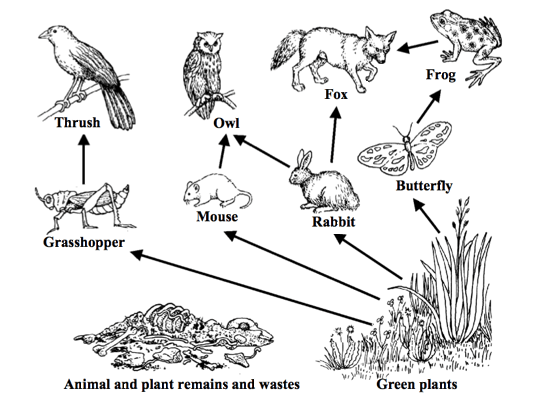
146.
The owl receives energy from which organisms?
a)
grasshopper and mouse
b)
mouse and rabbit
c)
rabbit and butterfly
d)
butterfly and frog
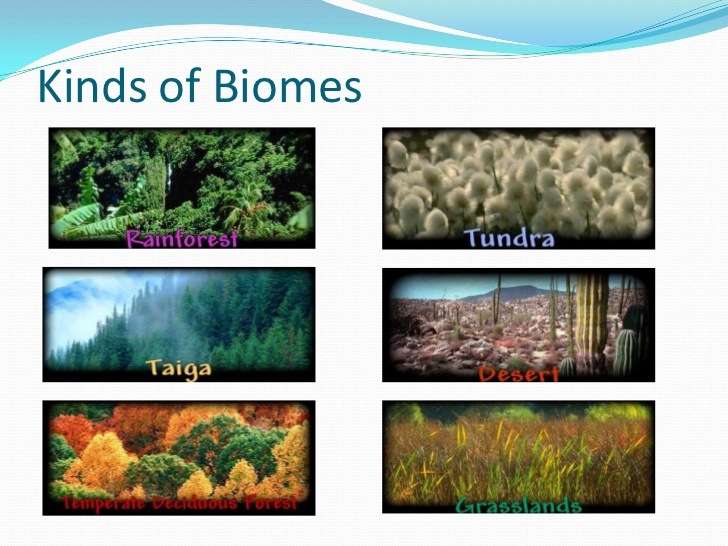
147.
What is the main factor that separates the biomes?
a)
Land
b)
Water
c)
Climate
d)
Longitude
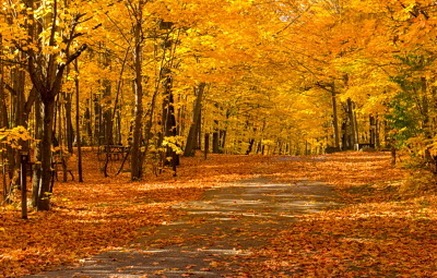
148.
Which biome has deciduous trees (which lose their leaves)?
a)
Temperate Forest
b)
Rainforest
c)
Grasslands
d)
Taiga
149.
Which biome has the most variety of plants and animals?
a)
Temperate Forest
b)
Rainforest
c)
Tundra
d)
Grasslands
150.
Which biome has coniferous trees (which don't lose their leaves)?
a)
Taiga
b)
Temperate Forest
c)
Tundra
d)
Grasslands
151.
Northern biome with many coniferous trees; very cold temperatures in the winter months.
a)
Taiga
b)
tundra
c)
desert
d)
temperate rain forest
152.
Choose the BEST example of balanced forces.
a)
a car speeding up
b)
a leaf blowing in the wind
c)
a car moving at a constant speed
d)
a tennis ball bouncing back and forth between players.
153.
Choose the correct tools for Melissa and Gabe to measure the speed of their leaves.
a)
measuring tape, balance, stopwatch
b)
spring scale, measuring tape
c)
measuring tape, stopwatch
d)
stopwatch, balance, spring scale
154.
How is motion affected when forces are unbalanced acting on an object?
a)
Change the speed, change direction, & cause and object at rest to move or change positions
b)
change speed
c)
change directions
d)
object at rest will move or change positions.
155.
Molly is watching a wind-up toy walking across a table. She observes that the toy covers 1 cm every second for 10 seconds. Which graph do you think most closely represents the toy's  journey across the table?
a)
A
b)
B
c)
C
d)
D
156.
Every morning John walks a half mile to school.  One Morning, halfway to school, he stopped to watch a some deer in the field.  When he realized he was late, he ran the rest of the way to school to avoid being late.  Which graph below shows John's speed during his walk to school?
a)
A
b)
B
c)
C
d)
D
157.
Melissa and Gabe were testing the flight of leaves as they tossed them in the air.  The leaves would go up and then came to a rest on the ground.  What force made the leaves land on the ground?
a)
gravity
b)
friction
c)
air pressure
d)
mass
158.

Which is an example of a different substance being formed?

a)

glass breaking

b)

metal melting

c)

water freezing

d)

wood burning

159.

In which way are evaporation and condensation similar?

a)

both cause decreases in air temperature.

b)

both cause increases in air temperature.

c)

both are caused by the warming of the atmosphere.

d)

both are caused by changes in heat energy.

160.

If 10 grams of water are added to 5 grams of salt, how much salt water will be made?

a)

2 grams

b)

5 grams

c)

10 grams

d)

15 grams

161.

Matt is a tall, eleven-year-old boy. He has a scar on his right cheek. He is intelligent and an excellent drummer. Which of his traits did he MOST LIKELY inherit?

a)

his height

b)

his scar on his right cheek

c)

his intelligence

d)

his ability to play drums

162.

Which is an example of a single-celled organism?

a)

amoeba

b)

insect

c)

fish

d)

worm

163.

Which organism is a producer?

a)

frog

b)

mushroom

c)

grass

d)

lizard

164.

Which will MOST LIKELY result from a low-pressure weather system?

a)

warm temperatures

b)

cloudy conditions

c)

clear conditions

d)

cool temperatures

165.

Which is the BEST explanation for how air masses move across the US?

a)

The prevailing westerlies move air masses from west to east across the US but may be deflected by the jet stream.

b)

The trade winds move air masses from west to east across the US.

c)

The jet stream moves air masses from the Pacific Ocean across the US.

d)

The warm air of the Gulf Stream causes air masses to move from the Atlantic Ocean to the Pacific Ocean.

166.

Which has the GREATEST effect on wind speed?

a)

precipitation

b)

cloud cover

c)

wind direction

d)

air pressure

167.

What is the cause of rising surface temperatures of the Pacific Ocean, drought in the western US, and flooding on the Pacific coast of South America?

a)

the Gulf Stream

b)

the jet stream

c)

La Niña

d)

El Niño

168.

On a cold, cloudy day, the local weather forecaster predicts that a high-pressure system will be moving into the area in the next 24 hours. Which weather conditions will this system MOST LIKELY bring into the area?

a)

stormy

b)

sunny

c)

snowy

d)

hot

169.

Which is most responsible for the uneven heating of the air in the atmosphere?

a)

radiation

b)

convection

c)

conduction

d)

condensation

170.

Four solid balls, each with a different mass, are moving at the same speed. Which ball would require the MOST force to stop its motion?

a)

ball with a mass of 5 kg

b)

ball with a mass of 10 kg

c)

ball with a mass of 15 kg

d)

ball with a mass of 20 kg

171.
In which way are evaporation and condensation similar? 
a)
Both cause decreases in air temperature. 
b)
Both cause increases in air temperature. 
c)
Both are caused by the warming of the atmosphere.
d)
Both are caused by changes in heat energy. 
172.
Which is most responsible for recycling dead plants and animals in an ecosystem? 
a)
water 
b)
bacteria 
c)
fish
d)
insects
173.
Which best describes the speed of a ball as it is thrown straight up into the air and comes back down? 
a)
The ball goes up at a constant speed, stops, then comes down at a constant speed. 
b)
The ball goes up at a constant speed, stops, and increases speed as it comes down. 
c)
The ball goes slower and slower as it goes up, stops, and then goes faster and faster as it comes down. 
d)
The ball goes slower and slower as it goes up, stops, and then comes down at a constant speed. 
174.

Which food chain is in the correct order?

a)

grasshopper → grass → snake → frog → hawk

b)

grasshopper → frog → hawk → snake → grass

c)

grass → grasshopper → frog → snake → hawk

d)

grass → grasshopper → snake → frog → hawk

175.

This diagram represents a food web. What role is the owl in the food web?

a)

consumer

b)

decomposer

c)

herbivore

d)

producer

176.

What prevents plant growth beneath the trees in thick forests?

a)

The trees limit the amount of sunlight that is able to reach the ground.

b)

The roots of the trees make it difficult for plants to grow.

c)

Little water reaches the ground under the trees.

d)

The temperature of the soil under the trees does not allow plants to grow.

177.

Which is the best example of habitat reduction caused by humans?

a)

Birds and animals flee a forest fire caused by lightning

b)

Birds become sick from eating insects new to their area.

c)

Fish swimming to breeding grounds are blocked by dams.

d)

A new species of fish migrates up a river, competing with native fish for food.

178.

All of the landforms on Earth are constantly changing shape. What is most responsible for the changes in the landforms?

a)

earthquakes

b)

water erosion

c)

pollution

d)

oceans

179.

Which statement best describes runoff?

a)

Water vapor cools off and changes into water droplets.

b)

Water in the form of rain, snow, sleet or hail falls from clouds.

c)

Precipitation that falls to Earth eventually flows over land into lakes, streams and rivers.

d)

Water from the oceans and the surface of the earth changes into water vapor.

180.

This diagram shows a light bulb. The bottom of the light bulb is shaped so that the bulb fits securely into a light socket.

Which type of simple machine is the bottom of the bulb?

a)

lever

b)

pulley

c)

screw

d)

wedge

181.

Which of the following statements best describes the climate of an area rather than its weather conditions?

a)

The summers are hot and humid.

b)

The temperature at noon was 86°F.

c)

Total rainfall on April 9 was 2 inches

d)

Strong winds are expected tomorrow evening

182.

Which statement best describes what must happen in order for a person to lift an object?

a)

The force of gravity must be greater than the mass of the object

b)

The mass of the object must be greater than the force of gravity.

c)

The force of gravity must be greater than the upward pull or push on the object.

d)

The upward pull or push on the object must be greater than the force of gravity.

183.

What is speed?

a)

how much an object's position changes

b)

how far an object moves

c)

how long an object moves

d)

how far an object moves in a certain amount of time

184.

Wind pushes a toy sailboat across a pond. the boat moves in a straight path. What is changing?

a)

the boat's direction

b)

the boat's path

c)

the wind's direction

d)

the boat's position

185.

What does the x-axis show on a distance-time graph

a)

time

b)

speed

c)

position

d)

distance

186.

Which graph shows the object not moving?

a)

Graph A

b)

Graph B

c)

Graph F

d)

Graph D

187.

Which graph shows the object returning to home?

a)

Graph A

b)

Graph B

c)

Graph C

d)

Graph D

188.

Which graph shows the object traveling at a constant speed?

a)

Graph A

b)

Graph B

c)

Graph C

d)

Graph D

189.

How does the distance between objects affect the force of gravity between them?

a)

the greater the distance, the greater the force of gravity

b)

the smaller the distance, the greater the force of gravity.

c)

the smaller the distance, the smaller the force of gravity.

d)

Distance has no effect on the force of gravity.

190.

Friction is a force that

a)

pulls objects down to the ground

b)

acts when two surfaces touch each other

c)

pulls two surfaces apart

d)

makes an object moves faster.

191.

In the water cycle, what does the sun provide?

a)

energy for water to evaporate from oceans

b)

water for evaporation to happen

c)

a force to pull water downhill

d)

water for condensation to happen

192.

Which sentence is TRUE about a physical change?

a)

a physical change cannot be reversed.

b)

a physical change causes new materials to form.

c)

You can most often reverse a physical change.

d)

A change in state is not a physical change.

193.

Which question could be answered with qualitative data?

a)

How tall is the plant?

b)

How do the plant's flowers smell?

c)

How many leaves are on the plant?

d)

How much matter makes up the plant?

194.

Rolanda is growing tomato plants in her garden. She has created a compost pile and has been adding compost around her tomato plants to help fertilize them. Compost is solid waste in which organic material is broken down by microorganisms in the presence of oxygen to where it can be safely stored, handled, and applied to the environment. On what does Rolanda primarily rely in order for composting to work?

a)

Producers

b)

Consumers

c)

Scavengers

d)

Decomposers

195.

Which best explains why offspring usually look like their parents?

a)

Parents choose appropriate characteristics for their offspring.

b)

Offspring receive characteristics that have been passed down from their parents.

c)

Parents change the appearance of the offspring until they more closely resemble them.

d)

Offspring adapt to their surroundings, causing them to develop characteristics similar to their parents.

196.

How long would it take a car traveling 60 miles per hour to get from Charlotte, NC to Atlanta, GA if the two cities are 240 miles apart? (speed = distance ÷ time)

a)

2

b)

4

c)

6

d)

10

197.

Lilly has a flat piece of paper and a ball of paper. She drops both papers at the same time from the same height. The ball of paper hits the ground first. Which force acts on the flat piece of paper that slows it down?

a)

Friction

b)

gravity

c)

inertia

d)

magnetism

198.

While working in the yard, John and his father trimmed a few trees and put the branches into a machine to create mulch for the yard. If they created 10 kg of mulch, which is most likely the weight of the branches they used?

a)

5 g

b)

10kg

c)

15kg

d)

20kg

199.

Which best describes the purpose of the cardiovascular system?

a)

It delivers blood to the body’s tissues.

b)

It supplies stability to the skeleton.

c)

It delivers food to power the body.

d)

It supplies oxygen to the body.

200.

Which body system processes foods into a useable source of energy?

a)

circulatory

b)

digestive

c)

nervous

d)

skeletal

201.

Which is a function of the cardiovascular system?

a)

to move water throughout the body

b)

to provide structural support for the body

c)

to eliminate waste from the body

d)

to transport gases throughout the body

202.
The 3 main parts of the circulatory are all of these EXCEPT
a)
Heart
b)
Blood
c)
Esophagus
d)
Blood Vessels
203.
What part of the blood fights against germs in the body?
a)
Plasma
b)
Red Blood Cells
c)
White Blood Cells
d)
Platelets
204.
What kind of blood vessel carries blood AWAY from the heart?
a)
Capillaries
b)
Arteries
c)
Veins
d)
Valves
205.
What body system takes in oxygen from the air and exhales CO2 from the body?
a)
Circulatory
b)
Respiratoy
c)
Digestive
d)
Muscular
206.
What are the tiny tubes that carry air into the lungs called?
a)
Capillaries
b)
Veins
c)
Bronchioles
d)
Tubes
207.
What part of the body contains the vocal cords?
a)
Lungs
b)
Trachea
c)
Larynx
d)
Esophagus
208.
What is the tube that carries food to the stomach called?
a)
Trachea
b)
Larynx
c)
Esophagus
d)
Bronchioles
209.

What are Voluntary Muscles?

a)

Muscles you can control

b)

Muscles that are found in the heart

c)

Muscles that you CANNOT control

d)

Muscles that you build

210.

What is the main purpose of our immune system?

a)

To help us move

b)

To help us breathe

c)

To help protect us from bacteria and viruses

d)

To help our hair grow

211.

What system moves blood and oxygen throughout the entire body?

a)

Skeletal system

b)

Digestive System

c)

Nervous System

d)

Circulatory System

212.

What system sends and receives messages between the brain and the body?

a)

Nervous System

b)

Circulatory System

c)

Muscular System

d)

Skeletal System

213.
What do kidneys act like?
a)
a filter
b)
a pump
c)
a grinder
d)
a storage place
214.
Which two systems work together to help us breath and get oxygen to all parts of our body?
a)
Circulatory, Skeletal
b)
Respiratory, Digestive
c)
Circulatory, Respiratory
d)
Circulatory, Urinary
215.
Which system works with the skeletal system to make your body move?
a)
muscular
b)
digestive
c)
nervous
d)
circulatory
216.
What is the function of the heart?
a)
Pump oxygen through out the body.
b)
Pump waste out of the body.
c)
Pump water to the kidneys.
d)
Pump blood through the body.
217.
How does the digestive system work with all other systems?
a)
The digestvie system transports blood to all the other systems
b)
The digestive system puts oxygen into the body
c)
The digestive system gives the body energy and nutrients
d)
The digestive system allows the body to move
218.
How many bones make up a human adult?
a)
205
b)
206
c)
207
d)
208
219.
The smallest unit that is a building block for all life.
a)
tissue
b)
organelle
c)
cell
d)
molecule
220.
Which two systems work together to transport nutrients to the body for energy?
a)
The nervous and digestive systems
b)
The respiratory and circulatory systems
c)
The digestive and circulatory systems
d)
The skeletal and digestive systems
221.
Includes brain, spinal chord and neurons. 
a)
nervous system 
b)
endocrine system 
c)
respiratory system 
d)
circulatory system 
222.
Which system of the body uses veins, blood, and arteries?
a)
The nervous system
b)
The circulatory system
c)
The respiratory system
d)
The blood system
223.

Which organs belong to the Respiratory System?

a)

Bones, cartilage

b)

Cardiac, smooth, skeletal

c)

Trachea, larynx, pharynx, lungs

d)

Kidneys, urinary bladder

224.

Which level of organization is a heart at?

a)

Cell

b)

Tissue

c)

Organ

d)

Organ System

225.

What are the levels of organization in order?

a)

Cell, Tissue, Organ, Organ System, Organism

b)

Cell, Tissue, Organ, Organ System

c)

Cell, Tissue, Organ, Organism, Organ System

d)

Cell, Organ, Tissue, Organ System, Organism

226.

What are tissues made up of?

a)

Many Cells

b)

Multiple Organs

c)

Multiple Organ Systems

d)

Multiple Organisms

227.

What are organs made up of?

a)

Multiple Organisms

b)

Multiple Tissues

c)

Multiple Organ Systems

228.

What is the function of the respiratory system?

a)

To digest your food

b)

To remove waste from the body

c)

To take in oxygen and remove carbon dioxide

d)

To fight disease

229.

Which statement best describes the relationship between the nervous system and the muscular system?

a)

The nervous system controls the muscular system.

b)

The muscular system controls the nervous system.

c)

The nervous system provides nutrients for the muscular system.

d)

The muscular system provides nutrients for the nervous system.

230.

Which two body systems work together to support the body and allow the body to move?

a)

circulatory and respiratory

b)

digestive and nervous

c)

skeletal and muscular

d)

circulatory and digestive