

Wayground logo

Free Printable Worksheets

Font size

S
M
L
XL
Worksheets

7th Grade Final Review

Total questions: 174

Worksheet time: 2hrs 3mins

Name
Class
Date
1.
What types of election fraud were committed by political machines?
a)
Paying people to vote for their candidate
b)
Leaving a name off of the ballot
c)
Stuffing the ballot box with extra votes
d)
Using "repeaters"
2.
Who is the political boss in charge of Tammany Hall
a)
William Marcy Tweed
b)
Grover Cleveland
c)
W.E.B. Dubois
d)
Ida Tarbell
3.
Wanted reforms in working conditions, sanitation, education, and housing
a)
Corrupt politicians
b)
Progressives
c)
Muckrakers
d)
Immigrants
4.
John Dewey believed students should_____
a)
Memorize facts
b)
Start with a healthy breakfast
c)
Learn problems solving skills
d)
Memorize math facts
5.
Which of the following describes bosses and political machines
a)
Did not care for the poor or immigrants
b)
Powerful orgnizations that dominated federal government
c)
Disliked the practice of giving jobs to supporters of winning candidates
d)
Used corrupt methods to fix urban issues
6.
How did progressives improve education
a)
They started kindergarten programs for young children in the city
b)
They made schools less crowded by making school optional
c)
Encouraged children to memorize facts
d)
They required students to pass an exam before entering school
7.
Why did the Supreme court rule that laws passed by congress concerning child labor were unconstitutional
a)
They violated freedoms of the first amendment
b)
They believed that all people including children had the right to work
c)
the laws went beyond the federal government's power to regulate interstate commerce
d)
the court believed the laws would hurt the families who needed the children's income
8.
What made the AFL different from the IWW?
a)
It only allowed skilled workers
b)
Wanted to overthrow capitalism
c)
Used strikes to advance reforms
d)
Focused on achieving higher pay
9.
Why did women become active in reform movments such as temperance and suffrage?
a)
They wanted to attend college
b)
They wanted to put their education to good use
c)
They wanted to join unions and campaign for shorter work hours
d)
they could only find work in jobs that required them to be politically active
10.
How was Booker T. Washington different from other African American leaders?
a)
He took a direct approach to fighting racial injustice
b)
He fought against discrimination using the courts
c)
He thought that African Americans should not opnely challenge segregation
d)
He believed that African Americans should demand equal rights immediately
11.
Which of the following policies did Theodore Roosevelt make a top goal of his administration?
a)
Reforming banks
b)
ending conservation
c)
regulating big business
d)
supporting labor unions
e)
`
12.
Who wrote The Jungle which exposed unsanitary conditions in the meatpacking industry
a)
Ida Tarbell
b)
John Dewey
c)
Upton Sinclair
d)
Robert Lafollette
13.
Which amendment banned the consumption, sale, and manufacturing of alcohol?
a)
16
b)
17
c)
18
d)
19
14.
What is the 19th Amendment
a)
Gave women the right to vote
b)
Banned the sale and consumption of alcohol
c)
Created income tax
d)
Right to bear arms
15.
Who is Alice Paul?
a)
Led the women's suffrage movement, protested to get the right to vote
b)
Led the temperance movement, believed alcohol was bad and wanted to ban it
c)
Created Hull House and other settlement houses
d)
Created schools for poor children in cities
16.

Why did the Stock Market crash in October 1929?

a)

most investors stopped buying stock on margin and began paying full price for them

b)

many people wanted to sell their stocks but so few wanted to buy them that prices fell

c)

the Federal Reserve Board made it easy for brokers to offer margin loans to investors

d)

Many banks closed when they did not have enough money on hand to cover all deposits

17.

Which of the following helped lead to the Great Depression?

a)

Increasing world trade

b)

lowering foreign tariffs

c)

limited market competition

d)

overproduction of goods

e)

governmental monetary policy

18.

Why did many Americans blame Hoover for the Great Depression?

a)

They were upset that he made payments to the Bonus army

b)

They felt his assistance programs made the economy worse

c)

They believed he should have done more to fid the economy

d)

They thought his low tariff policy was a major cause of the Depression

19.

Civil works Administration

a)

hired people to build dams and generators

b)

employed Americans to build roads and airports

c)

helped refinance mortgages for farmers

d)

provided jobs planting trees and improving national parks

20.

Civilian conservation Corps

a)

hired people to build dams and generators

b)

employed Americans to build roads and airports

c)

helped refinance mortgages for farmers

d)

provided jobs planting trees and improving national parks

21.

Tennessee Valley Authority

a)

hired people to build dams and generators

b)

employed americans to build roads and airports

c)

helped refinance mortgages for farmers

d)

provided jobs planting trees and improving national parks

22.

Farm Credit Administration

a)

hired people to build dams and generators

b)

employed Americans to build roads and airports

c)

helped refinance mortgages for farmers

d)

provided jobs planting trees and improving national parks

23.

Which of the following correctly describes a criticism of the New Deal?

a)

Dr. Townsend argued that the New Deal helped only business interests

b)

Father Coughlin thought that the New Deal didn't do enough for older americans

c)

Huey Long believed that the high cost of new programs would lead to new taxes on businesses

d)

The American Liberty League argued that the New Deal laws gave the president too much authority

24.

Which programs were part of the 2nd New Deal?

a)

Social Security Act

b)

Emergency Banking Relief Act

c)

Civil Works Admin

d)

National Youth Administration

e)

Works Progress Administration

25.

Which of the following correctly describes what happened to farmers who lived in the Dust Bowl

a)

Many farmers led their farms to find new jobs in other states

b)

most farmers sold their land and became wealthy

c)

most farmers rebuilt their farms using the same techniques they always had

d)

many farmers joined the government in order to pass laws support farming

26.

Even though they continued to face discrimination, ___________ supported Roosevelt because the president included them in recovery programs and consulted with leaders known as _____________

a)

Asian Americans, Dust Bowl

b)

Native Americans, Bonus Army

c)

African Americans, Black Cabinet

d)

Mexican Americans, New Deal

27.

Which of the following New Deal programs are still part of the US government?

a)

Social Security Act

b)

Agricultural Adjustment Act

c)

Civilian Conservation Corps

d)

National Industrial Recovery Act

e)

Federal Deposit Insurance Corporation

28.

What happened on October 29, 1929

a)

Stock prices collapsed and the stock market crashed

b)

Banks made it more costly to offer margin loans

c)

Stock market turned into a bull market

d)

13 years before Bob Ross is born

29.

Why did banks close in the late 1920s and early 1930s?

a)

The federal government took over banks

b)

Banks ran out of money

c)

Many bankers retired

d)

Customers preferred to keep their money in the stock market

30.

How did Hoover respond to the Great Depression?

a)

He did little to provide direct assistance to individuals

b)

he made early military bonus payments to WWI veterans

c)

"Oh man. That is really unfortunate." -Herbert Hoover (probably)

d)

He set up Hoovervilles for the newly homeless

31.

How was FDR's philosophy of government different from that of Hoover?

a)

Rosevelt insisted on limited government

b)

Roosevelt felt it was up to the private individual to offer relief

c)

Roosevelt believed that the government should take active steps to provide aid

d)

Roosevelt thought that providing aid would weaken American's spirit of self-reliance

32.

What were the Hundred days?

a)

the sessions in which the SEC established rules to regulate football

b)

the period of time when banks stayed closed until the Federal Deposit Insurance Corporation was established

c)

when Roosevelt and congress worked together to create new programs and economic recovery

d)

the period of time when the government inspected the finances of every bank to see which were healthy enough to reopen

33.

How did Huey Long's criticism of the New Deal differ from that of the American Liberty League

a)

Long thought the new deal helped only business interests

b)

Long argued that the New Deal gave the president too much power

c)

Long insisted that the New deal did not go far enough to help people

d)

Long believed that the New Deal overlooked the needs of older Americans

34.

Why did the Wagner Act encourage people to join unions?

a)

Limited the power of organized labor

b)

Guaranteed the right to join unions

c)

Established a minimum wage

d)

Provided financial security for the elderly, children, and the unemployed

35.

Why did President Roosevelt propose a bill to reorganize the judiciary?

a)

To establish a mandatory retirement age for all Supreme Court justices

b)

He wanted to increase the total number of control the Democrats had on the government

c)

He wanted to increase the total number of Supreme court justices by adding six new judges

d)

He wanted to make it more likely that New Deal programs were declared unconstitutional

36.

Which of the following factors contributed to farmers' difficulties in the 1920s and 1930s?

a)

severe rain in the Plains

b)

an increase in prices for farm products

c)

withering crops, leading to the loss of topsoil

d)

an increase of new farming methods

37.

Why did swing music become popular during the Depression?

a)

it helped people forget their troubles

b)

it focused on the sadness of the time

c)

its slow paced rhythms matched the mood of the country

d)

its dark themes showed the grim realities people were facing

38.

Which of the following correctly states an effect of the New Deal?

a)

it helped to quickly end the Great Derpession

b)

it was helpful at the time but had no long term government

c)

it greatly increased the role of the federal government

d)

it gave little help to Americans in a time of economic crisis

39.

How were labor conditions during this time?

a)

It was a safe environment.

b)

Dangerous working conditions.

c)

Good pay.

40.

8) How did industrialization effect children?

a)

Children got jobs and were managers in short time

b)

Many children were taken for farming jobs

c)

Children got low paying jobs and injuries instead of going to school

d)

Children were banned from working factory jobs

41.
Which of the following was NOT a problem labor unions fought for?
a)
shorter hours
b)
lower pay
c)
no child labor
d)
safer working conditions
42.
An organization of workers who promote their interests collectively (as a group)
a)
Labor union
b)
Political machine
c)
Caucus
43.

How was the American Federation of Labor different from the Industrial Workers of the World?

a)

The AFL wanted to overthrow capitalism

b)

It used strikes to achieve reforms

c)

It focused on achieving higher pay

d)

It allowed only skilled workers to join

44.

Why did the Supreme Court rule that the federal child labor laws passed by Congress were unconstitutional?

a)

The laws violated the freedoms provided in the First amendment

b)

The Court believed that all people, including children, had the right to work

c)

The court believed the laws would hurt the families who needed the children's income

d)

The laws went beyond the federal government's power to regulate interstate commerce

45.

Why did child labor reforms not work as expected? (select two)

a)

Blocked by the Supreme Court

b)

Parents sent kids to work anyways

c)

Business owners agreed to a pay increase

d)

Congress refused to create child labor laws

46.

An economic system in which private businesses run most industries and competition determines the price of goods

a)

Capitalism

b)

Socialism

c)

Communism

d)

Mixed Market

47.

An economic system in which the government owns and operates a country's means of production

a)

Capitalism

b)

Socialism

c)

Communism

d)

Mixed Market

48.

Why did women become active in reform movements such as temperance and suffrage?

a)

They wanted to fight to gain the right to be allowed to attend college

b)

they could find work only in jobs that required them to be more politically active

c)

they wanted to join unions that campaigned for higher wages

d)

they were denied access to some professions and wanted to put their educations to use

49.

What is the temperance movement?

a)

Avoidance of alcohol

b)

The right to vote

c)

Workplace reforms

d)

Urban reforms

50.

What is suffrage?

a)

Avoidance of alcohol

b)

Right to vote

c)

Urban reforms

d)

Workplace reforms

51.

What did reformers blame for social problems and criminal violence?

a)

alcohol

b)

popular music

c)

women getting the right to vote

d)

video games

52.

Why did many women start joining progressive movements?

a)

More women were able to get an education

b)

They were denied entry into male dominated fields

c)

More women became involved in religious ministries

d)

They were encouraged to find jobs outside of the home by their families

53.

How did Carrie Nation involved in the Temperance movement?

4 lines
54.

What is the 18th Amendment?

a)

Established the direct election of US senators

b)

Prohibits the manufacture and sale of alcohol

c)

Gave women the right to vote

d)

Limits the number of times someone can run for president

55.

What is the 19th Amendment?

a)

Established the direct election of US senators

b)

Prohibits the manufacture and sale of alcohol

c)

Gave women the right to vote

d)

Limits the number of times someone can run for president

56.

What reasons did some people give for NOT supporting women's suffrage?

4 lines
57.

How were NAWSA and the NWP different?

a)

Many felt that NAWSA didn't go far enough

b)

the NWP held parades, public demonstrations, picketing, and hunger strikes to call attention to their cause

c)

NAWSA used boycotts to call attention to their cause

d)

Both groups used the same methods to call attention to their cause

58.
What was a economic impact of the Great Depression?
a)
Stock market crashed and millions of Americans lost their jobs
b)
Many Americans moved to California in search for Gold
c)
Many Americans began to become wealthy due to Oil being found in Texas
59.
How is the Dust Bowl and the Great Depression related?
a)
Both events caused Americans to struggle financially
b)
Both events caused riots throughout the nation
c)
Both events led to World War II beginning 
60.
What was created to end the Great Depression?
a)
The New Deal
b)
American Purchase
c)
Stock Market
d)
Economic control
61.
What was the effect of the Dust Bowl?
a)
New farming techniques were used to prevent erosion
b)
Many Americans moved to east Texas for proper soil
c)
The New Deal restricted farmers from buying future stocks
62.
The falling of the _________ was the main reason why the Great Depression began
a)
stock market
b)
soldiers
c)
deported goods
63.
The New Deal
a)
was a failure.
b)
created new jobs.
c)
only helped farmers.
d)
increased unemployment.
64.
The Great Depression caused many people to lose their money and their jobs.  In cities from New York to California, many people who had lost their homes did which of these?
a)
worked and saved their money
b)
went back to school
c)
became farmers
d)
built Hoovervilles
65.
What does this list describe the effects of?
- People who have lost their homes leave the Great Plains for California.
- Crops are ruined, and farmers cannot pay back their debts.
- Migrant workers cannot find work because the farms have been destroyed.
a)
the Dust Bowl.
b)
Hoovervilles.
c)
the Roaring Twenties.
d)
Black Tuesday.
66.
What happened to bank customers in the 1930s?
a)
They earned interest on their savings accounts.
b)
They sold their shanties to the bank for a profit.
c)
Many of them lost their savings when banks closed.
d)
They asked the bank for loans to buy stocks.
67.
Who started the "New Deal" to help America recover from the Great Depression?
a)
Franklin Roosevelt
b)
Herbert Hoover
c)
Henry Ford
d)
Duke Ellington
68.
The day the stock market crashed is known as:
a)
Black Monday
b)
Black Tuesday
c)
Black Wednesday
d)
Black Thursday
69.
Buying on margin means:
a)
buying stocks at a fraction of their price, with the promise of paying the rest later
b)
planning out your budget to make sure you have enough to get by
c)
Buying a few stocks from many companies to ensure profit
d)
Pouring all of your money into one stock in order to ensure profit
70.
This president was blamed for not doing enough during the Great Depression, so much so that shanty towns were named after him
a)
Hoover
b)
Roosevelt
c)
Wilson
d)
Polk
71.
Which of the following was a major cause of the Great Depression?
a)
overproduction and underconsumption
b)
a decrease in the supply of consumer goods
c)
an increase in demand for imported products
d)
an increase in the price of wheat on the world market
72.
How did "bank runs" impact the American people during the Great Depression?
a)
Banks eventually ran out of money to loan, and people's life savings were gone.
b)
Banks made loans throughout the Great Depression, helping people pays bills until they could find work.
c)
Banks were able to people's deposits safe, but they could not loan out any more money.
d)
Banks were not at all involved in the Great Depression because people did not use them.
73.
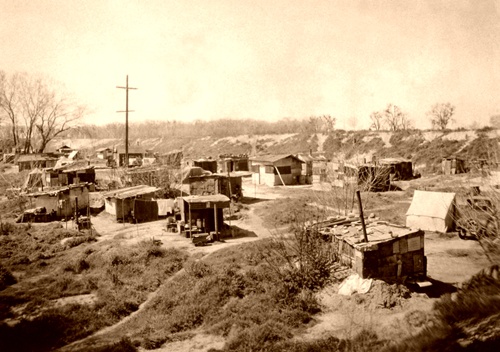
What was the main reason for the emergence of “Hoovervilles” like the one shown in the photograph?
a)
Many Americans had lost jobs during the Great Depression.
b)
Thousands of homes had been destroyed by the effects of the Dust Bowl.
c)
Housing projects could not keep up with the demand for homes needed by the poor.
d)
Preparations for World War I had created a shortage of building materials.
74.
During the early 1930s, the main goal of the Bonus Army was to pressure the Hoover administration to
a)
strengthen the nation’s defenses
b)
end the military draft
c)
bring American troops home from overseas
d)
support the early payment of money promised to veterans
75.
During the 1930s, poor land management and severe drought conditions across parts of the Midwest resulted in the
a)
formation of the United States Department of Agriculture
b)
creation of wheat surpluses
c)
growth of the Populist movement
d)
development of Dust Bowl conditions on the Great Plains
76.
Which of these statements is true of the 1932 presidential election?
a)
Franklin Roosevelt won in a landslide.
b)
Hoover lost by a narrow margin.
c)
Huey Long ran a strong third-party campaign.
d)
Roosevelt won a third term.
77.
A major difference between the philosophies of President Herbert Hoover and President Franklin D. Roosevelt in responding to the Great Depression is that Roosevelt
a)
wanted to rely on private charities to provide assistance
b)
stressed the need for individual rugged individualism
c)
supported direct relief to people out of work
d)
thought the government should not be involved in economic reform
78.
FDR addressed the American public in weekly broadcasts known as:
a)
FDR Hour
b)
Hangin' With Franklin
c)
Fireside Chats
d)
Around the Fire
79.
What was a guiding principle of the New Deal economic policies?
a)
Pro-business tax breaks would solve the problems associated with urban poverty.
b)
Antitrust legislation would destroy the free market economy of the United States.
c)
Rugged individualism must be allowed to solve social inequality.
d)
Government must assume more responsibility for helping the poor.
80.
As part of the New Deal, the Securities and Exchange Commission (SEC) and the Federal Deposit Insurance Corporation (FDIC) were created to
a)
allow for a quick recovery of stock prices
b)
provide direct loans to businesses
c)
protect individual investors from stock fraud and bank failure
d)
allow banks and companies to invest in the stock market
81.
A major reason that President Franklin D. Roosevelt proposed adding Justices to the Supreme Court in 1937 was to
a)
make the Court processes more democratic
b)
end corruption and favoritism in handling cases
c)
influence Court decisions related to New Deal programs
d)
ensure the appointment of members of minority groups
82.
Passage of the Social Security Act (1935) helped American workers by 
a)
creating jobs for the unemployed
b)
guaranteeing a minimum wage
c)
legalizing the right to join labor unions
d)
providing financial assistance after retirement
83.
Senator Huey Long, Dr. Francis Townsend, and Father Charles Coughlin are best known as
a)
members of President Franklin D. Roosevelt’s cabinet
b)
outspoken critics of President Franklin D. Roosevelt’s New Deal
c)
supporters of President Franklin D. Roosevelt’s reelection campaign in 1940
d)
members of the Supreme Court nominated by President Franklin D. Roosevelt
84.
A major result of the New Deal was that it
a)
eliminated poverty in the US
b)
extended the merit system in the civil service
c)
destroyed the private enterprise system
d)
greatly increased the size and power of the Federal Government
85.
Which of the following was "NOT" a cause of the Great Depression?
a)
Over speculation on stocks using borrowed money
b)
High tariffs discouraged international trade
c)
Unpaid debts from fighting World War I
d)
Too much debt from buying goods on installment plans
86.
What was the concern with credit?
a)
Interest rates on loans were too high. 
b)
Banks required an application to get a loan.
c)
People did not know where to get a loan. 
d)
People could not make payments on loans.
87.
When people could not pay back their loans ___________. 
a)
banks forgave them
b)
banks loaned more 
c)
banks raised the interest rate
d)
banks closed
88.
What did the FDIC do?
a)
secure deposits
b)
help the unemployed
c)
plant trees
d)
build bridges
89.
What programs are still in place today?
a)
FDIC and the SSA 
b)
FDIC and CCC
c)
CCC and SSA
d)
NASA and FDR
90.

The countries featured above on the left represent

a)

the Allied Powers

b)

the Axis Powers

c)

the Central Powers

d)

the neutral nations

91.

The countries featured above on the right represent

a)

the Allied Powers

b)

the Axis Powers

c)

the Central Powers

d)

the neutral nations

92.

Pictured above from left to right are Joseph Stalin, Adolf Hitler, and Benito Mussolini. These three leaders can best be described as

a)

kings

b)

emperors

c)

dictators

d)

presidents

93.

The political cartoon above represents the policy of

a)

giving Hitler what he wanted in order to preserve peace.

b)

encouraging the League of Nations to condemn Hitler

c)

stopping the Japanese invasion of Manchuria.

d)

allowing Mussolini to keep Ethiopia.

94.

"Yesterday, December 7, 1941 - a date which will live in infamy ..."


President Roosevelt used these words to describe the

a)

start of World War II on Europe.

b)

surprise attack on Pearl Harbor.

c)

D-Day invasion at Normandy.

d)

dropping of the atomic bomb on Hiroshima.

95.

“Yesterday, December 7, 1941 - a date which will live in infamy…”


As a result of the event reference above, the United States

a)

stopped shipping oil to Japan.

b)

boycotted trade with Germany.

c)

joined World War II.

d)

withdrew support for the League of Nations.

96.

What term is used to describe the kind of military campaign shown on the map above?

a)

Kamikaze attack

b)

Trench warfare

c)

Aerial bombardment

d)

Island hopping

97.

"Yesterday, December 7, 1941 - a date which will live in infamy ..."


President Roosevelt used these words to describe the

a)

start of World War II on Europe.

b)

surprise attack on Pearl Harbor.

c)

D-Day invasion at Normandy.

d)

dropping of the atomic bomb on Hiroshima.

98.

“Yesterday, December 7, 1941 - a date which will live in infamy…”


As a result of the event reference above, the United States

a)

stopped shipping oil to Japan.

b)

boycotted trade with Germany.

c)

joined World War II.

d)

withdrew support for the League of Nations.

99.

Who was the leader of U.S.A.?

a)

Churchill

b)

Hitler

c)

Stalin

d)

Roosevelt

100.

Who was the leader of Italy?

a)

Churchill

b)

Hitler

c)

Stalin

d)

Mussolini

101.

Who was the leader of Great Britain?

a)

Churchill

b)

Hitler

c)

Stalin

d)

Roosevelt

102.

Who was the leader of the Soviet Union?

a)

Churchill

b)

Hitler

c)

Stalin

d)

Roosevelt

103.

Who was the leader of Germany?

a)

Churchill

b)

Hitler

c)

Stalin

d)

Mussolini

104.

The day that Japan officially surrendered is called?

a)

Victory Day

b)

V-E Day

c)

D Day

d)

V-J Day

105.
Hoping to avoid war, Great Britain and France adopted a policy of appeasement and gave in to Germany's demand for more territory.
a)
True
b)
False
106.
The United States declared war on Japan after the bombing of Pearl Harbor in Hawaii.
a)
True
b)
False
107.
To solve the shortage of farm workers during World War II, the U.S. government requests the help of Mexican farm workers known as braceros.
a)
True
b)
False
108.
What is significant about D-Day?
a)
It was the Allied invasion of France, the largest land-sea-air operation in army history, and the turning point of the war.
b)
Thousands of Nazi soldiers froze or starved to death after they were trapped by the Soviets.
c)
The Allies discovered concentration camps where Jews and others had been murdered.
d)
The British stopped the German advance and were able to gain control of the Suez Canal.
109.
Which of the following enabled the U.S. military to keep important messages secret from the Japanese.
a)
Code Talkers
b)
Manhattan Project
c)
Hiroshema
d)
Battle of Midway
110.

Where were the atomic bombs dropped?

a)

Hiroshima/Nagasaki

b)

China

c)

Tokyo

d)

Okinawa

111.

What was the purpose of the Manhattan Project?

a)

to create an international peacekeeping organization

b)

top secret government project to develop the atomic bomb

c)

to provide benefits to World War II veterans

d)

to help workers who lost their jobs when the was ended

112.

Which dictator(s) helped cause World War II?

a)

Mussolini, Hitler, and Tojo

b)

Tojo, and Mussolini

c)

Hitler

d)

Mussolini, and Hitler

113.

Why did the nation put thousands of Japanese Americans in internment camps during the war?

a)

They never did that.

b)

They feared that Japanese-Americans were a security threat.

c)

To make Japan "salty".

d)

They wanted to protect Japanese-Americans.

114.
What event led Great Britain and France to declare war on Germany?
a)
Germany invaded Poland.
b)
Germany and Italy formed the Rome-Berlin Axis.
c)
Germany invaded Sudetenland.
d)
Germany and the Soviet Union agreed not to attack each other.
115.

Allied strategy in the Pacific was called island hopping.

a)

True

b)

False

116.

In what ways did Americans at home contribute to the war effort?

a)

Working in War Related Industries

b)

Rationing

c)

Buying War Bonds

d)

All of the Above

117.
What was the main group of people killed in the Holocaust?
a)
The Jewish People
b)
The German People
c)
The Italian People
d)
The Christian People
118.

What happened as a result of the event in the newspaper article?

a)

United States declared war on Japan

b)

United States remained neutral

c)

Japan captured and took control of Hawaii

d)

Germany declared war on Japan

119.

A political philosophy in which total power is given to a dictator and individual freedoms are denied is called

a)

direct democracy

b)

monarchy

c)

representative democracy

d)

fascism

120.

During World War II, which of the following nations fought on the side known as the Axis Powers?

a)

Germany

b)

Soviet Union

c)

Japan

d)

Italy

e)

Great Britain

121.

The systematic attempt to rid Europe of all Jews during

World War II was called

a)

the Progressive Movement

b)

Internment camps

c)

the Marshall Plan

d)

the Holocaust

122.

Which brought an end to the Great Depression?

a)

Organized labor unions

b)

America’s involvement in World War II

c)

Entrance of women into the workforce

d)

Conservation and rationing of resources

123.

The event that occurred in the cities on the map is significant

because

a)

it marked the turning point of World War II in the Atlantic

b)

it was where Japan hid its weapons of mass destruction

c)

it forced Japan to surrender and ended World War II

d)

it marked the turning point for the war in Eastern Europe

124.

Effect: Turning point of the war in the Pacific and the U.S. was victorious. What was the CAUSE?

a)

Battle of Midway

b)

Battle of Stalingrad

c)

D-Day

d)

Battle of Britain

125.

Political and economic conditions in Europe following World War I and Fascism were causes of

a)

worldwide prosperity

b)

increased job opportunities

c)

World War II

d)

the Spanish American War

126.

In the World War II poster, what did Rosie the Riveter

symbolize to Americans?

a)

American women who were placed in internment camps

b)

American women who fought for the right to vote

c)

American women who were opposed to the war

d)

American women who took jobs in defense plants

127.

During World War II, which of the following nations fought on the side of the Allies?

a)

Great Britain

b)

Soviet Union

c)

United States

d)

Japan

e)

Canada

128.
The 1920s were characterized by 
a)
Economic depression
b)
Wars 
c)
Economic Prosperity 
d)
none of the above 
129.
Author who's depiction of the black experience was essential to the Harlem Renaissance.
a)
Babe Ruth
b)
Langston Hughes
c)
Marcus Garvey
d)
Clarence Darrow
130.
The Harlem Renaissance was focused on the writing and music related to
a)
African Americans
b)
Immigrants
c)
Communists
d)
Republicans
131.
The _____ was the movement of African Americans from the South to cities in the North.
a)
Big Migration
b)
Great Migration
c)
Yellow Migration
132.
What was the major change for women in the 1920s?
a)
Right to Vote
b)
Right to Work
c)
Right to Dance
d)
Right to Drink
133.
The Harlem Renaissance was
a)
Celebration of African American Culture
b)
Spark of increased industrial jobs
c)
Creation of controversial policies
d)
Creation of the Department of Interior
134.
How did the automotive industry help stimulate the U.S. economy?
a)
Ended dependence on foreign cars
b)
Increased employment for female engineers
c)
Increased demand for steel, rubber, and gasoline
d)
Started the Industrial Revolution
135.
_______________ were young women who rebelled against traditional ways of thinking and acting.
a)
Expatriates
b)
Jazzers
c)
Flappers
d)
Scats
136.
What innovation did Henry Ford use to boost the automotive industry?
a)
Interchangeable Parts
b)
The Assembly Line
c)
The Seaplane
d)
Washing Machine
137.
In the 1920's many Americans purchased _________ to listen to news, sports, and entertainment shows. 
a)
Radios
b)
TVS
c)
Netflix 
d)
Cable
138.
Movies became very popular in the 1920's. The first movies had no sound and were called...
a)
Silent Movies
b)
Talkies
c)
Blockbusters
d)
Hollywood Films 
139.

To encourage Americans to "buy now" and "pay latter" when purchasing products in their stores they encouraged

a)

Credit

b)

Margin Buying

c)

Muckraking

d)

Imperialism

140.
The practice of borrowing money to buy shares of stocks is known as...
a)
Margin Buying
b)
Buying on Credit
c)
Diversification Portfolio 
d)
Fast Money
141.
What Amendment made it illegal to purchase and distribute Alcohol? 
a)
18th
b)
19th
c)
20th
d)
21st
142.
With Alcohol being illegal, this became known as ___________.
a)
Prohibition 
b)
Progressive
c)
Intolerance
d)
Imperialism 
143.
Hidden bars and establishments that sold alcohol became known as 
a)
Speakeasies 
b)
Night Clubs
c)
Cotton Clubs
d)
Raves
144.
The 1920's saw an increase of intolerance towards immigrants and African-Americans with the rise of membership in the
a)
KKK
b)
League of Women Voters
c)
The Bull Moose Party
d)
The Populist Party
145.
What two nations were in competition with each other during the Cold War?
a)
Spain and Portugal
b)
England and France
c)
Germany and Italy
d)
United States and Soviet Union
146.
Who were the two participants in the Space Race?
a)
The US and Cuba
b)
China and US
c)
The USSR and US
d)
US and North Vietnam
147.
What does the ‘Iron Curtain’ symbolize? 
a)
The division between East Germany and West Germany
b)
The division between East Berlin and West Berlin
c)
The division between communist Europe and noncommunist Europe 
d)
The division between North Korea and South Korea
148.
This type of government is ran by the people.
a)
Socialism
b)
Communism
c)
Democracy
d)
Government
149.
This is a type of government where the government has complete control of the country. 
a)
Communism
b)
Socialism
c)
Democracy
d)
Government
150.
Was the Cold War an actual war?
a)
Yes
b)
No
151.
A hunt for Communists led by Joseph McCarthy was caused by America's fear of __________________________.
a)
communism
b)
imperialism
c)
capitalism
d)
boogers
152.
What did Winston Churchill mean when he said an "iron curtain" descended across Europe? 
a)
the separation of Communist and capitalist nations
b)
a railroad system
c)
a divider made of iron that separated Europe into sections
d)
the Berlin Wall
153.
A competition between nations to build powerful weapons is called ___________.
a)
Arms Race
b)
Blockade
c)
Space Race
d)
Atomic Bomb
154.
_______________________________ is a war of ideas between communists and non-communists.
a)
Vietnam War
b)
The Cold War
c)
Korean War
d)
World War II
155.

During the Cold War, what bill did the U.S. Congress pass to provide financial assistance to western European countries?

a)

Truman Doctrine

b)

Open Door Policy

c)

Marshall Plan

d)

Domino Theory

156.

What policy implemented in the Cold War said the U.S. would give military aid to a country that needed to resist communism?

a)

Marshall Plan

b)

Truman Doctrine

c)

Domino Theory

d)

Open Door Policy

157.

During the Cold War, what policy did the U.S. follow to stop the spread of communism?

a)

Open Door Policy

b)

Big Stick Policy

c)

Containment Policy

d)

Dollar Diplomacy

158.
Why were the US and Soviet Union on opposite side of the Cold War?
a)
The US dropped bombs on the Soviet Union
b)
The Soviet Union dropped bombs on the US
c)
The two countries have different viewpoints of government and economy.
159.
a meeting between the leaders of the Allied powers that resulted in a plan for peace after World War II
a)
United Nations
b)
NATO (North Atlantic Treaty Organization)
c)
Yalta Conference
d)
Nuremburg Trials
160.
the war crimes trials of Nazi leaders
a)
United Nations
b)
NATO (North Atlantic Treaty Organization)
c)
Yalta Conference
d)
Nuremburg Trials
161.
an alliance of nations that attempts to end disputes between countries peacefully
a)
United Nations
b)
NATO (North Atlantic Treaty Organization)
c)
Yalta Conference
d)
Nuremburg Trials
162.
an alliance of Western powers
a)
United Nations
b)
NATO (North Atlantic Treaty Organization)
c)
Yalta Conference
d)
Nuremburg Trials
163.
a law that offered veterans money for school, houses, farms, and businesses
a)
Marshall Plan
b)
Brinkmanship
c)
GI Bill of Rights
d)
Fair Deal
164.
President Truman’s legislative plan for the nation that included antilynching laws
a)
Marshall Plan
b)
Brinkmanship
c)
GI Bill of Rights
d)
Fair Deal
165.
also known as Chairman Mao, was a Chinese communist revolutionary who was the founder of the People's Republic of China
a)
Mao Zedong
b)
Joseph McCarthy
c)
38th Parallel
d)
Hydrogen Bomb
166.
the boundary between North and South Korea before the Korean War
a)
Baby Boom
b)
Sputnik
c)
38th Parallel
d)
Hydrogen Bomb
167.
Senator who lent his name to the term McCarthyism. He dominated the U.S. political climate in the early 1950s through his sensational but unproven charges of communist subversion in high government circles. 
a)
Mao Zedong
b)
Joseph McCarthy
c)
Truman Doctrine
d)
United Nations
168.
a thermonuclear weapon that gets its power from splitting a hydrogen atom
a)
Truman Doctrine
b)
Sputnik
c)
38th Parallel
d)
Hydrogen Bomb
169.
the first artificial satellite, launched by the Soviet Union in 1957
a)
Truman Doctrine
b)
Sputnik
c)
38th Parallel
d)
Hydrogen Bomb
170.
the Cold War foreign policy designed to “get to the verge without getting into the war”
a)
Baby Boom
b)
Brinkmanship
c)
Arms Race
d)
Urban Renewal
171.
a governmental program that attempted to rid cities of slums and replace them with low- and middle-income housing
a)
Baby Boom
b)
Brinkmanship
c)
Arms Race
d)
Urban Renewal
172.
Why was the United States involved in the Berlin Airlift?
a)
to airlift food to the people of West Berlin
b)
to bomb East Berlin
c)
to demolish the Berlin Wall
d)
to transport people out of East Berlin
173.
Why did the United States become involved in the Korean War?
a)
to contain communism
b)
to colonize Korea
c)
to spread communism
d)
to Christianize Koreans
174.
In 1950, Korea fought a civil war over the spread of communism.  Communists from the north tried to take over the south.  What role did he US play in this war?
a)
The US and its allies went to Vietnam to fight Korean Communists.
b)
The US and its allies join the fight to keep communism from spreading.
c)
The US and its allies did not join the Korean War.
d)
The US and its allies fought to defend the North.

Similar Resources on Wayground
