
 Worksheets
Self-test 3.3: Refraction and Lenses
Total questions: 15
Worksheet time: 15mins
The bending of light as it passes at an angle from one medium into another of different optical density is called __________.
refraction
reflection
diffraction
interference
The ratio of the speed of light in a vacuum to its speed in a given substance is called __________.
Index of refraction
total internal reflection
refracted ray
incident ray
When a ray of light passes at an angle from a medium of lesser to one of greater optical density, it bends __________ from the normal.
towards
away
behind
in front
The limiting angle of incidence in the denser medium resulting in angle of refraction of 90° is known as __________.
critical angle
angle of incidence
angle of refraction
angle of reflection
The kind of lens that will always form a virtual, erect and smaller image is called __________.
Concave lens
Convex Lens
Concave mirror
Convex Mirror
The principle involved in the formation of image on lenses is __________.
refraction
reflection
diffraction
interference
An enlarged, erect and real image is formed by a __________ lens.
convex lens
concave lens
convex mirror
concave mirror
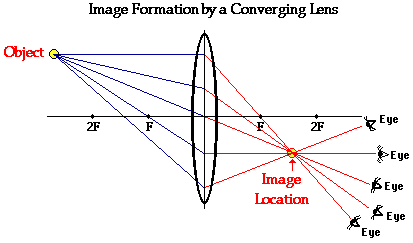

This image is...
real, Inverted and smaller
real, Inverted and larger
virtual, upright and smaller
virtual, upright and larger
When will total internal reflection occur?
When light travels from a less dense to a more dense medium
When the angle of incidence is smaller than the critical angle
When the angle of incidence is greater than the critical angle
When the light cannot pass through a medium

The above image is an example of a ____________. They happen because cool and hot air have a different ___________________________.
Mirage; angle of incidence
Optical fibre; refractive index
Lateral inversion; angle of reflection
Mirage; refractive index
Birds need to take REFRACTION into account when diving for fish in water because it makes the fish appear:
Invisible
Deeper than they are in reality
Bent
Shallower than they are in reality
When a laser beam is refracted as it passes from air into water, it is bent:
Towards the abnormal
Away from the normal
Away from the abnormal
Towards the normal

