wayground logo

Free Printable Worksheets

Font size

S
M
L
XL
Worksheets

Science Concept Review 5

Total questions: 30

Worksheet time: 30mins

Name
Class
Date
1.
The non-living factors in an ecosystem such as rocks, water and temperature.
a)
natural selection
b)
biotic
c)
biodiversity
d)
abiotic
2.
What type of heat transfer is A?
a)
convection
b)
radiation
c)
conduction
d)
heat
3.
Which of the following has the biggest impact on the seasons?
a)
Earth's rotation
b)
Tilted axis
c)
Moon's gravitational pull
d)
Pressure systems
4.

A student added white crystals to a clear liquid. The crystals dissolved in the liquid. After a few seconds, the liquid became quite warm and then turned bright red in color. The first indication that a chemical change was taking place could be observed when?

a)

The crystals were added to the liquid.

b)

The crystals dissolved in the liquid.

c)

The temperature of the liquid increased.

d)

The color of the mixture changed.

5.

A student added white crystals to a clear liquid. The crystals dissolved in the liquid. After a few seconds, the liquid became quite warm and then turned bright red in color. The first indication that a chemical change was taking place could be observed when?

a)

The crystals were added to the liquid.

b)

The crystals dissolved in the liquid.

c)

The temperature of the liquid increased.

d)

The color of the mixture changed.

6.
What might happen if you remove a primary consumer from the ecosystem?
a)
There would be more food for secondary consumers.
b)
The number of primary consumers would increase.
c)
The number of plants would increase.
d)
The number of secondary consumers would increase.
7.
The atoms along the staircase are called 
a)
metals
b)
nonmetals
c)
metalloids
d)
noble gases
8.
Element or compound?
H2O
a)
element
b)
compound
9.
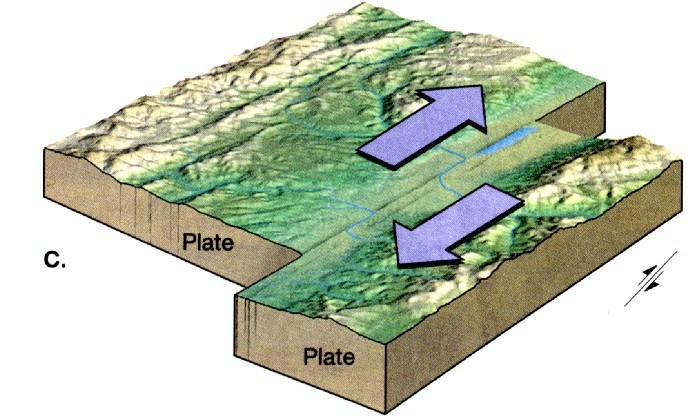
What type of plate boundary is this?
a)
Transform
b)
Convergent
c)
Divergent
d)
Plate
10.

Match the following organelle to the function: Nucleus

(MS-LS1-3)

a)

Manufactures proteins

b)

Power house of the cell

c)

Control center

d)

Storage area

11.
Mr. S set up an experiment to see how the mass of a ball affects the distance it rolls off a ramp. Identify the independent variable.
a)
Distance traveled by the ball
b)
Height of the ramp
c)
Mass of the ball
12.
Mr. S set up an experiment to see how the mass of a ball affects the distance it rolls off a ramp. What is the dependent variable?
a)
Distance traveled by the ball
b)
Height of the ramp
c)
Mass of the ball
13.
Mr. S set up an experiment to see how the mass of a ball affects the distance it rolls off a ramp. What is the controlled variable?
a)
Distance traveled by the ball
b)
Height of the ramp
c)
Mass of the ball
14.

A student draws the model shown in the picture. Which of these best compares the conditions at Location X and Location Y?

a)

It is day at Location X and night at Location Y.

b)

It is winter at Location X and summer at Location Y.

c)

There are more hours of daylight at Location X than at Location Y.

d)

The moon is brighter when viewed from Location X than when viewed from Location Y.

15.

Which of these locations on Earth experiences the least change in the number of daylight hours throughout the year?

a)

Equator

b)

North Pole

c)

Tropic of Cancer

d)

Tropic of Capricorn

16.

Rotate

a)

an invisible line around which an object spins.

b)

to turn around a center point or axis.

c)

period of the year distinguished by special climatic conditions.

17.
Which of the following best describes the acceleration of an object
a)
A car maintains a constant speed
b)
A car is sitting still
c)
A car turns the corner
18.
What is the difference between the velocity and the speed of an object?
a)
Velocity is the change in distance over time, while speed is the change in velocity over time.
b)
Velocity has a direction associated with it, while speed has no specific direction.
c)
Velocity has no direction associated with it, while speed has a specific direction. 
d)
Velocity is the change in speed over time, while speed is the change in distance over time.
19.
Which way will the box in the picture accelerate? (Click on the question to see the picture more clearly!)
a)
Left
b)
Right
c)
Stay Stil
d)
Up and Down
20.

The amount of space matter takes up

a)

density

b)

texture

c)

mass

d)

volume

21.
Emily slid down the sliding board at the park. Where did Emily have the most potential energy?
a)
In the middle of the slide
b)
Near the bottom of the slide
c)
At the top of the slide
22.
Law of conservation states that matter CANNOT be _________ or _________
a)
created or destroyed
b)
invented or deconstructed
c)
transformed or transferred
d)
in or out
23.
What phase is illustrated here?
a)
1st Quarter
b)
Waning gibbous
c)
Waxing crescent
d)
New moon
24.

A population is...

a)

A group of one species in one area

b)

Multiple species that live in one area

c)

All of the living and nonliving things in an area

d)

None of these

25.
Which of the following statements is true for all living things (organisms)?
a)
All living things have organs
b)
All living things produce their own food through photosynthesis
c)
All living things are made of one or more cells
d)
All living things are made of more than one cell
26.

Age of ocean floor provides evidence for what process?

a)

seafloor spreading

b)

subduction

c)

hotspots

d)

all of the above

27.
Which of the following are NOT found in BOTH plant and animal cells?
a)
chloroplasts
b)
nuclei
c)
vacuoles
d)
mitochondria
28.
Lucy wanted to know if the tread on a bike tire would affect how fast a bike could go. What would be the Independent variable ( the manipulated variable) 
a)
How many times she conducts the experiment 
b)
How fast the bike will go
c)
The tread on the bike tire
d)
The type of road
29.

What sets an object into motion?

a)

Kinetic

b)

Potential

c)

Force

d)

Movement

30.

Light is a ____ that carries ____

a)

Wave, inertia

b)

Energy, wave

c)

Wave, energy

d)

Kinetic, potential