
 Worksheets
SOL Review: Modules 6-7 (Classification & Populations)
Total questions: 16
Worksheet time: 10mins
Which of the following are found in extreme conditions? (Deep ocean vents, high salinity, boiling springs, etc.)
Archaebacteria
Eubacteria
Cyanobacteria
Mycobacteria
Homologous structures are defined as anatomical structures originating from the same structure in ancestral form. Which of the following does the presence of homologous structures in vertebrates suggest?
All vertebrates developed at the same rate.
All vertebrates developed internally.
All vertebrates evolved from different animals.
All vertebrates have a common ancestor.
According to Darwin's theory on natural selection, the traits that survive and continue in future generations are –
caused by response to stress
made by environmental change
already present in the population
introduced by immigrating species
Survival of the fittest can best be described as –
the process by which only the strongest of a species will be able to survive and reproduce
the process in which organisms that are better adapted to their environment will have a better chance of surviving and reproducing
the reason the strongest of the species will not be able to reproduce as often as others
the reason weaker organisms in a species will always be killed by predators
Which process results in greater genetic diversity in offspring?
genetic linkage
recombination of DNA during meiosis
crossing-over during mitosis
rearrangement of chromosomes in germ cells

Which list correctly identifies characteristics that protists share with animals?
F
G
H
J
A scientific name consists of
Genus and Order
Genus and Domain
Genus and Species
Kingdom and Phylum
The 8 levels of classification, most broad to most specific.
Genus, Family, Order, Domain, Class, Phylum, Kingdom, Species
Species, Kingdom, Genus, Phylum, Family, Class, Order, Domain
Domain, Kingdom, Phylum, Class, Order, Family, Genus, Species
Order, Kingdom, Domain, Species, Phylum, Family, Class, Genus
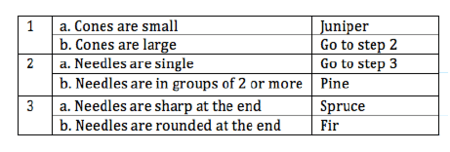
A dichotomous key for trees is provided.
Hikers found a tree that has large brown cones and single sharp needles.
What species of tree have the hikers found?
Juniper
Pine
Spruce
Fir

The table indicates the number of amino acids that differ in the amino-acid sequence of the hemoglobin from selected organisms when compared to human hemoglobin. On the basis of this information, which organism would be classified as most closely related to humans?
dog
macaque
frog
lamprey

The information in the table supports which conclusion?
frogs, monkeys, and sea anemones are classified into different kingdoms
sea anemones are more complex than frogs or monkeys
sea anemones and monkeys are adapted to similar environments
frogs are more closely related to monkeys than sea anemones

The different species of Hawaiian honeycreepers shown all descended from a single species of North American bird. They now have different beaks, eat different foods, sing different songs, and live in different environments on the islands. Which factor probably contributed most to the development of these different species?
loss of habitat
geographic isolation
egg size
predation
Under a microscope, a series of cells are observed that lack membrane-bound internal organelles. Which of these is the most likely cell type?
prokaryotic cell
eukaryotic cell
plant cell
animal cell
Fungi, such as mushrooms and molds, get their nutrition primarily by
producing food by chemosynthesis
decomposing dead organic matter
preying on other organisms
parasitic relationships with plants
An important feature of modern classification systems is that they
can incorporate new scientific studies
can predict the discovery of a new species
apply only to the organisms that are alive today
group organisms that live in the same habitat

