
 Worksheets
Natural Resources
Total questions: 20
Worksheet time: 14mins
Natural resources are
renewable.
non-renewable.
things that occur naturally.
resources produced by humans from using living and non-living factors found in nature.
Which of the following is NOT a natural resource?
Oil
Natural Gas
Plastic
Water
Most natural resources are physical resources. Physical
resources are
things we can physically see and touch.
things we cannot physically see and touch.
things that we can only see.
things we can only touch.
Renewable resources
can be replenished.
cannot be replenished.
are limited.
are finite.
Which of the following is a renewable natural resource?
Plants
Nuclear
Gasoline
Electricity
Which group includes ALL renewable resources?
Coal, Plants, Water, Sun
Water, Wind, Sun, Plants
Minerals, Sun, Plants, Water
Oil, Water, Sun, Plants
Why is water a renewable resource?
It can be frozen into ice.
It evaporates into air.
It is constantly replaced.
It can change its state - gas, liquid and solid.
Which of the following can be a disadvantage of renewable resources?
They can be only available at certain times or in certain places.
They release a lot of CO2.
They will always be available.
They have a large carbon footprint.
Non-renewable resources
can be replenished.
cannot be replenished.
are not limited.
are infinite.
Which of the following is non-renewable natural resource?
Water
Trees
Solar
Coal
Which of the following natural resources are non-renewable?
Water
Animals
Nuclear
Wind
Fossil fuels are non-renewable because
they are used to produce heat.
they take a long time to form.
they can be found underground.
they are easy to replace.
What is a disadvantage of using non-renewable resources?
They have a large carbon footprint.
They can all be used up over time.
They can lead to global warming.
All of these.
What are the two most important positive effects of using our natural resources?
Global warming and climate change.
Pollution and Global Warming.
Climate change and Diseases.
Improvements in people’s daily lives and job creation.
What does sustainable use of resources mean?
Use as much of the resources as you can.
Only use the resources at home.
Using the resources you need but ensuring that future generations can also be able to use them too.
Using the resources you need even if there will be none for future use.
Which word do we use for “taking care of natural resources and not wasting them?”
Reservation
Conservation
Observation
Preservation
The Jones family cares about the environment. They run their dryer only when it is completely full. Which of the following BEST explains why they do this?
To save money.
To recycle water.
To reduce sewage.
To conserve electricity.
The three R's stand for:
Recycle, Reconstruct, Reuse
Reconstruct, Reduce, Rebuild
Reduce, Reuse, Recycle
Rebuild, Reuse, Recycle
Which of the following is NOT a way a person could conserve natural resources?
Recycling waste materials like plastic, glass, paper, and aluminium.
Limiting water use when showering, brushing teeth and doing dishes.
Using fruits and vegetables that are in season.
Hunting or eating endangered species such as shark.
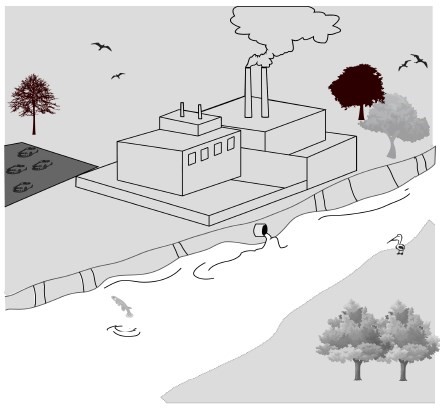
If the factory in this diagram was NOT practicing good environmental conservation, what effect would be produced?
air and water pollution.
good fishing for recreation.
plentiful animals in the river.
purified drinking water.

