
 Worksheets
Probability Unit test review A1
Total questions: 56
Worksheet time: 2hrs 58mins

Six friends are going to play a ball game. Each team has 3 players. How many different team combinations are possible?
120
6
18
20

Kimberly has seven colors of lanyards. She uses three different colors to make a key chain. How many different combinations can she choose?
210
5.040
6
35

In how many ways can a group of 4 boys be selected from 10 if the oldest boy is included in each group?
84
81
504
6

How many basketball games are played in a 10-team league if each team plays all other teams TWICE?
90
45
180
100

Which of the following is an example of combination?
Form a passcode with 4 digits
Students line up in a queue to assembly
Choose 4 students in a class committee
Choose the chairperson, secretary and treasurer in a club

Four people posing for pictures
Permutation
Combination
Picking 6 balls from a basket of 12 balls
Permutation
Combination

How would you solve?
A book club offers a choice of 8 books from a list of 40. In how many ways can a member make a collection?
Permutation
Combination
Factorial
MPC
Forming a committee of 5 members from 20 people
Permutation
Combination
Determining the top three winners in a Science Quiz Bee
Permutation
Combination
Selecting 5 basketball players out of 10 team members for the different positions
Permutation
Combination

Homecoming has 7 candidates for King. How many ways can a King and a First Runner-up be chosen to form the Festival Court?
23
840
42
3,628,800


A piggy bank contains 4 quarters, 18 dimes, 10 nickels, and 8 pennies. A coin is chosen at random, not replaced, then another is chosen. Find each probability.
P (penny, then dime).
1/8
9/100
6/65
17/195
A piggy bank contains 4 quarters, 18 dimes, 10 nickels, and 8 pennies. A coin is chosen at random, not replaced, then another is chosen. Find each probability.
P quarter, then nickel).
1/39
1/20
10/39
9/195
A piggy bank contains 4 quarters, 18 dimes, 10 nickels, and 8 pennies. A coin is chosen at random, not replaced, then another is chosen. Find each probability.
P (both dimes).
17/200
1/25
51/260
102/521
A piggy bank contains 4 quarters, 18 dimes, 10 nickels, and 8 pennies. A coin is chosen at random, not replaced, then another is chosen. Find each probability.
P ( worth at least 10 cents, then penny).
7/20
1/25
11/100
22/195
A piggy bank contains 4 quarters, 18 dimes, 10 nickels, and 8 pennies. A coin is chosen at random, not replaced, then another is chosen. Find each probability.
P ( silver coin, then penny).
32/195
18/195
0
1/25
Find the probability of each set of independent events.
drawing a black checker from a bag of 6 black checkers and 4 red checkers, replacing it, and drawing another black checker.
2/3
9/25
2/5
3/5
Find the probability of each set of independent events.
rolling a six on the first roll of a 1-6 number cube and rolling an odd number on the second roll of the same cube.
1/12
1/6
1/8
1/2
Find the probability of each set of independent events.
flipping a tail on a coin and spinning a 5 on a spinner with sections of equal area numbered 1-5.
1/2
1/7
1/5
1/10
Find the probability of each set of independent events.
drawing a 1,2, or 3 from 9 cards numbered 1-9, replacing the card, and drawing 7, 8, or 9.
1/3
1/9
3/8
1/12
A standard die is rolled twice. Find each probability.
P (odd both times)
1/2
1/4
2/3
1/9
A standard die is rolled twice. Find each probability.
P (both perfect squares)
1/2
1/4
2/3
1/9
A standard die is rolled twice. Find each probability.
P (even, then less than 5)
1/2
1/3
2/3
1/9
A standard die is rolled twice. Find each probability.
P (prime, then 6)
1/2
2/3
1/9
1/12
A jar contains 8 green, 4 blue, 10 red, and 2 yellow Skittles. A Skittle is randomly drawn, REPLACED, then another is drawn. Find each probability.
P (red, then yellow)
5/138
5/288
5/144
5/12
A jar contains 8 green, 4 blue, 10 red, and 2 yellow Skittles. A Skittle is randomly drawn, REPLACED, then another is drawn. Find each probability.
P (blue, then green)
1/18
1/12
2/3
1/24
A jar contains 8 green, 4 blue, 10 red, and 2 yellow Skittles. A Skittle is randomly drawn, REPLACED, then another is drawn. Find each probability.
P(both blue)
1/18
1/12
1/36
1/24
A jar contains 8 green, 4 blue, 10 red, and 2 yellow Skittles. A Skittle is randomly drawn, REPLACED, then another is drawn. Find each probability.
P(both red)
5/144
5/138
25/140
25/144
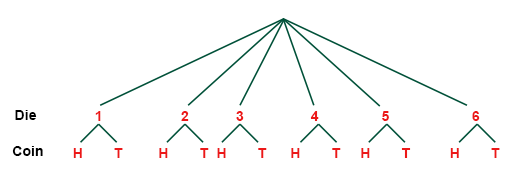
How many total outcomes are there?
A tree diagram is useful in determining the __________of a probability experiment.
result
possible outcomes
event
none of the above

What is the probability that you will get mushrooms on your pizza?
2/10
2
2/5
What type of probability is a way of estimating the probability of an event happening based on repeated trials?
Experimental Probabillity
Theoretical Probability
What type of probability is used to find the probability of an event when all outcomes are equally as likely. "What COULD happen"
Experimental Probability
Theoretical Probability
Jon made 15 out of 35 free throws.
What is his experimental probability as a fraction?
**SIMPLIFY THE FRACTION!**
3/7
15/35
1/2
5/7
Theoretically what is your chance of making a free throw?
Pick out your answer written as a percent.
25%
50%
75%
100%

Kate spun the spinner 75 times and landed on "3" thirty times.
What is the experimental probability as a percentage?
20%
30%
40%
50%

Theoretically, what is the probability that you will land on a 3?
25%
50%
75%
0%

Sarah hit the ball 3 times out of the 8 times.
What is the experimental probability (as a percent) that she will hit the ball next?
22.5%
37.5%
45%
3%

If the spinner was spun 50 times and landed on 11 fifteen times, which statement is true?
The experimental probability of landing on 11 is 1/8 while the theoretical probability of landing on 11 is 3/10
The theoretical probability of landing on 11 is 12.5% while the experimental probability of landing on 11 is 30%
The experimental probability of landing on 11 is less than the theoretical probability of landing on 11
The theoretical probability of landing on 11 is equal to the experimental probability of landing on 11
A cell phone company expects that every 2 out of 25 cell phones will have some form of defect. At this rate, how many cell phones out of 500 will be expected to have a defect?
35
40
4
12

If you draw out a red marble, keep it, then draw out a blue marble, is it independent or dependent probability?
Independent
Dependent

What is the P(blue)?
(leave answer in fraction form in lowest terms)
1/3
1/6
1/2
2/6

You roll a 6-sided number cube. What is the probability of rolling an even number three times in a row? (leave answer in fraction form in lowest terms)
3/100
1/8
1/6
1/2

