
 Worksheets
11.7 Review (Modeling)
Total questions: 67
Worksheet time: 5hrs 56mins
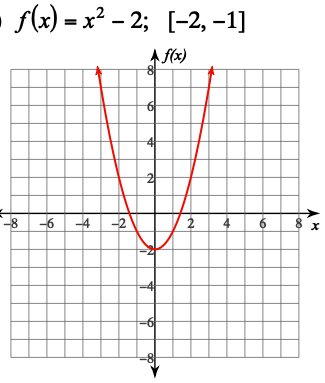
Use the given function or the graph to find the average rate of change
3
-3
3/2
-1/3

Use the given function or the graph to find the average rate of change
5
-1/5
-5
15

Use the given function or the graph to find the average rate of change
-1
1
1/2
2
What is the average rate of change of f(x) on the interval [-3, -2].


What is the average rate of change of f(x) on the interval [-3, -2].


Which of the following graphs or equations have an average rate of change of 2 from the x-values 0 to 3? (check all that apply)
f(x)=x2+2x-3


f(x)=x3-7x-1

Which of the following graphs has the largest average rate of change from -1 to 2?


Which of the following graphs has the largest average rate of change from -1 to 2?
Find the average rate of change of f(x)=2x2+3x-1 from 1 to 2.
18
-9
9
3

The table below shows the snowfall in a north-eastern city in inches for the first week in January.
Find the average rate of change in the number of inches of snowfall from January 8 to January 11.
2/3 in.
2 in.
3 in.
6 in.

Calculate the average rate of change from 20 to 40 minutes.
-2 minutes per gallon
-20 minutes per gallon
-2 gallons per minute
-20 gallons per minute


What is the solution?


Solve using substitution:
y = -6x + 5
-2x + y = 5
(-3, -6)
(-6, 3)
(0, 5)
(-3, 5)
Solve with substitution
x = -3y - 8
x - 2y = -3
(5, -1)
(-5, 1)
(-5,-1)
(1,-5)
Solve with substitution:
y = -2x + 18
y = 8
(5, 8)
(-5, 8)
(2, 8)
(-2, 8)
-2x + 6y = 16
-4x - 3y = 2
4x + 8y = 20
-4x + 2y = -30
You can solve systems using these methods:
graphing, substitution, and elimination
rearranging, thinking, and guessing
only by graphing
7x+y=-9
-3x-y=5
y = 2/3x - 2
y = -x + 3
3x + 2y = 16
7x + y = 19
8x + 4y = 12
y = -2x + 3
5x - y = 16
2m - n = 8
(solve for x)
12x - 4y = 20 , for y
x = w / a
pV = nRT
solve for R
R= p/n + V/T
R= pV - nT
R= (pV-n)/T
R=pV/nT
ax - b = c+d
pV = nRT
solve for n
n= pV/RT
n= p/R + V/T
n= pV - RT
n= (pV-R)/T

Solve for p
A = 21pa
A−21a = p
a2A=p
2aA=p
2A−a = p
Solve for p
SA =hp + 2B
hSA−2B=p
hSA−2B=p
2BSA−h=p
SA−2B−h=p
Solve for h
V = lwh
V −l−w = h
V−lw = h
lwV= h
V−wl=h
Solve for r:
LA = 2πrh
LA−2πh = r
2πhLA= r
2LA−πh = r
πh2LA= r
Solve for h:
V = 31πr2h
πr23V=h
31V −πr2=h
3V − πr2=h
31Vπr2=h
Solve for h:
SA = 2πr2+2πrh
2πr2+2πrSA=h
2πr2SA−2πr=h
2πrSA−2πr2=h
SA − 2πr2πr2= h
Solve for c:
c = −ax2−bx
c = ax2+bx
c=bxax2
c=ax2−bx
Solve for p:
SA = 21lp +B
l2SA−B= p
l2SA−B = p
2lSA−B=p
l2(SA−B)=p
Solve for x:
m =2x+y
2m−y=x
y2m=x
2m−y=x
2(m−y)=x


Decreasing Interval
Increasing Interval
Constant Interval


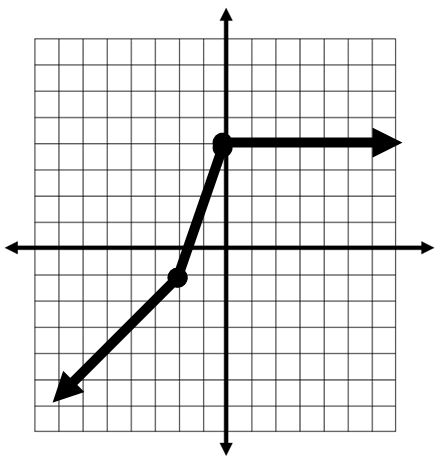
What is the RANGE of the function?
All real numbers
y ≤ 4
y < 4
0 ≤ y ≤ 4


Find f(0)
-3
18
4
0

Match the graph with the correct equation.


Find f(2)
f(2) = 0
f(2) = 1
f(2) = 3
f(2) = 4

A house painter charges $12 per hour for the first 40 hours he works, $18 for the ten hours after that, and $24 for all hours after that.
How much does he earn for a 70 hour week?
$1020
$1140
$840
He works for free!

