wayground logo

Free Printable Worksheets

NEW

Font size

S
M
L
XL
Worksheets

Biology Validation

Total questions: 44

Worksheet time: 29mins

Name
Class
Date
1.

What is the dependent variable in the scientific method?

a)

Something you measure

b)

something you keep the same

c)

Something you purposely change

d)

Something that you look at

2.
A series of steps used by scientists to solve a problem or answer a question. 
a)
scientific method
b)
recipe
c)
data collection
d)
metric system
3.
A testable explanation to a problem that has not yet been tested. 
a)
data
b)
theory
c)
hypothesis
d)
fact
4.
Testing a hypothesis often involves a(n):
a)
answer
b)
experiment
c)
problem
d)
safety check
5.

What is the first step in the scientific method?

a)

Data

b)

Conclusion

c)

No Horse Play

d)

Observe a problem

6.
This is the group that we will compare our experimental group to. This group stays "normal."
a)
Control Group
b)
Experimental Group
c)
 Normal Group
d)
Weird Group
7.

The name of the information that you get from your experiment (you organize it into tables).

a)

observations

conclusion

b)

data

c)

variables

d)

hypothesis

8.
Should experiments be repeated over and over to see if the results are the same each time?
a)
yes
b)
no
9.
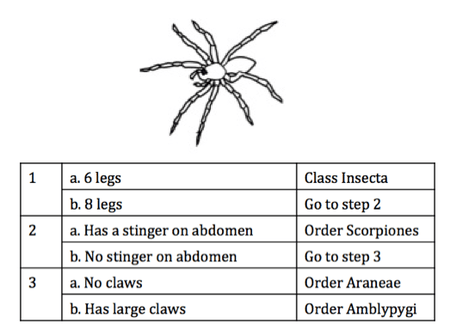
An illustration and a dichotomous key are given. What is the correct classification for this organism?
a)
Class Insecta
b)
Order Amblygygi
c)
Order Araneae
d)
Order Scorpiones
10.
A table of arachnid and insect characteristics is shown. Which characteristic could be used to distinguish between
arachnids and insects?
a)
Jointed legs
b)
Body segments
c)
Presence of eyes
d)
Presence of antennae
11.
When using a dichotomous key to identify organisms, what do we look at?
a)
physical features
b)
weather patterns
c)
environment
d)
diet
12.
What is a dichotomous key used for in science?
a)
To organize biomes
b)
Classify organisms
c)
Identify bacteria only
d)
None of these
13.
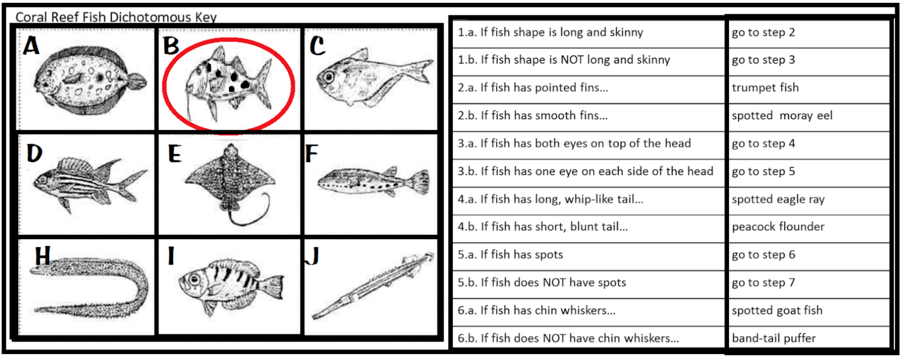
Using this dichotomous key, identity the name of the circled fish.
a)
band-tail puffer
b)
spotted goat fish
c)
peacock flounder
d)
trumpet fish
14.
Using this dichotomous key, identify the name of the circled Fish, J.
a)
peacock flounder
b)
band-tail puffer
c)
trumpet fish
d)
spotted goat fish
15.

the largest classification category

a)

Kindgom

b)

Phylum

c)

Order

d)

Species

16.

the smallest, most specific classification category

a)

Genus

b)

Phylum

c)

Order

d)

Species

17.

Subdivision of a kingdom

a)

Genus

b)

Phylum

c)

Order

d)

Species

18.

Subdivision of a class

a)

Genus

b)

Phylum

c)

Order

d)

Species

19.

Which of the following is the correct order from broadest to smallest?

a)

Kingdom, Class, Order, Family, Genus, Species, Phylum

b)

Species, Genus, Family, Order, Class, Phylum, Kingdom

c)

Kingdom, Phylum, Order, Class, Family, Genus, Species

d)

Kingdom, Phylum, Class, Order, Family, Genus, Species

20.

What two levels make up a scientific name?

a)

genus and order

b)

genus and species

c)

domain and kingdom

d)

family and genus

21.

The 5 kingdoms are Animals, Plants, Fungi, Bacteria and

a)

Pokemon

b)

Archaea

c)

Humans

d)

Protists

22.

Which of these has a backbone?

a)

jellyfish

b)

squid

c)

worm

d)

snake

23.

All living things are made of

a)

cells

b)

prokaryotes

c)

autotrophs

d)

heterotrophs

24.

Which of these is a fungus?

a)

bacteria

b)

mushroom

c)

algae

d)

seaweed

25.
Who is the closest relative to the birds?
a)
crocodiles
b)
sharks
c)
fish
d)
amphibians
26.
Who is the closest relative to the sharks?
a)
crocodiles
b)
sharks
c)
ray-finned fish
d)
amphibians
27.

Which of the following organisms is a vertebrate?

a)

insect

b)

sponge

c)

monkey

d)

earthworm

28.

Which vertebrate is ectothermic (cold-blooded)?

a)

cat

b)

chicken

c)

human

d)

lizard

29.

Which term describes an animal without a

backbone?

a)

chordate

b)

invertebrate

c)

protozoan

d)

vertebrate

30.

Fish, amphibians, reptiles, birds and mammals all

belong to which group?

a)

vertebrate

b)

invertebrate

c)

bacteria

d)

vertebrate and invertebrate

31.

An animal's qualities are listed below:

ANIMAL'S QUALITIES

● Moist skin

● Has four legs

● Lays eggs

● Breathes with lungs and gills

● Cold blooded


What type of animal is described in the box?

a)

amphibian

b)

fish

c)

mammal

d)

reptile

e)

bird

32.

What trait do all mammals share?

a)

walk upright

b)

have an opposable thumb

c)

have large brains

d)

nurse their young with milk

33.

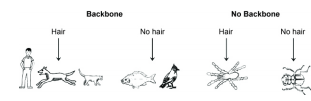
According to the classification key above, which pair of animals could be classified as mammals?

a)

humans and dogs

b)

birds and fish

c)

birds and fish

d)

cats and birds

34.
What type of animal spends its entire life under water, has fins, and breathes using gills
a)
amphibian
b)
fish
c)
bird
d)
reptile
35.
What type of animal has dry scaly skin and lays its eggs on land?
a)
fish
b)
amphibian
c)
reptile
d)
mammal
36.
What is the only type of animal that has feathers?
a)
bird
b)
mammal
c)
amphibian
d)
reptiles
37.
Which type of animal goes through a metamorphosis (body change)? 
a)
bird
b)
mammal
c)
reptile
d)
amphibian
38.
What classification of animals are  vertebrae (have a backbone)?
a)
birds only
b)
reptiles only
c)
reptiles and birds but not mammals and fish
d)
mammals, fish, reptiles, amphibians, and birds
39.
Which animal is warm blooded?
a)
reptiles
b)
fish
c)
mammals 
d)
amphibians
40.
Cold blooded animals
a)
Make their own heat
b)
Are the temperature of their surroundings
c)
Have blue blood
d)
Are a type of plant
41.
This is a 
a)
bird
b)
fish
c)
mammal
d)
reptile
42.
This is a 
a)
Reptile
b)
Fish
c)
Mammal
d)
Amphibian
43.
This is a 
a)
Reptile
b)
Fish
c)
Mammal
d)
Amphibian
44.
This is a 
a)
Reptile
b)
Bird
c)
Mammal
d)
Fish