
 Worksheets
BIG QUIZIZZ ALL ERRYTHING
Total questions: 87
Worksheet time: 4hrs 26mins
Question1 ) Let f(x) = x + 14
and
g(x) = 3x + 7
What is f(g(x)) = ?
(3x + 7) + 14
3(x + 14) + 7
3x +x + 14 +7
2x −7
Question 2) Given f(x)= -3x+7 and g(x)=2x2 - 8, find f(g(x)).
f(g(x))= -6x2+31
f(g(x))= -6x2+24
f(g(x))=18x2-84x+6
f(g(x))=9x2-42x-1
Question 3) Given f(x)= -3x+7 and g(x)=2x2 - 8, find g(f(x)).
g(f(x))= -6x2+31
g(f(x))= -6x2+24
g(f(x))=18x2-84x+90
g(f(x))=9x2-42x-41
Question 2) What does it mean to find the inverse of a function?
the x's and y's are switched
the x's and y's are divided by 2
the x's and y's are made negative
the x's and y's are the same
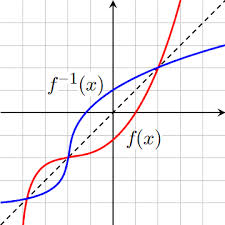
Question 2) The inverse has been reflected over which line?
y = x
x = 0
y = 0
x = -y

Question 2)
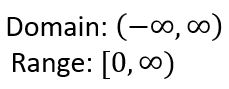
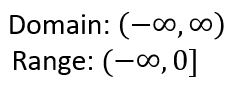
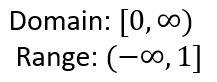

Question 2)
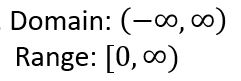
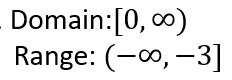
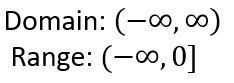
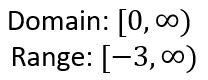
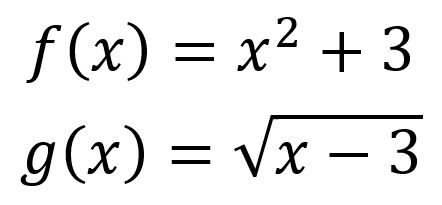
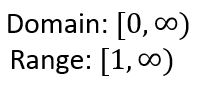
Question 2) How must the domain of f(x) be restricted such that g(x)=f-1(x) ?
x ≤ 0
x ≥ 0
x ≤ 3
x ≥ 3
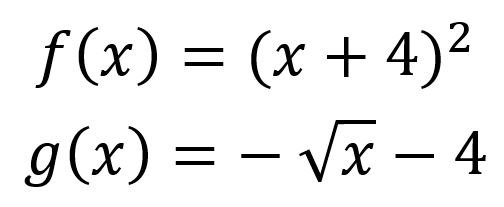
Question 2) How must the domain of f(x) be restricted such that g(x)=f-1(x) ?
x ≤ -4
x ≥ -4
x ≤ 0
x ≥ 0
Question 3) Describe the transformation of y = f(x) for the new function
f(x) = ⅔(x - 7)2
Shrink of ⅔
Right 7
Shrink of ⅔
Left 7
Stretch of ⅔
Right 7
Stretch of ⅔
Left 7
Question 3) What are the transformations?
y=3(x-4)2?
horz shift right 4, vert stretch by a factor of 3
horz shift left 4, vert stretch by a factor of 3
horz shift right 4, vert stretch by a factor of 1/3
horz shift right 4, vert shift up 3
Question 3) Describe the transformation of y = f(x) for the new function
f(x) = 5x2 + 2
Stretch of 5
Up 2
Shrink of 5
Up 2
Stretch of 5
Down 2
Shrink of 5
Down 2
Question 3) The original function has equation f(x). State the transformations given the new function f(x) = ⅔(x - 7)2
Vertical Shrink of ⅔
Right 7
Horizontal Shrink of ⅔
Left 7
Left ⅔
Vertical stretch of 7
Right ⅔
Horizontal stretch of 7
Question 3) If the original function is f(x) then state the transformation that takes f(x) to g(x) = |-x + 3|
Reflect over y-axis
Left 3
Reflect over y-axis
Right 3
Reflect over x-axis
Left 3
Reflect over x-axis
Right 3
Question 3) Describe the transformations that maps
y = g(x) to y = - g(x + 6) - 10
Reflect over y-axis
Shifted down 10 units
Shifted left 6 units
Reflect over x-axis
Shifted up 10 units
Shifted left 6 units
Reflect over y-axis
Shifted up 10 units
Shifted right 6 units
Reflect over x-axis
Shifted down 10 units
Shifted left 6 units
Problem #4: y=−x3−9x2−24x−22
What is the relative maximum of this graph?
(−4,−6)
(−2,−2)
(−5.2,0)
(−∞,∞)
Problem #4: y=−x3−9x2−24x−22
What is the zero(s) of this graph?
(−4,0)
(−2,0)
(−5.2,0)
(−∞,∞)
Problem 4: y=−x3−9x2−24x−22
What is the Domain and Range of this graph of this graph? (Select all that apply)
Domain (−∞,∞)
Range [−2,∞)
Domain (−∞,0]
Range (−∞,∞)
Problem #4: y=−3x2−7x+4
What is the Domain and Range of this graph of this graph? (Select all that apply)
Domain (−∞,∞)
Domain [8,∞)
Range (−∞,8]
Range (−∞,∞)
Problem #4: y=−3x2−7x+4
During which interval is the graph increasing?
(−∞,−1.2)
(1.2,∞)
Problem #4: y=−x3+3x2−5
During which intervals is the graph decreasing?
(0,2)
(−∞,0)
(2,∞)
(−∞,∞)
Problem #4: y=x4−4
What is the domain of the graph?
(−∞,0)
(0,∞)
(−∞,∞)
[−4,∞)
Problem 4Decide if (x-3) is a factor of 3x3+10x2-x-12
Yes, it is a factor!
No, it is not a factor!

Problem 4
Is (x-3) a factor of
(x3 - 3x2 + 2x + 2)?
Yes
No
Problem 4
Find all the factors of x3 -3x2 -4x +12 given that -2 is a zero.
(x-2) (x+2) (x+3)
(x-2) (x-2) (x+3)
(x+2) (x+2) (x+3)
(x-2) (x+2) (x-3)
Problem #5
Expand the expression using the Binomial Theorem.
(2x+5)4
2x4 + 40x3 + 300x2 + 1000x +625
16x4 + 160x3 +600x2 +1000x + 625
16x4 + 1000x3 + 600x2 + 160x +625
Problem #5
Expand the expression using the Binomial Theorem.
(2x+5)4
2x4 + 40x3 + 300x2 + 1000x +625
16x4 + 160x3 +600x2 +1000x + 625
16x4 + 1000x3 + 600x2 + 160x +625

Problem #6
A
B
C
D

Problem #6 What is the conjugate you would multiply by?
5+2i
5-2i
-5-2i
-5+2i
(−3−7i)(−8−4i) Problem 6) For this problem, what is the number we would use to simplify this division problem?
-8 + 4i
8 - 4i
3+7i
-3 +7i

Problem #6
A
B
C
D

Problem #6
A
B
C
D

Question 11) Divide the Rational Expression
A
B
C
D

Question 11) Divide the Rational Expression
A
B
C
D

Question 10) Simplify the expression.


Question 10) What value(s) make the expression undefined?
x = - 3 and x = 4
x = 3 and x = - 4
x = 3 only
x = - 4 only

Question 10
(x+2)/(6x2)
(3x+4)/(6x2)
(3x+8)/(6x2)
(3x+2)/(6x2)

Question 10)
A
B
C
D
Question 9 What is the definition of an ASYMPTOTE?
A curved line.
A line that only touches the origin.
A line that only lives on the first quadrant.
A line that a curve approaches, as it heads towards infinity.
Question 9 The equation of a vertical asymptote is written in the form:
x=
y=
none of the above
Question 9 Which of the following is determined by just looking at the denominator?
vertical asymptote
horizontal asymptote
holes
slant asymptote
Question 9 Find the vertical asymptote.
x=-5
x=1/2
x=-1/2
x=-3
x=2
Question 9 Does this function have any vertical asymptotes? If so, what are their equations? y=(x−4)(x+3)(x−4)(x+7)
No vertical asymptotes.
One vertical asymptote: x = 4
Two vertical asymptotes: x = -3 and x = -7
Three vertical asymptotes: x = -3, x = 4, and x = -7
Question 9 The holes of a rational function occur when :
my pencil pokes a hole in the paper I'm working on
there is something left in the denominator
the value of f(0)
a factor in the denominator cancels with a factor in the numerator
Question 9 f(x)=(x−3)(x−5)(x+7)(x−3)(x+1)
Select all of the true statements.
A hole occurs where x=3
vertical asymptote at x=3
vertical asymptote at x=5
A hole occurs where x=5

Question 9 Where are the discontinuities?
holes: (5, 5)
asymptotes: x=3
holes: (3, 0)
asymptotes: x=5
holes: (-5, 5/4)
asymptotes: x=-3
holes: (5, 0)
asymptotes: x=-3

Question 9 Where are the discontinuities?
holes: (-3,, 1)
asymptotes: x=-1
holes: none
asymptotes: x=-1
holes: (-1, 0)
asymptotes: x=-3
holes: (-1, 2)
asymptotes: none
Question 8) TRUE OR FALSE? If f is continuous on [-1,1], f(-1)=4 and f(1)= -2, then there is a zero between -1 and 1.
TRUE
FALSE
CANNOT BE DETERMINED
Question 8) TRUE OR FALSE? If f(x) = |x+1|/(x+1), then there is a zero on the interval [-2,0].
TRUE because there is a sign change on the interval
FALSE because there is no sign change on the interval
TRUE because of the Intermediate Value Theorem
FALSE because the function is discontinuous on the interval
Question 8) Given the function f(x) = x3 + x - 3, which of the intervals below contains a zero?
[-1,1]
[0,1]
[1,2]
None of these intervals
Question 8) Given the function g(x) = 2x4 - x3 + 8/x which of the intervals must contain a zero?
[-1,1]
[0,2]
[2,4]
None of these intervals

Question 8) TRUE OR FALSE? There is a zero on the interval [1,3].
True because the function is continuous and there is a sign change on the interval [1,3]
We cannot be certain since the function is not continuous on the interval [1,3]
False because there is no sign change on the interval [1,3]
False because the graph is not continuous on the interval [1,3]
Question 8) Let f be a function that is continuous on the closed interval [2,4] with f(2) = 10 and f(4) = 20. Which of the following is guaranteed by the Intermediate Value Theorem?
f(x) = 13 has at least one solution in the open interval (2,4)
f(3) = 15
f attains a maximum on the open interval (2,4)
f(x) = 10 at some other value(s) of x other than x = 2
Question 7) How many zeros does the following function have?
f(x)= x5 - 3x3 + x
8
9
5
3
Question 7) The degree of the polynomial determines the number of roots.
True
False
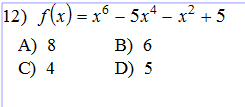
Question 7) Use the Fundamental Theorem of Algebra to state the number of zeros/solutions/roots of the polynomial.
A
B
C
D
Question 7) Find the roots of 0=x3-4x2+2x-8
±2,4
±2i,4
±i√2,4
±√2,4

Question 24) What is the correct ratio?
sin 40 = w/28
cos 40 = w/28
tan 40 = w/28
sin 40 = 28/w

Question 24) Susan is flying a kite, which gets caught in the top of a tree. Use the diagram to estimate the height of the tree.
63 ft
65 ft
74 ft
87 ft

(Question 24) A yacht is anchored 90 feet offshore from the base of a lighthouse. The angle of elevation from the boat to the top of the lighthouse is 26 degrees. The distance between the yacht and the top of the lighthouse is about 100 feet. Which of these is nearest to the height of the lighthouse?
25 feet
45 feet
110 feet
135 feet

(Question 24) A hawk sitting on a tree branch spots a mouse on the ground 15 feet from the base of the tree. The hawk swoops down toward the mouse at an angle of 30 degrees. What is the distance from the tree branch to the mouse?
7.5 ft
15 ft
26 ft
30 ft
Question 23) Which of the following is equivalent to tan (A−B)
tan A − tan B
1+ tanAtanBtan A −tan B
1− tanAtanBtan A +tan B
cos Bsin A
question 23) Which of the following is equivalent to cos(α−β) ?
cosαcosβ+sinαsinβ
cosαcosβ−sinαsinB
cosαsinβ+sinαcosβ
cosαsinβ−sinαcosβ
(Question 23) Which of the following is not a step in proving that
Prove cos (x-pi/2) = sin (x)
cos(x)cos(pi/2)+sin(x)(sinpi/2)
cos(x)*0+sin(x)*1
sin(x)
cos(x)cos(pi/2)-sin(x)(sinpi/2)
(Question 22) Solve equation for 0≤θ<2π .
−2+cotθ=−3
θ=43π,34π,47π
θ=43π,47π
θ=3π,34π
θ=43π,34π
(Question 22) Solve equation for 0≤θ<2π .
−1−2sec2θ=−3sec2θ
θ=0,π,34π
θ=0
θ=4π,43π,45π,47π
θ=0,π
(Question 22) Solve equation for 0≤θ<2π .
1+tan2θ=4tan2θ
θ=6π,65π,67π,611π
θ=3π,32π,34π,35π
θ=6π,67π
θ=6π,65π,67π
(Question 22) Solve equation for 0≤θ<2π .
1+tan2θ=4tan2θ
θ=6π,65π,67π,611π
θ=3π,32π,34π,35π
θ=6π,67π
θ=6π,65π,67π
(Question 22) Solve equation for 0≤θ<2π .
3sin2θ+4=5+sin2θ
θ=4π,45π,47π
θ=4π,47π
θ=4π,43π
θ=4π,43π,45π,47π
(Question 21) Solve on the Interval [0,2π)
tan(x)+1=2
0 and π
3π/4 and 7π/4
π/4 and 5π/4
3π/4 and 5π/4

(Question 20) The daily temperature in the month of March in a certain city varies from a low of 24°F to a high of 40°F. The temperature reaches the freezing point 32°F at noon and midnight.
Find a sinusoidal function to model daily temperature. Let t=0 correspond to noon.
y=8cos(12πx)+32
y=8sin(12πx)+32
y=8sin(6πx)+32
y=−8cos(6πx)+32
(Question 20) The hour hand of the large clock on the wall in Union Station measures 24 inches in length.
At noon, the tip of the hour hand is 30 inches from the ceiling. At 3 PM, the tip is 54 inches from the ceiling, and at 6 PM, 78 inches. At 9 PM, it is again 54 inches from the ceiling, and so forth.
Let y equal the distance from the tip of the hour hand to the ceiling and x be the number of hours after noon.
Find the equation that models the motion of the hour hand.
y=30cos(6πx)+54
y=30sin(6πx)+54
y=24sin(6πx)+54
Question 19) sin(x)=.3, what is sin(−x)?
.3, because the function is even.
-.3, because the function is even.
-.3, because the function is odd.
-.3, because the function is odd.
Question 19) If cos(x)=.5, what is cos(−x)?
0.5, because the function is even.
-0.5, because the function is even.
0.5, because the function is odd.
-0.5, because the function is odd.
Question 19) Simplify the expression to either 1 or -1
sin(x)csc(-x)
1
-1
(Question 18) Find the value of tan θ given the point
(8, −17)−17917
1309130
−17817
−817
(question 18) Find the value of cos θ given the point
(5, 11)11611
56
511
65
Question 17. sin(611π)
21
−21
23
−23
1
-1
22
2−2
Question 17 tan(π)
0
1
-1
Undefined
Question 17) sin(47π)
1
-1
22
2−2
Question 17 cos(67π)
23
−23
21
−21
Question 17.) What is the location of a point on a unit circle at 30 degrees? Hint (cosx,sinx)
sqrt(3)/2, 1/2
1/2, sqrt(3)/2
0,1
sqrt(2)/2, sqrt(2)/2
(Question 16) Convert 4π/ 3 radians in degrees
120
240
210
270
(Question 16) Convert 7π/ 6 radians into degrees
225
210
270
240
(Question 16) For a unit circle the arc length of the entire circle (aka circumference) is equal to 2pi
True
False

