
 Worksheets
Chemistry Unit Review
Total questions: 30
Worksheet time: 35mins
Each electron has a _________________ electrical charge
Positive
Negative
Neutral
Shocking
An element is determined by the number of ___________________ (also known as its atomic number).
Neutrons
Electrons
Protons
Wontons

In a neutral atom the amount of electrons is electron is equal to
When an atom gains electrons, it has a ________ net charge.
positive
negative
neutral

Which elements are to the right of the zig zag?
metals
nonmetals
metalloids
Which of these are properties of non-metals
brittle
shiny
conduct electricity
malleable
don't conduct electricity
You have a red substance that looks uniform, has a nice smell, and you cannot identify crystals with the naked eye, however, when you boil the substance, the liquid part evaporates and a red solid remains on the pot. Your substance is most likely a:
Pure substance
Homogeneous Mixture
Heterogeneous Mixture
Which of these properties can you use to tell an element apart from a mixture?
Elements can only be broken down by force.
Elements can only be broken down into something smaller by chemical reactions.
elements cannot react with other elements
Ionic or covalent?
NaBr
Ionic
Covalent
Ionic or covalent?
O2
Ionic
Covalent
Ionic or covalent?
CaCl2
Ionic
Covalent

Which of these diagrams represents the formation of a covalent bond?


Which characteristic of a substance is considered a chemical property?
its boiling point
its ability to oxidize (combine with oxygen)
its magnetism
its conductivity
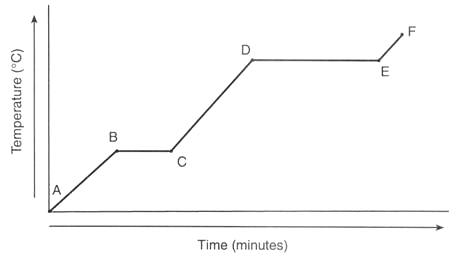
What is happening to the particles in the substance between points D and E?
Melting
Freezing
Vaporizing (boiling)

If you are given 30 g of ice, wood (oak), ethanol, and gold. Which one would have a larger volume?
ice
wood (oak)
ethanol
Gold
An object has a mass of 125 g and a volume of 100 mL. Will the object sink or float in water?
Sink
Float
Which of the following is NOT an indicatoor that a chemical change took place?
Change in color
Change in temperature
Formation of a gray Gas
Formation of water vapor
In a reaction A + B ----> C, reactant A has 10g and product C has 21g. How many grams should reactant B have?
11g
5g
9g
14g

According to the pH range which substance is more acidic than lemon juice
Hydrochloric acid
cabbage
milk of magnesia


Identify the following substance.
Element
Compound
Mixture
Diatomic Molecule

Identify the following substance
Element
Compound
Mixture
Diatomic Molecule

Which chemical equation supports the law of conservation of mass?
Equation (a)
Equation (b)
Equation (c)
Equation (d)

Which of the following equations is balanced?
Equation (a)
Equation (b)
Equation (c)
Equation (d)

Observe the reaction shown here. The formula for this equation is N2 + H2 → NH3 . What do you observe about the atoms of hydrogen in this reaction?
There are 2 atoms of hydrogen in the reactants and only 1 in the products. This violates the Law of Conservation of Mass.
There are 2 atoms of hydrogen in the reactants and 3 in the products. This violates the Law of Conservation of Mass.
There are 2 atoms of hydrogen in the reactants and 2 in the products. This is in line with the Law of Conservation of Mass.

