
 Worksheets
Semester Review - Spring 2021
Total questions: 248
Worksheet time: 11hrs 54mins
(x - 9)(x - 7)
What is the GCF of 12x3 - 18x?
3x
6x
2x2
6x2
Factor.
-9w5 + 21w3
-3(3w5 - 7w3)
3w2(-3w3 + 7w)
3w5(-3w + 7w2)
-3w3(3w2 - 7)
x2 + 5x + 4
2x2 - 7x - 4
x2 - 8x + 15
(x2 + 17x+42) ft2.
If its width is (x + 3) ft.
What is its length?
Factor completely.
x3 - 6x2 - 16x
( Note: Factor out GCF = x first.)
x ( x2 - 6x - 16 )
x ( x - 8 ) ( x + 2 )
x ( x - 8 ) ( x - 2 )
x ( x + 8 ) ( x - 2 )
Completely factor:
Answer with NO spaces
(a)
Completely factor:
Answer with NO spaces
(a)
(2x2 + 5x - 7) + ( 3 - 4x2 + 6x)
(3- 2x + 2x2) - (4x -5 +3x2)
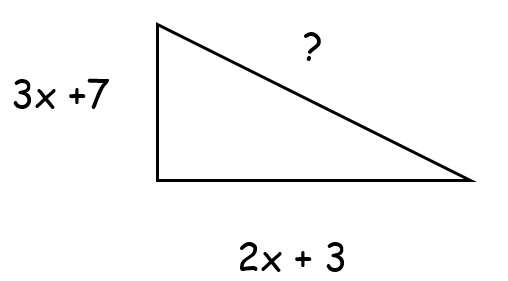
triangle is 10x+20. Find the length of the missing side


-3x2( 7x2 - x + 4)
-8 (5b + 2) -7 (b - 5)


(9x2 + 6x) ÷ 3x


(24x + 4) / (6x+1)
2x2
4x3 + 2
4x2 - 21x + 5
2x3
3x4 + 4x + 1
P(x)=3x4-7x2-2x7-x+4


How many terms are in this polynomial?
2x3 - 8x2 + 3x - 7
7
1
4
2
What is the constant of this polynomial?
2x3 - 8x2 + 3x - 7
2
-8
3
-7
What is the coefficient of this term?
9x3
None
9
3
x
(6x + 9) / (3x)
(9x2 + 6) / (3x)


Express the following in Interval Notation
-8 ≤ x < 8
[-8, 8]
[-8,8)
(-8, 8]
(-8, 8)
(8, -8]
Write the following in interval notation
-7 ≤ x < 8
(-7, 8)
[-7, 8)
[-7, 8]
(-7, 8]
(8, -7]
x < 8
Write the following in interval notation
x < 3 or x ≥ 5
(3, -∞) U (∞, 5]
[-∞, 3) U [5, ∞]
(-∞, 3) U [5, ∞)
(3, -∞] U [∞, 5]
(3, -∞] U [5, ∞]


What is the range of the graph?
[-7, 5)
(-3, 1]
[-3, 1)
(-7, 5]

What is the range?
[0, ∞)
(−∞, ∞)
None of the answer choices

What is the domain?
[-2, 3]
[-2, 3)
(-2, 3]
[-3, 4]
(-3, 4]
What is the range?
[-3, 4]
(-3, 4)
(-3, 4]
(-2, 3]
[4, -3]

What is the domain?
(−∞, −3]
[3, −∞)
(−∞,3]
(−∞,∞)
None of the answer choices
What is the range?
(−∞, −3]
[3, −∞)
(−∞,3]
None of the answer choices
[−3, ∞)

What is the domain?
(a)
What is the range?
(a)

What is the domain?
(∞,−2]
[−2, ∞)
[-2,3]
(−∞, −2]
None of the answer choices
What is the domain?
(∞, −2]
[−2, ∞)
(-2, 3)
[-2, 3]
None of the answer choices

What is the domain?
(-8, 4]
(-8,-3) U [-1, 4]
[-8,-3) U [-1, 4]
(-8,-4] U [-1, 4]
(-2, 6]
What is the range?
(-2, 6] U[1,4]
(-8, 2] U (3, 6]
(-8,-3) U [-1, 4]
(-2, 6]
None of the answer choices
Which of the following is NOT a quadratic function
f(x) = -3x2
f(x) = -5x - x2
y = 3x3 - 4x + 5
A=πr2
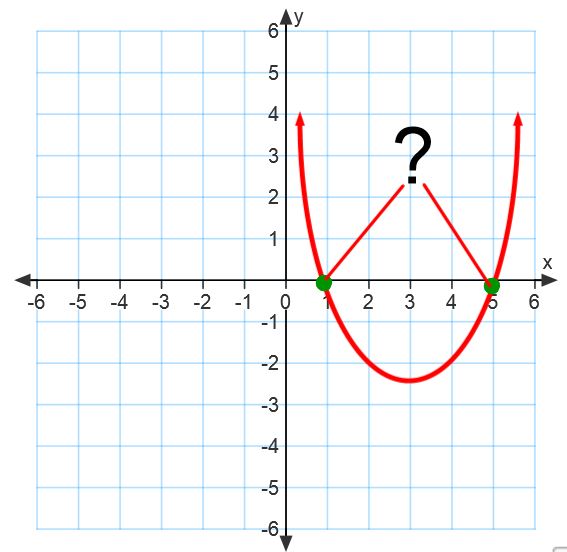
What are the green dots called? [check ALL that apply]
zeros
vertex
parabola
roots
x-intercepts

What is the equation for axis of symmetry?
(a)
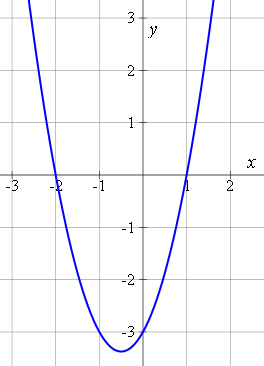
a, b, and c for
the quadratic equation:
4x2 – 8x = 3
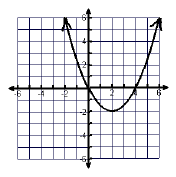
The formula x = -b/2a is used to find, [check ALL true answers]
the roots
the x-value of the vertex
the y-intercept
the axis of symmetry
the zeros
y = x2 - 6x + 11?
Y = -3x2 +7x - 2
The equation
y = x2 -12x + 36 has
no solutions
1 solution
2 solutions
3 solutions
more than 3 solutions
x2 + x - 6 = 0
What is the factored form of this curve?
f(x)=21(x)(x−4)
f(x)=21(x)(x+4)
f(x)=(x)(x−4)
f(x)=(x)(x+4)
Choose the correct factors for the following trinomial. x2+2x−8
x + 6
x + 4
x - 2
x - 10
Which of the following is NOT a zero of the polynomial 2x2−2x−12 ? Select all that apply.
-3
3
-1
-2
0

Match the graph above with it's equation.
−(x−4)(x+2)
−(x+1)2+9
2(x−1)2−8
(x+1)(x−3)
2x2+4x−6

Match the graph above with it's equation.
−(x−4)(x+2)
−(x+1)2+9
2(x−1)2−8
(x+1)(x−3)
2x2+4x−6

Match the graph above with it's equation.
−(x−4)(x+2)
−(x+1)2+9
2(x−1)2−8
(x+1)(x−3)
2x2+4x−6

Which of the following equations matches vertex form of a quadratic?
ax + by = c
y = a(x - h)2 + k
y = ax2 + bx + c
y = mx + b
4m2 - 100 = 0

What is the significance of the ordered pair (0, -2) to the graph?
It is the vertex
It is an x-intercept
It is the y-intercept
It is the axis of symmetry
What is the significance of the ordered pair (2, -4) to the graph?
It is the vertex
It is an x-intercept
It is the y-intercept
It is the axis of symmetry
Determine the domain and range of the function
Domain: All real numbers, Range: All real numbers
Domain: x ≥ -4, Range: All real numbers
Domain: All real numbers, Range: y ≥ -4
Domain: -1 ≤ x ≤ 5, Range: y ≥ -4

What is the equation of the axis of symmetry?
(a)
(x+7)(x−3)=0 After writing this equation in standard form, what is the value of b ?
-7
3
4
10
Solve the following equation
x2=64
32
±8
±9
8


√6 ⋅√6
Simplify the radical - 10√20
5√20
-20√5
4√5
40√5
Simplify:
√72
√72
2√2
6√2
4√18
√100
√200
3√16


SImplify:
5√6
25√6
√150
10√15

Simplify:
12√90
√10
2√10
(2√5)/2

A
B
C
D


5x610x
x32x
x32
x52
None of these.
Simplify:
230
103
22
120
Simplify:
62⋅514
327
607
27
307
Simplify:
520
525
51
4
2
Simplify:
6⋅6
36
23
12
6
Simplify:
56⋅618
63
663
26
1803
Simplify:
−210⋅320
−602
102
−630
−6200

Simplify
42
4
22
82
2121248
12
64
124
24
624
18
4
4
2
2200
10
10
100
100
3147
7
7
49
49
Which is the simplest form of 245 ?
210
1020
4410

Simplify the radical expression


a polynomial containing two unlike terms. (e.g., 2x + 6 or a - b).
(a)

The highest exponent value of any of its terms, e.g.
a + b ... degree 1
a2 + b ... degree 2
a3 + b ... degree 3
(a)

The variable's exponent, also called the 'order'.
(a)

A term whose variable's degree is one.
(a)

An expression that contains one term which may be
a number, a variable or a product of numbers and
variables, with no negative or fractional exponents.
(a)

A binomial that is multiplied by itself. (i.e. (a + b)2)
(a)

an expression that is a monomial or the sum of monomials.
(a)

An expression where the high degree is 2. Also called a quadratic expression.
(a)
An expression where the high degree is 2. Also called a quadratic expression.
(a)

a polynomial containing three unlike terms. (e.g., x + y - 3 or x2 - 2x + 1)
(a)
A + B = B + A
Associative Property
Commutative Property
Distributive Property
Reflexive Property
Symmetric Property
A + (B + C) = (A + B) + C
Associative Property
Commutative Property
Distributive Property
Reflexive Property
Symmetric Property
A(B + C) = AB + AC
Associative Property
Commutative Property
Distributive Property
Reflexive Property
Symmetric Property
A = A
Associative Property
Commutative Property
Distributive Property
Reflexive Property
Symmetric Property
If A = B, then B = A.
Associative Property
Commutative Property
Distributive Property
Reflexive Property
Symmetric Property
AB = BA
Associative Property
Commutative Property
Distributive Property
Reflexive Property
Symmetric Property
(AB)C = A(BC)
Associative Property
Commutative Property
Distributive Property
Reflexive Property
Symmetric Property
1 times x = ?
0
1
x
O Pato
0 times x = ?
0
1
x
O Pato
x divided by x = ?
0
1
x
O Pato

A line that a curve approaches, as it heads towards infinity.
(a)
A polynomial with two terms.
(a)
A special relationship where each input has a single output and all points are connected.
(a)
A special relationship where each input has a single output and the points are not connected, like a scatterplot.
(a)
All the values that go into a function. [inputs]
(a)
The process of reducing an amount by a consistent percentage rate over a period of time.
(a)
The process of increasing an amount by a consistent percentage rate over a period of time.
(a)
A special relationship where the base is a constant and the independent variable is the exponent.
(a)
Lines parallel to the x-axis that the graph of the function approaches as x tends to +∞ or −∞.
(a)
This compares two values, showing if one is less than, greater than, or simply not equal to another value.
(a)
A point at which a function's value is greatest.
(a)
A point at which a function's value is least.
(a)
The simplest form of a given family of functions.
(a)
A second degree expression with a single input and an equal sign.
(a)
Where the highest exponent of the variable (usually "x") is a square (2).
(a)
All the values that come out of a function. [outputs]
(a)
These are equidistant from the axis of symmetry in a quadratic function.
(a)
A polynomial with three terms.
(a)
Points on the graph where y = 0, also know as a zeros or roots.
(a)
Points on the graph where y = 0, also know as a x-intercepts or roots.
(a)
These are points on the graph of a function where x = 0.
(a)

The result of computing a non-perfect square in the calculator.
(a)

A root of the whole number that has an irrational value.
(Ex. The n in n .)
(a)

An equation of degree 2, such as
x2−2x+1
(a)

The result of simplifying a radical to its lowest form, like
18=32
(a)

A root of the whole number that has an irrational value.
(Ex. The n in n .)
(a)

The result of reducing a number to a product of prime numbers.
(a)
A number is a value that, when multiplied by itself, gives the number.
(a)
An expression that uses a root, such as square root, cube root.
(a)
The value inside a radical.
(a)
An equational where the variable is in the exponent.
(a)
A value that can be expressed as a fraction with integers.
(a)
A first degree equation which forms a straight line.
(a)
a special value that, when used in a multiplication three times, gives that number.
(a)
A fixed vale that does not change.
(a)
A number that has a rational square root.
Like 25=5
(a)
The number to the left of a variable,
like the 4 in 4x.
(a)
A number which can only be divided by itself and 1.
(a)
A number which can not be expression as a fraction and has decimal vales that do not repeat or terminate.
(a)
To reduce a value, term or equation to its most basic form.
(a)



