

wayground logo

Free Printable Worksheets

Font size

S
M
L
XL
Worksheets

Alchemy Chapter 3 Review

Total questions: 46

Worksheet time: 3570secs

Name
Class
Date
1.

Which of these determines the identity of an atom?

a)

proton

b)

neutron

c)

valence electron

d)

protons and neutrons

2.

How do you determine how many Neutrons an atom has?

a)

Protons + Valence Electrons

b)

Atomic Mass - Atomic Number

c)

Atomic Mass + Atomic Number

d)

Protons + Electrons

3.

_______ are atoms with the same number of protons but varying numbers of neutrons.

a)

ions

b)

elements

c)

allotropes

d)

isotopes

4.
What is the atomic number for an element with three protons?
a)
2
b)
1
c)
3
d)
6
5.
If an atom has 12 positively charged subatomic particles, which of the following must it also have to be considered a neutral atom?
a)
12 neutrons
b)
12 electrons
c)
12 protons
d)
24 protons and neutrons
6.
What is the mass number?
a)
The average atomic mass
b)
the number of protons and neutrons in the nucleus
c)
the number of protons in the nucleus
d)
the number of protons and electrons in the nucleus
7.

How many neutrons are in the given atom?

a)

92

b)

143

c)

235

d)

327

8.

What is the mass number of bromine?

a)

35

b)

45

c)

80

d)

79.904

9.

How many electrons does this magnesium ion have?

a)

24

b)

12

c)

10

d)

14

10.

If aluminum loses 3 electrons, what will the charge be?

a)

+

b)

-

c)

+3

d)

-3

11.

An ion is:

a)

An atom that has gained or lost electrons

b)

An atom that has gained or lost neutrons

c)

An atom that has gained or lost protons

d)

An atom that is neutrally charged

12.
Can an atom of Hydrogen have 2 protons?
a)
Yes, because it can be an ion
b)
No, because protons identify the atom
c)
Yes, because it can be an isotope
d)
No, because only neutral atoms exist
13.

JJ Thomson discovered what subatomic particle

a)

nucleus

b)

neutron

c)

proton

d)

electron

14.

Rutherford discovered what part of the atom

a)

nucleus

b)

neutron

c)

proton

d)

electron

15.

First person to propose the concept of an atom

a)

Rutherford

b)

Democritus

c)

Dalton

d)

Bohr

16.

Who proposed the theory that atoms orbit the nucleus in specific orbits.

a)

Bohr

b)

Democritus

c)

Rutherford

d)

Chadwick

17.

These particles are found in the nucleus

a)

protons and electrons

b)

nucleus and neutrons

c)

protons and neutrons

d)

electrons and neutrons

18.

Which of the following shows the correct order of Atomic Theory Timeline

a)

Rutherford, Bohr, Dalton, Democritus, Thomson

b)

Bohr, Democritus, Thomson, Rutherford, Dalton

c)

Dalton, Thomson, Rutherford, Bohr, Democritus

d)

Democritus, Dalton, Thomson, Rutherford, Bohr

19.
Subatomic particles with a positive charge
a)
neutrons
b)
atomic mass
c)
protons
d)
isotopes
20.
Subatomic particles that are neutral in charge
a)
Neutrons
b)
Protons
c)
Nucleus 
d)
Electrons
21.

Subatomic particles with a negative charge

a)

Electrons

b)

Neutrons

c)

Protons

d)

Quarks

22.
A tiny but very dense, positively charged portion of the atom that holds most of the atomic mass
a)
Electron Shells
b)
Orbitals
c)
Electron Cloud
d)
Nucleus
23.

John Dalton stated:

a)

Atoms are tiny, invisible particles.

b)

Atoms of one element are all the same.

c)

Atoms of different elements are different.

d)

Compounds form by combining atoms.

e)

All of the statements listed.

24.
If X is the symbol for an element, which of the following two symbols represent    isotopes of the same element?  
I. 7735X  II. 7733X  III. 8137X  IV. 8135 X
a)
I and II
b)
III and IV
c)
I and IV
d)
I and III
25.
An isotope has three forms.  30% have a mass of 4 amu, 20% have a mass of 5 amu and 50% have a mass of 3 amu.  Average atomic mass will be closest to
a)
2 amu
b)
3 amu
c)
4 amu
d)
5 amu
26.
How many protons does P-30 have?
a)
30
b)
16
c)
12
d)
15
27.
How many neutrons does the isotope of lithium have?
a)
8
b)
3
c)
4
d)
5
28.

Nuclear reactions involve changes to the nucleus of an atom. This includes

a)

protons

b)

electrons

c)

neutrons

29.
Which type of nuclear radiation is being emitted here?
a)
alpha
b)
beta
c)
gamma
d)
none
30.
24.1% of all the isotopes of a an element have a mass of 75.23 amu, 48.7% have a mass of 74.61 amu, and 27.2% have a mass of 75.20 amu.
What is the average mass of this element?
a)
74.92 amu
b)
24.97 amu
c)
75.01 amu
d)
74.51 amu
31.

Calculate how much Po-214 is left after 0.003 seconds?

a)

5 grams

b)

2.5 grams

c)

1.25 grams

32.

this reaction is an example of

a)

alpha decay

b)

beta decay

33.

How is the alpha particle written in a nuclear equation?

a)

42He

b)

24He

c)

0-1e

d)

00γ

34.
Solve this equation for alpha decay.
85209At = ___ + 24He
a)
83205Bi
b)
86209Rn
c)
81207Tl
d)
85208At
35.

Gamma rays have

a)

no mass

b)

a huge mass

c)

a small mass

d)

an average mass

36.

What is the half-life of a radioactive isotope?

a)

The time taken for the daughter nuclei to increase

b)

The time taken for the nucleus to decay

c)

The time taken for half the parent nuclei to decay
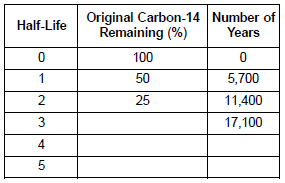
37.

After 22,800 years, approximately what percentage of the original carbon-14 remains?

a)

15%

b)

12.5%

c)

6.25%

d)

3.125%

38.

Which of these is an example of gamma decay?

a)

Reaction A

b)

Reaction B

c)

Reaction C

d)

None of these

39.

After an atom undergoes beta decay, how has the atomic number (number of protons) changed?

a)

doesn't change

b)

-1

c)

+1

d)

+2

40.

In this diagram, uranium-235 undergoes five steps of radioactive decay, eventually becoming radium-223.

What type of decay occurs at the first and last steps?

a)

alpha decay

b)

beta decay

c)

gamma decay

d)

None of these

41.
Solve this equation for beta decay.
6027Co = ___ + 0-1e
a)
5625Mn
b)
6028Ni
c)
5823V
d)
5927Co
42.
Identify the missing substance in each of the following nuclear reactions.
 _____→137 56 Ba + 0 −1
a)
13755Ba
b)
13757La
c)
13856Ba
d)
137 55Cs
43.
Which of the following nuclear emissions has the greatest penetrating power?
a)
alpha
b)
gamma
c)
beta
d)
positron
44.
Oxygen-16 undergoes positron emmission to form what daughter isotope and decay particle?
a)
167N + e+
b)
178O + e+
c)
166O + e+
d)
157N + e+
45.
The process of the production of lighter nuclei from heavier nuclei is called
a)
mass energy
b)
magneticism
c)
fusion
d)
fission
46.
What is the missing isotope that will balance the following nuclear equation?
94Be  +  11H →  _____  +  42He
a)
105B
b)
105Ne
c)
63Li
d)
63C
