
 Worksheets
Physics Unit 9 - Thermal Physics
Total questions: 25
Worksheet time: 23mins
All materials have minimum internal energy at
Absolute zero
Zero degree Celcius
Zero degree Farahiet
100 K
If there is no transfer of energy between two objects then their Temperature is
Same
Different
Zero
Infinite
The SI unit for measuring heat is the
Pascal
Kelvin
Joule
Calorie
When one end of a cold metal spoon is placed upright in a cup of hot coffee, the other end gets hotter. Which one of the following best describes what is happening?
Warmer molecules will rise to the top.
The hot molecules produce thermal radiation that is then absorbed by the colder molecules.
Higher-energy molecules hit lower-energy molecules, increasing their speed and therefore their temperature.
Lower-energy molecules hit higher-energy molecules and the friction increases their temperature.

Which type of heat transfer is shown?
convection
conduction
radiation
stir frying

You are sitting 2 m away from this camp fire and you feel your body absorbing thermal energy from the fire. What type of heat transfer are you experiencing?
convection
conduction
radiation
bonfire

What type of heat transfer is occurring inside the liquid water shown in this picture?
convection
conduction
radiation
boiling water

The specific heat of platinum is 133 J/kgK. How much heat is released when a 0.0255 kg piece of platinum cools from 100.0°C to 30.0°C? Your answer must include correct units and significant digits.
(a)
0.020 kg of water is placed in a jar and left standing. Since the water temperature changes from 25.0°C to 20.0°C, how much heat energy moves from the water to the surroundings? The specific heat of liquid water is 4180 J/kgK. Your answer must include correct units and significant digits.
(a)
Select the state changes that latent heat of fusion applies to.
melting
evaporating
freezing
condensing
sublimation
Select the state changes that latent heat of vaporisation applies to.
melting
evaporating
freezing
condensing
sublimation
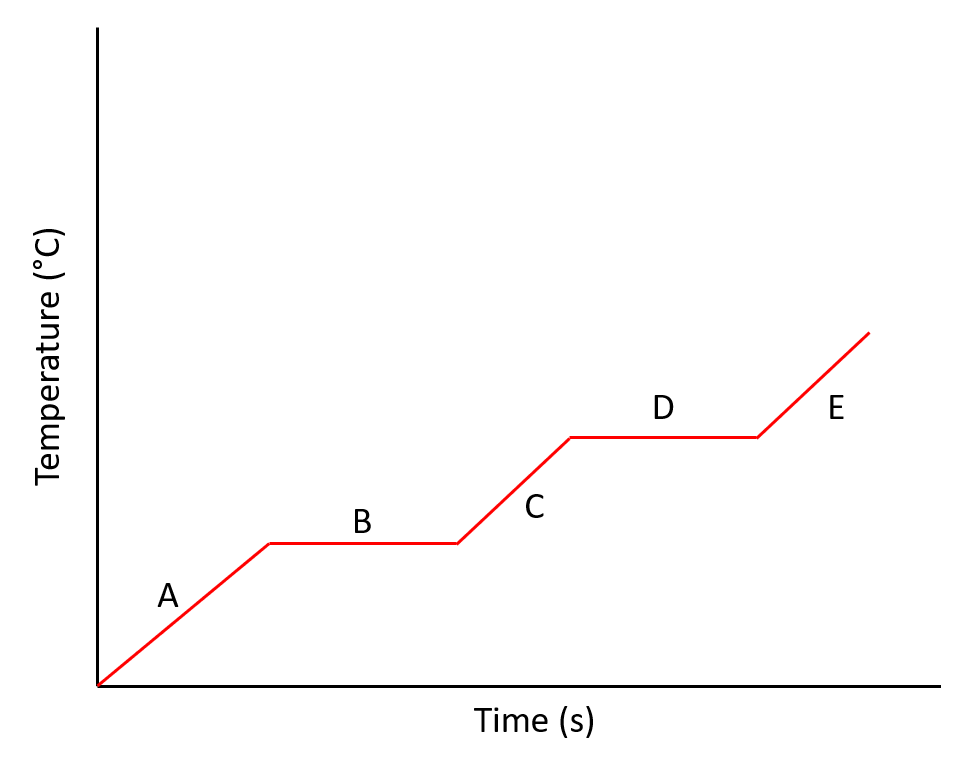
The diagram shows a heating curve for ice. Which line represents the ice melting?
A
B
C
D
E
Why are lines B and D flat?
The ice is melting
The ice is freezing
All of the thermal energy is used to break the bonds
They stopped the stopwatch
They stopped heating the ice.

The diagram shows a cooling curve for ice. Which line represents the ice in a liquid state (water)?
A
B
C
D
E
The diagram shows a cooling curve for ice. Which line represents the ice freezing?
A
B
C
D
E
The diagram shows a cooling curve for ice. Which line represents the ice in a solid form?
A
B
C
D
E

