
 Worksheets
Mechanical Waves
Total questions: 20
Worksheet time: 18mins
Name
Class
Date
1.
What unit is used to measure frequency?
a)
centimeters (cm)
b)
meters (m)
c)
hertz (Hz)
d)
miles per hour
2.
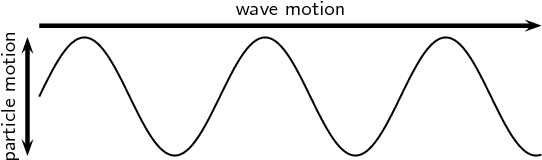
What kind of wave is pictured below?
a)
compressional wave
b)
transverse wave
c)
sound wave
d)
mechanical wave
3.
Waves are a transfer of what?
a)
Heat
b)
Light
c)
Energy
d)
Food
4.
Amplitude reflects the amount of ____________________ in a wave.
a)
energy
b)
compression
c)
rarefaction
d)
speed
5.
The highest point on a wave is:
a)
the crest
b)
the trough
c)
the top
d)
the coast
6.
The lowest point on a wave is the:
a)
Amplitude
b)
Crest
c)
Trough
d)
Wavelength
7.
The number of wavelengths that pass a point each per second is:
a)
frequency
b)
period
c)
longitudinal
d)
transverse wave
8.
The type of waves that require medium to pass:
a)
Mechanical Waves
b)
Electromagnetic Waves
9.
When the frequency of a wave increases, what happens to the wavelength?
a)
The wavelength is not directly affected by the frequency of a wave.
b)
The wavelength increases.
c)
The wavelength decreases.
d)
More specific information is needed to form a conclusion about the wavelength.
10.
A wave in which the particles of the medium vibrate parallel to the direction of the wave motion
a)
A. mechanical wave
b)
B. surface wave
c)
C. longitudinal wave
d)
D. wave
11.
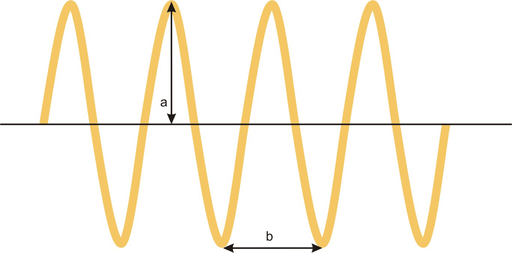
How many waves are in this wave chain?
a)
6
b)
3
c)
4
d)
5
12.
What is the resulting direction of a surface wave?
a)
parallel
b)
circular
c)
opposite
d)
perpendicular
13.

This is a _____ wave.
a)
surface
b)
longitudinal
c)
transverse
14.

The distance between two corresponding parts of a wave is the ____.
a)
crest
b)
trough
c)
amplitude
d)
wavelength
15.
Which of the following is NOT a mechanical wave?
a)
surface wave
b)
electromagnetic wave
c)
transverse wave
d)
longitudinal wave
16.

The part of a longitudinal wave where the particles are close together.
a)
amplitude
b)
compression
c)
frequency
d)
rarefaction
17.
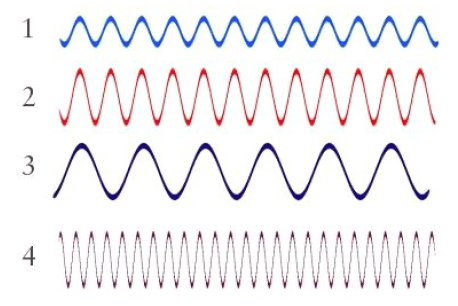
Which wave in the diagram has the greatest wavelength?
a)
1
b)
2
c)
3
d)
4
18.
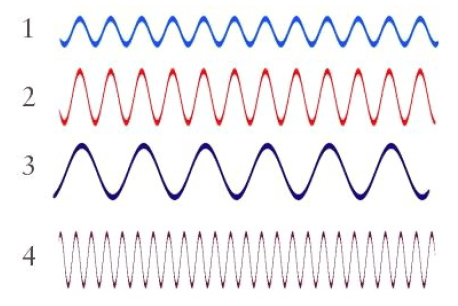
Which wave in the diagram has the greatest frequency?
a)
1
b)
2
c)
3
d)
4
19.
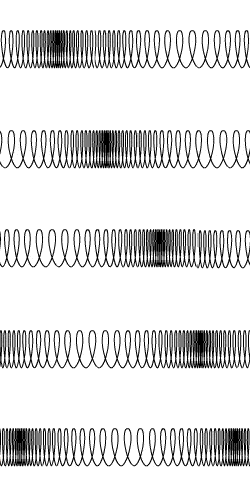
What type of wave is this?
a)
Longitudinal
b)
Transverse
20.
The matter (solid, liquid, or gas) through which mechanical waves travel.
a)
medium
b)
vibration
c)
disturbance
d)
energy
100 %

