
 Worksheets
Heat
Total questions: 24
Worksheet time: 26mins
Name
Class
Date
1.
Heat transfers from ______ objects to cold objects.
a)
Cold
b)
Hot
c)
Convection
d)
Radiation
2.
What type of heat transfer happens in liquids and gases?
a)
Conduction
b)
Convection
c)
Radiation
3.
Touching hot sand is....
a)
Conduction
b)
Convection
c)
Radiation
4.
Hot air ______ while cool air ____
a)
Sinks, Rises
b)
Rises, Rises
c)
Rises, Sinks
d)
Convection, Radiation
5.
A heat lamp on a reptile cage is what type of heat transfer?
a)
Conduction
b)
Convection
c)
Radiation
6.
Hot air rising from a campfire is...
a)
Conduction
b)
Convection
c)
Radiation
7.
Boiling water is an example of what two types of heat transfer
a)
Conduction and Radiation
b)
Conduction and Convection
c)
Radiation and Convection
8.
what is the meaning of convection?
a)
cold rises heat falls
b)
heat
c)
cold
d)
hot rises cold falls
9.

It is cooler outside than inside of my house. Is an example for which concept?
a)
Thermal Energy
b)
Heat
c)
Temperature
10.

My hands feel warm because
a)
The temperature is cold outside
b)
The molecules are moving
c)
The heat is transferring
11.
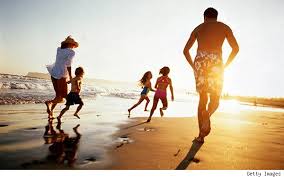
The sun shines down on this family as the play on the beach.
a)
conduction
b)
convection
c)
radiation
12.

A group of friends gather around a fire to stay warm.
a)
conduction
b)
convection
c)
radiation
13.
What is the definition of CONDUCTION?
a)
When heat is transferred from objects like rays of light or electromagnetically.
b)
a hot liquid or air that expands, becomes less dense, and rises or becomes more dense, and sinks.
c)
When heat transfers from objects that are touching.
d)
When heat transfers through the heater or AC in your house.
14.
What is the definition of CONVECTION
a)
When heat transfers through waves.
b)
When heat transfers from objects that are touching.
c)
a hot liquid or air that expands, becomes less dense, and rises or becomes more dense, and sinks.
d)
Heat traveling from the sun
15.
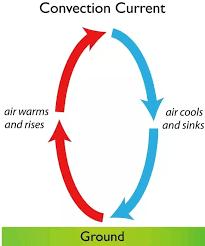
Which of the following is an example of convection?
a)
A hair dryer is drying up your hair.
b)
When the AC or heater changes the temperature.
c)
When a car engine turns hot after being turned on.
d)
When you are making soup and the water is rising and lowering.
16.
During a land breeze which way does the wind blow?
a)
from the sea to the land
b)
from the land to the sea
17.
Do sea breezes typically happen during the day or night?
a)
Day
b)
Night
18.
How does the air move in a sea breeze?
a)
wind moves from north to south
b)
wind moves from ocean to the land
c)
wind moves from the land to the ocean
d)
wind moves from south to north
19.
In a sea breeze, the air is warmer above the _____.
a)
land
b)
ocean
c)
sky
d)
beach
20.
When warm air rises, ______ pressure forms at the surface of the land or sea.
a)
high
b)
some
c)
low
d)
none
21.

Land breeze and sea breezes are caused by the different _________ between land and water surfaces.
a)
rotations
b)
temperatures
c)
gases
d)
solids
22.
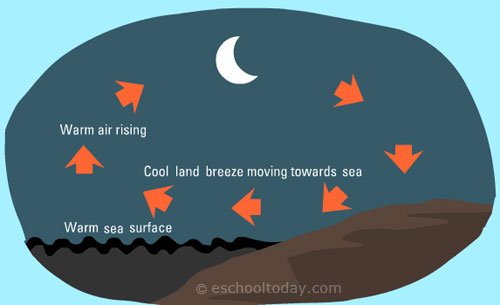
Is this a land or a sea breeze?
a)
land breeze
b)
sea breeze
23.
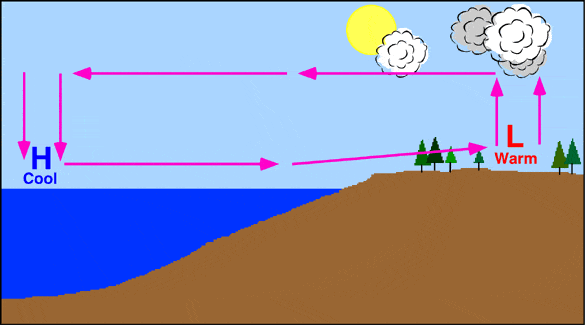
Is this a land or a sea breeze?
a)
land breeze
b)
sea breeze
24.

What is the main cause of winds?
a)
amount of trees
b)
the moon's gravity
c)
amount of animals
d)
uneven heating of Earth's surface
100 %

