
 Worksheets
compounds and mixture
Total questions: 112
Worksheet time: 1hrs 10mins


True or False: Each part of a mixture keeps its properties when mixed.
True
False
True or False: Mixtures can be separated by physical processes.
True
False
In which mixture can you see all of the parts?
homogeneous
heterogeneous
In which mixture can you not see all of the parts?
homogeneous
heterogeneous


What is a mixture in which all the parts are EVENLY mixed?
energy
beaker
solution
salad

Which of the following is a solution?
geletin with blueberries
granola
juice
salad

Which of the following is a solution?
lemonade
trail mix
legos
iron filings and sand

A salad is an example of a __________.
homogenous mixture
solution
heterogeneous mixture
homogenous solution

What is known as the "universal solvent?"
water
acid
sugar
salt
What is the definition of a solvent?
The substance that is dissolved.
The substance in which the solute is dissolved.
Unable to be dissolved.

A combination of two or more substances.
mixtures
separate
solid
whisk
What is aluminum (Al)?
Element
Compound
Mixture
What is water (H2O)?
Element
Compound
Mixture
What is table salt (NaCl)?
Element
Compound
Mixture
What is soda?
Element
Compound
Mixture
What is salt water?
Element
Compound
Mixture
What is salad dressing?
Element
Compound
Mixture
What is sodium bicarbonate (NaHCO₃)?
Element
Compound
Mixture
What is iron?
Element
Mixture
Compound
What is air?
Element
Compound
Mixture
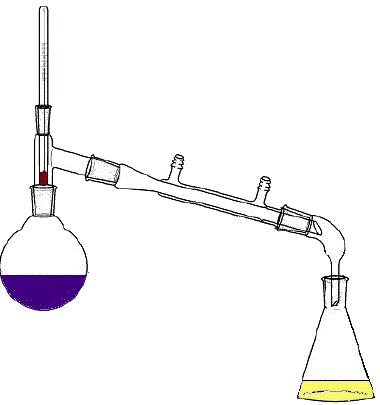

Name the method of separation
Fractional distillation
Chromatography
Condensation
Evaporation


This diagram represents...
An element
A molecule
A compound
A mixture of elements and compounds


What process is used to separate crude oil in hydrocarbons with different chain lengths?
distillation
fractional distillation
cracking
polymerisation
Fractional distillation separates crude oil based on the different __________ of the molecules in the mixture
melting point
boiling point
freezing point
chemical reactivity
Which of the following pairs of substances may best be separated through through fractional distillation
sand and soil
water and soil
salt and sand
water and alcohol

Label part 1
Thermometer
Fractionating column
condenser

Label 2
Thermometer
Fractionating column
condenser

Label 5
Water in
water out
condenser
fractionating column

Label 3
Beaker
Conical Flask
Boiling tube
rounded bottom flask

Ink can be separated by a method of -----------------------------------------------
distillation
filtration
chromatography
sedimentation
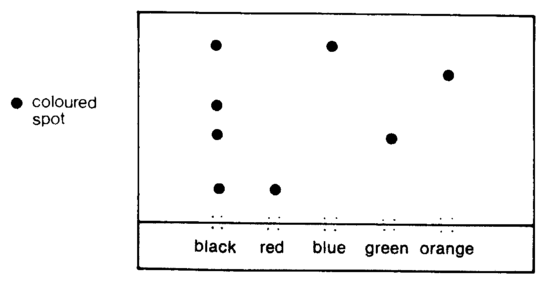
A pure substance shows ------------------ spot on chromatogram
0
1
2
3
A substance is soluble if it can be dissolved.
In paper chromatography, the most soluble solute _____________________ .
does not move from the start point
stays closest to the start point
travels furthest away from the start point
can be found in the middle of the chromatogram
What is the correct image of paper chromatography???


What is chromatography?
A way to see pretty colors
A laboratory technique used to separate a mixture.
A form of distillation
Two or more substances that are mixed together but not chemically combined create a...
solvent
compound
mixture
Which of the following mixture/s is/are separated by chromatography?
Pigments from natural colours
Colours in a dye
Colours of flowers extracts
All the above
In paper chromatography, the LEAST soluble solute ____.
does not move from the start point
stays closest to the start point
travels furthest away from the start point
can be found in the middle of the chromatogram

Blue loves water.
Yellow loves water.
Green loves water.
Which of the following techniques separates various coloured components of black-coloured ink?
Centrifugation
Chromatography
Evaporation
Distillation
Which of the following mixture/s is/are separated by chromatography?
Pigments from natural colours
Colours in a dye
Colours of flowers extracts
All the above
Which of the following is correct about chromatography?
It separates those solutes that dissolve in the same solvent.
It separates those solutes that dissolve in different solvents.
It separates a solute that dissolves in a solid solvent.
It separates gaseous solutes from liquid solvents.
Black dye separates into:
Yellow, red and green colour
Blue, red and yellow colour
Yellow and green colour
Red and yellow colour
Which of the following statements is correct?
The most soluble component remains near the bottom.
The most soluble component rises to the top.
The least soluble component remains near the bottom.
Both b and c
Which is the least soluble component in the case of green ink?
Blue
Yellow
Red
Pink
This is a type of mixture where one substance dissolves into another
Solution
Miscibility
Compound
Solubility
The substance that does the dissolving
Solute
Solvent
Solution
Miscibility


Identify the solute Lemonade - it contains Water, lemon juice, and sugar
water
lemon juice
sugar and lemon juice
In a sample of seawater, the solvent is:
water
sea
salt
air
Solutes that dissolve in water can be solids, liquids or gases
true
false
A common gas that we find dissolved in seawater is
krypton
neon
oxygen
carbon tetrachloride
If we heat a sample of water, then the amount of oxygen dissolved will increase
true
false

A common gas that we find dissolved in coca cola is
krypton
neon
oxygen
carbon dioxide

If I want more sugar to dissolve in water, I should stir the water
true
false
What is a solvent
A liquid that will dissolve a solid solute
Another word for solution
A thing that make drinks change colour
Usually the solid about to be dissolved
The substance being dissolved in a solution is the?
solution
solute
solvent
mixture
The substance in which a solute is dissolved is a?
solution
solvent
alloy
mixture
If I dissolve carbon dioxide in water, what is the solvent?
Carbon Dioxide
There is no solvent
Oxygen
Water
If I dissolve salt in water, what is the solvent?
salt
water
salt & water
none of the above
Define the term insoluble.
Can dissolve in water.
Cannot dissolve in water.
Partially dissolves in water.
Is water the only solvent that can dissolve solutes?
Yes
No
The solubility of aluminium fluoride at 60 deg Celsius is 1.1 grams in 100 mL of water. What does this mean?
The solution is saturated when 1.1 grams is put in 100 mL
1.2 grams can still be dissolved in 100 mL of water
0.1 grams will not dissolved anymore in 100 mL of water
The solution is dilute if 1.3 grams is put in 100 mL of water
The solubility of aluminium chloride at 80 deg Celsius is 48.6 grams in 100 mL of water. Which of the following statements is TRUE?
47 grams cannot be dissolved at 85 deg Celsius.
49 grams can be completely dissolved at that temperature
48.5 grams can be dissolved at that temperature
50 grams can be dissolved at 79 degree Celsius
Which of the following temperatures can dissolved more salt?
35 deg C
46 deg C
43 deg C
38 deg C
Sodium chloride has a solubility of 36 g/100 g of water and for calcium chloride, it is 74 g/100 g of water at 20 deg C. Which of the following is NOT correct?
both become saturated at that temperature
calcium chloride has higher solubility
sodium chloride dissolves faster than calcium chloride
38 grams more of calcium chloride can be dissolved at the same temperature
The solubility of copper sulfate at 20 deg C is 32 g/100 g of water. What is its solubility at 10 deg C?
64 g
32 g
16 g
128 g
The variable that you change in an investigation is _____.
independent
dependent
control
super dependent
The variable that you measure in an investigation is _____.
dependent
independent
control
super control
The variable that is kept the same in an investigation is ____.
control
dependent
independent
super dependent
Which of the following could be a variable?
mass of a rock
volume of ocean water
time of diffusion
all of these
A group of students set the temperature of water in an investigation from 10 deg C to 50 deg C. What is the range?
50
40
60
45
In an investigation, students studied the effect of volume of water on the amount of salt dissolved in it. Which of the following must be the control variable/s?
volume of water
temperature of water
mass of salt
both mass and temperature
Which of the following could be used to present the results of an investigation?
bar graph
line graph
tables
all of these

Use this graph to estimate the solubility of KCl at 70 deg Celsius.
about 48 g
about 42 g
about 40 g
50 g