
Font size
 Worksheets
Introduction to Electrochemistry
Total questions: 20
Worksheet time: 11mins
Oxidation occurs at the
anode
cathode

Given their standard reduction potentials, which of the species is going to be oxidized?
Cu2+/Cu = 0.34V
Zn2+/Zn = -0.76V
Cu
Zn
CuSO4
ZnSO4
An iron nail is put into a solution of copper nitrate, copper has a more positive reduction potential than iron, what will happen?
iron will be reduced
bubbles of oxygen gas will form on iron nail
the iron nail will become copper plated
no reaction occurs
What would be the theoretical cell potential of the previous electrochemical cell?
Ag+/Ag = 0.80V
Ni2+/Ni = -0.25V
1.05V
-1.05V
0.55V
-0.55V
Standard Conditions Galvanic Cells would be
1.0 M solutions
1 atm pressure
25o Celsius
all of the above
What is a redox reaction?
A reaction where both reactants get reduced.
A reaction where both reactants get oxidized.
A reaction that involves a transfer of electrons between reactants.
A reaction that involves the combustion of at least one reactant.
What is reduction?
It is the gain of electrons.
It is the loss of electrons.
It is the creation of electrons.
It is the destruction of electrons.
What is a reducing agent?
It is the species that gets reduced -- gains electrons.
It is the species that gets oxidized -- loses electrons.
It is the species that creates electrons.
It is the species that destroys electrons.
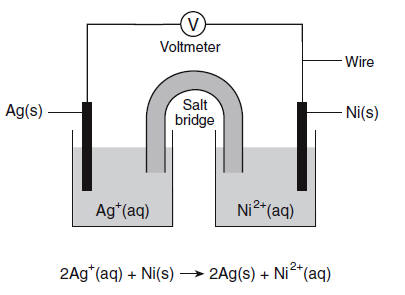
What reaction occurs at the anode?
Ag+/Ag = 0.80V
Ni2+/Ni = -0.25V
Ag+ + e- →Ag
Ag → Ag+ + e-
Ni2+ + 2e- → Ni
Ni → Ni2+ + 2e-

In the following reaction
Sn+2 + 2Fe+3 --> Sn+4 + 2Fe+2,
the reducing agent is...
Fe+3
Sn+2
Sn+4
Fe+2

Galvanic cells convert
mechanical energy in to electrical energy
potential energy in to electrical energy
electrical energy in to chemical energy
chemical energy in to electrical energy

Consider this cell.
Click all true statements
Zinc will be oxidised
Copper will be oxidised
Electrons will flow from right to left
The Zinc electrode is the negative electrode
Zn2+ will be reduced
Electrochemistry is
Study of electron in atom
Study of electricity in molecules
The relationship between chemical reactions and electricity
the study of electrons moving from one a tom to another

An oxidizing agent will
increase in mass
lose electrons
be reduced
increase in oxidation number

An electrolytic cell uses electrical energy to drive
chemical reaction
physical reaction
no reaction
none of above
EO represents
Single electrode potential
Standard electrode potential
Standard hydrogen electrode
None
The driving force behind the electron transfer is called the cell potential (Voltage).
True
False
In any redox reaction, both oxidation and reduction must occur.
True
False
F2 + 2e− ⟶ 2F
Oxidation Reaction
Reduction Reaction

