wayground logo

Free Printable Worksheets

NEW

Font size

S
M
L
XL
Worksheets

graph function

Total questions: 15

Worksheet time: 27mins

Name
Class
Date
1.
What is the definition of function?
a)
Has inputs and outputs
b)
Every input has only ONE output
c)
Inputs have different outputs every time
d)
x-values and y-values
2.
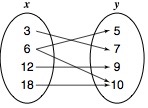
Is the relation a function? Why.
a)
Yes, because the x-value 11 has two y-values pair with it.
b)
Yes, because each x-value has only one y-value paired with it.
c)
No, because the x-value 11 has two y-values pair with it.
d)
No, because each x-value has only one y-value paired with it.
3.

What is the type of the relation?

a)

One-to-one relation

b)

One-to-many relation

c)

Many-to-one relation

d)

Many-to-many relation

4.

Which mapping diagram is not a function?

a)
b)
c)
d)
5.

What is the range?

a)

the set of all x-values

b)

the set of all y-values

6.
All of the x values or inputs are called what?
a)
Domain
b)
Range
c)
Relation
d)
Function
7.

What is the type of the relation?

a)

Many-to-one relation

b)

One-to-one relation

c)

Many-to-many relation

d)

One-to-many relation

8.

Relation is the matching of items from set A to set B. Relations can be represented by using the following, EXCEPT

a)

arrow diagram

b)

graph

c)

ordered pair

d)

chart

9.

This relation is called

a)

One-to-one Relation

b)

Many-to-one Relation

c)

One-to-many Relation

d)

Many-to-many Relation

10.

Which of the following diagrams represents a many-to-many relation?

a)
b)
c)
d)
11.

Base on the diagram, which one is TRUE?

a)

Set A is the codomain.

b)

{5, 7, 9, 11, 12} is the range of the function.

c)

5 is the object of 2.

d)

The object of 9 is 4.

12.

What is the relation between set A and set B.

a)

one to one

b)

one to many

c)

many to one

d)

many to many

13.
Is this mapping a function or not a function? 
a)
Function
b)
Not a Function
14.
Is this mapping a function or not a function? 
a)
Function
b)
Not a Function 
15.
Which set of values is a function?
a)
(9,5) (10,5) (9,-5) (10,-5)
b)
(3,4) (4,-3) (7,4) (3, 8)
c)
(6,-5) (7, -3) (8, -1) (9, 1)
d)
(2, -2) (5, 9) (5, -7) (1, 4)