

wayground logo

Free Printable Worksheets

NEW

Font size

S
M
L
XL
Worksheets

3.2 Kepler's Law Form 4 KSSM

Total questions: 12

Worksheet time: 6mins
Name
Class
Date
1.
Planets orbit the Sun in a shape called a(n)
a)
circle
b)
ellipse
c)
focus
d)
perihelion
2.
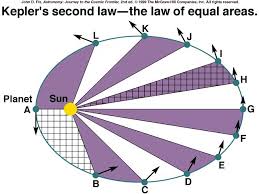
Where is the planet moving faster
a)
Position A to B
b)
Position B to C
c)
Position H to I
d)
Position I to J
3.
What is true about the area between points A, B and the Sun, and the area between points H, I and the Sun?
a)
The area between A, B and the Sun is the largest.
b)
The area between H, I and the Sun is the largest
c)
Both areas are equal in size
d)
There is not enough information to determine the areas
4.
Kepler's 2nd Law deals with 
a)
the shape of the planets' orbits
b)
the speed/area the planet travels 
c)
the length of time it takes the planet to orbit the sun
5.
A planet moves __________ when it is farthest from the sun.
a)
faster
b)
slower
6.
The farther away a planet is from the sun, the _______ it takes it to orbit the sun once. 
a)
longer
b)
shorter
7.
According to Kepler's 3rd law, the square of the time it takes for an object to orbit, T, is directly related to the cube of the distance, r, between the object and what it is orbiting.    
What this means is that if a satellite moves away from what it is orbiting,
a)
the larger the constant k is.
b)
the smaller the constant k is.
c)
the longer the orbital period is.
d)
the shorter the orbital period is.
8.
Kepler’s 3rd law states the square of the orbital period is proportional to the cube of the orbital radius. (T2=r3)

If a planet's orbital radius is doubled, what happens to the length of a year on that planet?
a)
It will become twice as long
b)
It will become about 8 times as long
c)
It will become 2.8 times as long
d)
It will remain the same
9.
According to Kepler's 3rd law, the square of the time it takes for an object to orbit, T, is directly related to the cube of the distance, r, between the object and what it is orbiting.    
What this means is that if a satellite moves away from what it is orbiting,
a)
the larger the constant k is.
b)
the smaller the constant k is.
c)
the longer the orbital period is.
d)
the shorter the orbital period is.
10.

Which statement best describes Kepler’s 3rd Law of Planetary Motion?​

a)

The closer a planet is to the sun, the shorter the orbital period is.

b)

Planetary orbits are in the shape of an ellipse

c)

The closer a planet is to its star, the lesser its orbital velocity.

11.

Which statement best describes Kepler’s 2nd Law of Planetary Motion?​


Penyataan yang manakah menerangkan Hukum Kepler Kedua?

a)

A line that connects a planet to the Sun sweeps out equal areas in equal times.


Garis yang menyambungkan planet dengan Matahari akan mencakupi luas yang sama dalam selang masa yang sama apabila planet bergerak dalam orbitnya.

b)

All planets move in elliptical orbits with the Sun at one focus.

Orbit bagi setiap planet adalah elips dengan Matahari berada di satu daripada fokusnya.

c)

The square of the orbital period of any planet is directly proportional to the cube of the radius of its orbit.


Kuasa dua tempoh orbit planet adalah berkadar terus dengan kuasa tiga jejari orbitnya.

12.

Which of the Kepler's Law state that all planet moves in elliptical orbit with the sun at one focus?

a)

Kepler's Law I

b)

Kepler's Law II

c)

Kepler's Law III
