wayground logo

Free Printable Worksheets

Font size

S
M
L
XL
Worksheets

HAP Unit #7 -- Quiz #1: Nervous Sys Introduction

Total questions: 49

Worksheet time: 53mins

Name
Class
Date
1.
The nervous system is composed of the ___, ___, and ___.
a)
heart, brain, kidneys
b)
lungs, liver, stomach
c)
brain, spinal cord, nerves
d)
eyes, pancreas, veins
2.

What does the nervous system do?

a)

Pumps blood from your heart to your body

b)

Carries messages back and forth between your brand and the rest of your body

c)

Breaks up food

d)

Secrete hormones.

3.

What is considered the command center of the nervous system?

a)

Neurons

b)

Heart

c)

Spinal Cord

d)

Brain

4.

What are the senses that the nervous system receives messages from? (mark all that apply)

a)

Vision

b)

Hearing

c)

Smell

d)

Taste

e)

Touch

5.

What kind of cells make up the nervous system?

a)

Plasma

b)

Neurons

c)

Blood Vessels

d)

Spinal Cord

6.

What makes up the Central Nervous System?

a)

Blood and Heart

b)

Spinal Cord

c)

Nerves

d)

Brain and Spinal Cord

7.

What is the Peripheral Nervous System consist of?

a)

The brain

b)

The spinal Cord

c)

The nerves that connect the CNS to all parts of the body.

d)

All of the above.

8.

What is paralysis?

a)

Loss of feeling or unable to move some body parts

b)

Able to jump around

c)

Able to run

d)

None of the above.

9.

What is the gap between two neurons called?

a)

Impulse

b)

Synapse

c)

CNS

d)

Inter neuron

10.

Select the VOLUNTARY action.

a)
b)
c)
d)
11.

Select the INVOLUNTARY action.

a)
b)
c)
d)
12.
What are the 2 major divisions of the peripheral nervous system (PNS)?
a)
Sensory & Motor
b)
Peripheral & Central
c)
Somatic & Autonomic
d)
Brain & Spinal Cord
13.
What is the purpose of the myelin sheath on the axon?
a)
To maintain temperature
b)
To improve conductivity
c)
To protect the axon
d)
To release neurotransmitters
14.
Sensory neurons carry nerve impulses from the sense organs and internal organs (like your stomach) to the
a)
peripheral nervous system (PNS)
b)
central nervous system (CNS)
c)
muscles
d)
sense organs
15.
What is NOT part of the peripheral nervous system (PNS)?
a)
axons
b)
sensory receptors
c)
spinal cord
d)
motor neurons
16.
a signal molecule that transmits nerve impulses across synapses
a)
neuron
b)
neurotransmitter
c)
nerve
d)
action potential
17.
nerve impulse
a)
action potential
b)
resting potential
c)
membrane potential
d)
synapse
18.
part of a neuron that receives information from other neurons
a)
axon
b)
dendrites
c)
myelin sheath
d)
synapse
19.
Location at which a neuron can transfer an impulse to another cell with the use of neurotransmitters is called __________.
a)
myelin sheath
b)
axon
c)
threshold
d)
synapse
20.
The part of the neuron that takes information away from the cell body is called a(n) _____________.
a)
dendrite
b)
axon
c)
cell body
d)
Schwann cell
21.
Label the Neuron-What does the letter "H" represent?
a)
Myelin Sheath
b)
Axon
c)
Axon Terminal
d)
Dendrite
22.
Label the Neuron-What does the letter "F" represent?
a)
Myelin Sheath
b)
Axon
c)
Axon Terminal
d)
Dendrite
23.
Label the Neuron-What does the letter "C" represent?
a)
Dendrite
b)
Axon
c)
Axon Terminal
d)
Cell Body
24.
Label the Neuron-What does the letter "A" represent?
a)
Dendrite
b)
Axon
c)
Myelin Sheath
d)
Node of Ranvier
25.
These carry signals from tissues and organs to the brain and spinal cord
a)
Sensory Neurons
b)
Motor Neurons
c)
Efferent Neurons
d)
Glial Cells
26.
The long, fiber like part of a neuron which the cell sends information to receiving neurons
a)
axon 
b)
dendrite
c)
axon terminal
d)
gene
27.
This releases neurotransmitters which are sent into the synaptic cleft for receptors on the dendrite
a)
axon
b)
axon terminal
c)
gene
d)
neuron
28.
These neuron processes transmit information from the sensory organs to the central nervous system
a)
efferent
b)
afferent
29.
These neuron processes transmit information from the central nervous system to the muscles and glands
a)
efferent
b)
afferent
30.
This part of the nervous system regulates involuntary actions such as heart function, blood pressure, breathing, digestion.
a)
Autonomic Nervous System
b)
Sensory Nervous System
c)
Motor Nervous System
d)
Peripheral Nervous System
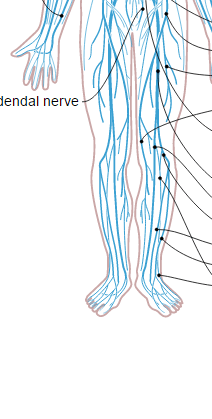
31.
This is a picture of the 
a)
peripheral nervous sysyem
b)
central nervous system
c)
respiratory system
d)
circulatory system
32.
The long, fiber like part of a neuron which the cell sends information to receiving neurons
a)
axon 
b)
dendrite
c)
axon terminal
d)
gene
33.
This insulating material forms a layer, around the axon of a neuron.  It enables electrical signals to travel down the axon at higher speeds.
a)
neuron
b)
myelin sheath
c)
dendrite
d)
neurotransmitter
34.
E
a)
Synapse
b)
Cell Body
c)
Axon 
d)
Dendrite
35.

The part of the PNS that controls involuntary actions

a)

autonomic nervous system

b)

somatic nervous system

c)

organic nervous system

d)

reflexive nervous system

36.
The part of the nervous system that consists of nerves that branch out from the CNS (central nervous system) and connect to other body parts
a)
Sympathetic
b)
Parasympathetic
c)
Autonomic
d)
Peripheral
37.
A chemical produced by neurons that carries messages to other neurons
a)
myelin sheath
b)
neurotransmitter
c)
axon
d)
axon terminal
38.
The tiny gap between neurons where nerve impulses are sent from one neuron to another.  It is where communication occurs between an axon and dendrite
a)
synapse
b)
axon terminal
c)
impulse
d)
myelin
39.
This part of the neuron stores then releases neurotransmitters into the synapse.
a)
Axon 
b)
Dendrite
c)
Myelin Sheath
d)
Axon Terminal
40.

Dr. Vazquez is examining a cell from the nervous system of an animal. He notices that at one end of the cell body is a long, fibrous strand of tissue. He immediately recognizes this as an axon that is responsible for

a)

carrying signals away from the cell body

b)

receiving signals from other cells and carrying them toward the cell body.

c)

determining the speed at which an action potential will travel

d)

determining whether the cell inhibits or excites neighboring neurons

41.

Which of the following is regulated by the autonomic nervous system

a)

Breathing

b)

Kicking a soccer ball

c)

Balancing on one foot

d)

Raising your hand

42.

Dopamine and Serotonin are examples of _______________

a)

Axon

b)

Neurotransmitters

c)

Somatic Nerves

d)

Autonomic Nerves

43.

Neurotransmitters are ______________ that travel across the ______________ to another cell.

a)

electrical signals; receptors

b)

electrical signals; synapse

c)

chemicals; receptors

d)

chemicals; synapse

44.

The branch like figures that receive impulses & conducts them to the cell body

a)

Dendrite

b)

Axon

c)

Cell Body

d)

Myelin Sheath

45.

The two parts of the Peripheral Nervous System

a)

Brain and Spinal Cord

b)

Somatic and Autonomic

c)

Systematic and Brain

d)

Spinal cord and Autonomic

46.

The ____________ is part of the peripheral nervous system and controls our senses.

a)

Systemic

b)

Autonomic

c)

Somatic

d)

Autonomous

47.

What is number 3 pointing at on the neuron?

a)

Dendrite

b)

Axon

c)

Myelin Sheath

d)

Soma

48.

What part of the neuron is number 4 pointing at?

a)

Dendrite

b)

Axon Terminal

c)

Axon

d)

Myelin Sheath

49.

Which part of the Neuron is number 1 pointing at?

a)

Dendrite

b)

Cell body

c)

Axon

d)

Nucleus