
Font size
 Worksheets
Y7 Top-up Quiz - CHEMICAL REACTIONS
Total questions: 15
Worksheet time: 17mins
Which of the following is an example of a CHEMICAL REACTION?
water freezes to form ice
sugar dissolves in water
petrol burns in a car engine
a piece of metal expands when it is heated
Which of the following is an example of a CHEMICAL REACTION?
a bike rusting
painting a house
washing a dog
tearing up a newspaper
In a chemical reaction, a piece of metal (Magnesium) is put into a test tube with some acid (Hydrochloric acid) and it fizzes ..
The GAS produced is...
chlorine
oxygen
magnesium chloride
hydrogen
Some Hydrochloric Acid is added to marble chips (Calcium Carbonate) in a test tube. The GAS produced is....
hydrogen
calcium chloride
carbon dioxide
chlorine
I heat some copper carbonate in a test tube. It goes black. This is due to the Copper carbonate reacting to form...
(select 2 ansqers)
copper oxide
carbon dioxide
copper
oxygen
What does the Law of Conservation of Mass state?
Matter cannot be gained or lost in a chemical reaction.
Matter can only be lost in a chemical reaction.
Matter can only be gained in a chemical reaction.
Matter can be gained and lost in a chemical reaction.
A single compound is heated and reacts to form two new smaller substances. What type of reaction is this?
combustion
neutralisation
thermal decomposition
displacement
Which of the following is evidence of a chemical reaction?
fizzing
water changing to ice
salt dissolving in water
paper being cut in half
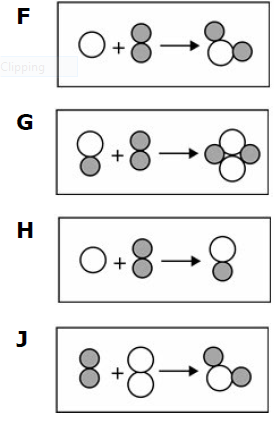
Which of the following models best demonstrates a balanced chemical equation?
F
G
H
J
What are Chemical Reactions?
when two substances are mixed together and then heated
a process in which atoms are rearranged to form new substances
when a liquid in a test tube bubbles
when sugar / salt / something similar is put into water and it disappears

If you start a chemical reaction with 4 atoms of hydrogen in the reactants, how many atoms of hydrogen will you be left with at the end in the products?
1 atoms
4 atoms
15atom
10 atoms
What is type of reaction happens when a metal oxide cancels out an acid?
combustion
decomposition
reversible
neutralisation
What is type of reaction happens when copper sulfate can be heated to make it change colour, before adding water to make it change colour a second time?
combustion
decomposition
reversible
neutralisation
What is type of reaction happens when magnesium is heated in air until it starts to burn?
oxidation
decomposition
reversible
neutralisation

