
Font size
 Worksheets
Rate of reaction
Total questions: 20
Worksheet time: 25mins
Which of the following reactions occurs at the highest rate?
Photosynthesis
Rusting of iron
Combustion of hydrogen in oxygen
Combustion of magnesium in oxygen
The following equation shows the reaction between calcium carbonate, CaCO3 and hydrochloric acid, HCl:
CaCO3(aq) + 2HCl(aq) → CaCl2(aq) + CO2 (g) + H2O(l)
Which of the following is the suitable method to determine the rate of reaction?
Change in the temperature of the solution with time
Change in the volume of carbon dioxide gas with time
Change in the mass of water with time
Change in the concentration of hydrochloric acid with time

Table 4 shows the total volume of gas evolved at different intervals for the dissociation of hydrogen peroxide.
What is the average rate of reaction in the second minute?
14.0 cm3 min-1
16.0 cm3 min-1
18.0 cm3 min-1
28.0 cm3 min-1

An experiment is carried out to study the effect of concentration on the rate of reaction between sodium thiosulphate and hydrochloric acid.
Graph of the concentration of sodium thiosulphate against 1/time is as shown.
Based on the graph, what is the value of t if the experiment is repeated using sodium
thiosulphate solution 0.025 mol dm-3.
32.3 s
50.0 s
0.020 s
0.031s

Diagram 4 shows the graph of volume of carbon dioxide gas against time when 5 g of marble chips is added to
50 cm3 of 0.2 mol dm-3 hydrochloric acid.
At what time the rate of reaction the highest?
t1
t2
t3
t4

Diagram 7 shows a graph of the volume of gas produced against time for the reaction between zinc granules and hydrochloric acid.
The gradient of the graph decreases with time because
catalyst is not used
volume of mixture decreases
temperature of reaction decreases
concentration of hydrochloric acid decreases
The equation represents the reaction between sodium carbonate and hydrochloric acid.
Na2CO3 + 2 HCl → 2 NaCl + H2O + CO2
The mass of the beaker and its contents is plotted against time.
Which graph represents what happens when sodium carbonate reacts with an excess of dilute hydrochloric acid?


Table 9 shows the experiments carried out to study the rate of reaction between zinc carbonate and nitric acid.
Which of the following graph represents the two experiments?


Figure 12 shows the apparatus set-up to determine the rate of reaction between calcium carbonate and hydrochloric acid.
Which of the following is not correct in the apparatus set-up for this experiment?
Fixing of cork
Position of thistle funnel
Position of the delivery tube in the basin.
Position of the delivery tube in the conical flask.
Magnesium reacts with acid to produce hydrogen gas, H2.Which solution would give the highest initial rate of reaction?
100 cm3 of 1.0 mol dm-3 of nitric acid, HNO3
100 cm3 of 1.0 mol dm-3 of hydrochloric acid, HCl
100 cm3 of 1.0 mol dm-3 of sulphuric acid, H2SO4
100 cm3 of 1.0 mol dm-3 of ethanoic acid, CH3COOH

In an experiment, 25 cm3 of 0.2 mol dm-3 hydrogen peroxide solution decomposes to produce oxygen gas. Graph of volume of oxygen gas against time is sketched and curve R is obtained as shown in Diagram 12.
Which of the following solution will produce curve S?
20 cm3 of 0.10 mol dm-3 hydrogen peroxide
30 cm3 of 0.20 mol dm-3 hydrogen peroxide
20 cm3 of 0.30 mol dm-3 hydrogen peroxide
10 cm3 of 0.30 mol dm-3 hydrogen peroxide
Which manufacturing of the following is not a characteristic of catalyst?
A catalyst is specific in its reaction.
A catalyst influences the quantity of product of a reaction.
The chemical property of a catalyst remains unchanged at the end of the reaction.
Only a little amount of a catalyst is needed to influence the rate of reaction.
Which of the following explains the meaning of effective collision?
The collision where its energy is less than the activation energy
The collision that has a low energy
The collision which takes place before a reaction
The collision that causes a reaction

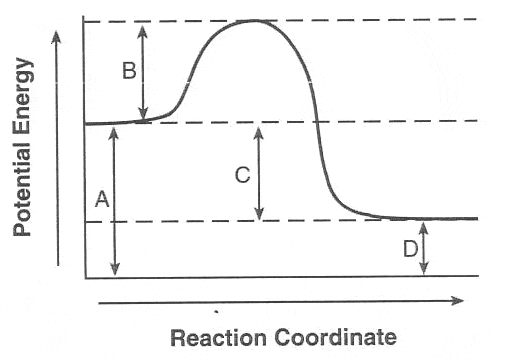
Diagram 12 shows an energy profile diagram. Ea is the activation energy for the decomposition of hydrogen peroxide.
P
Which of the following is the activation energy for the dissociation of hydrogen peroxide when manganese(IV) oxide is added?
P
Q
R
S
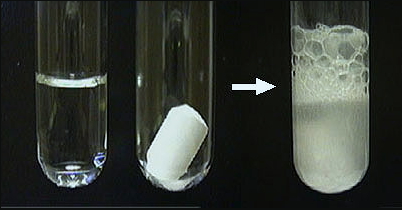
How could we make this reaction happen more quickly?
Decrease the concentration of the acid
crush the chalk to increase the surface area
Put the test tube in an ice bath
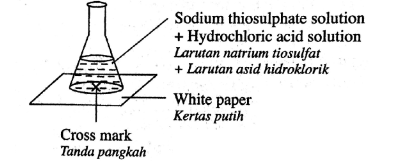
Diagram shows the apparatus set up for an experiment to determine the rate of reaction.
Which of the following techniques is the most suitable to determine the rate of reaction?
Record the time as soon as precipitate is formed
Record the time taken to obtain the maximum temperature
Record the times as soon as the cross mark cannot be seen
Record the times taken for the change of the pH value until a fixed pH value is obtained
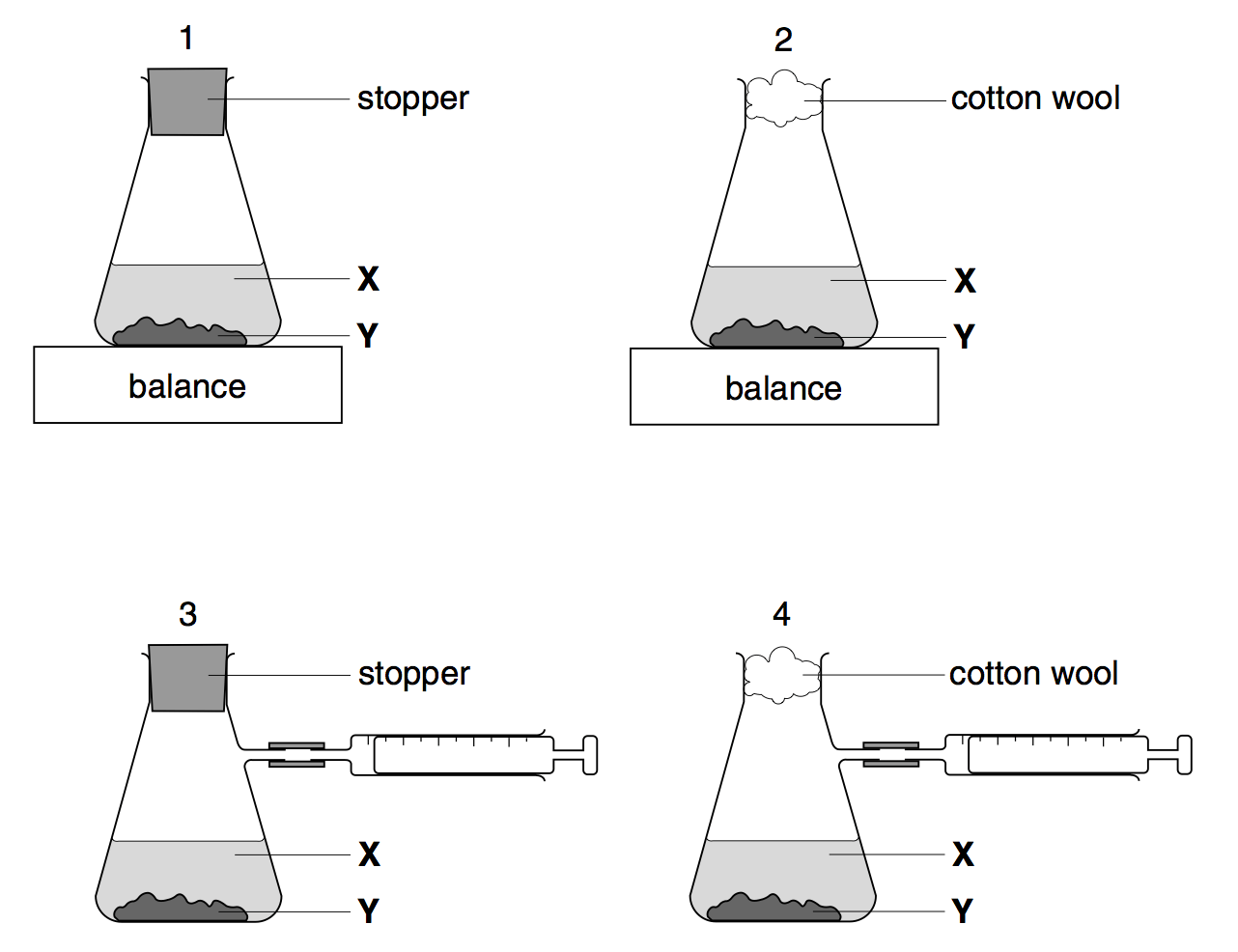
Which two diagrams show suitable methods for investigating the speed of the reaction?
What is used as a catalyst in the Contact process?
Apakah mangkin yang digunakan dalam proses Sentuh?
Iron filings
Serbuk besi
Vanadium(V) oxide
Vanadium(V) oksida
Sulphur
Sulfur
Water
Air
This method can use to collect gas produced ...
using a gas syringe system
downwards water displacement
using digital balance

