
 Worksheets
Unit 1: Colonization
Total questions: 151
Worksheet time: 2hrs 8mins
In 1620, the Pilgrims signed the ____to create a government in their colony at Plymouth.
Mayflower Compact
Fundamental Orders of Connecticut
1763 Proclamation
Townshend Acts
The ____ was a religious movement that encouraged colonists to seek self-government.
Transcendentalism
Great Awakening
urbanization
First Amendment
The 13 Colonies can be divided into ___ regions based on their physical geography.
2
3
4
5
The 13 Colonies can be divided into ___ regions based on their physical geography.
2
3
4
5
The first permanent English colony was established in ___ at ___
1803, Louisiana
1620, Plymouth
1848, Mexican Cession
1607, Jamestown
The development of large farms called ____ made the Southern Colonies different from the Middle and New England Colonies.
plantations
estates
sharecropping
slums
Most of the New England colonies were started for ____ reasons.
economic
social
religious
political
This Colony was established by Puritans.
Virginia
New Jersey
Massachusetts
South Carolina
Tobacco and rice were important crops in which colonial region?
Southern
Middle
New England
Poor farming conditions made this region a center for fishing and shipbuilding.
Southern
Middle
New England
Most of the colonies in this region were created for religious reasons.
Southern
Middle
New England
Slavery was common in this colonial region.
Southern
Middle
New England
Most of the larger cities, ports and farms producing food were located in this colonial region.
Southern
Middle
New England
This region was nicknamed "the Breadbasket" of the colonies.
Southern
Middle
New England
Which colony is best described by the following: (1) rich soil, (2) many large farms growing cotton or tobacco and (3) most of the work was done by enslaved African-Americans?
Middle
Southern
New England
How did the creation of the Virginia House of Burgesses create a foundation for the future system of government in the United States?
it was the first written constitution in the colonies
it allowed women the right to vote
it gave the colonists a voice in their government for the first time
it create a clear separation between religion and government
This colony was created for economic reasons?
Massachusetts
Georgia
Virginia
Pennsylvania
Which colonists were farmers and plantation owners who grew rice, indigo, and tobacco?
New England
Southern
Middle
Backcountry
The first permanent English settlement in North America was
St. Augustine
Quebec
Plymouth
Jamestown
William Penn founded Pennsylvania for what religious group?
Protestant
Baptist
Catholic
Quaker
The first form of representative government in the American colonies.
English Bill of Rights
Articles of Confederation
House of Burgesses
Congress
Who wanted to establish a fur and fishing trade?
Spain
France
English
Who sent missionaries to the New World to convert Native Americans to Christianity, specifically Catholicism?
Spain
France
English
Dutch
Who established the colony of Quebec and the land of Lousiana?
Spain
France
English
Who came to find gold and silver in the New World?
Spain
France
English
What was the main economic goal of European colonization?
make money and send resources back to Europe
Use natives as slaves in Africa
Build a network of roads to trade across America
Dig canals across America for trade with India
What motivated Europeans to explore and settle new territory?
economic gain through land and goods (gold)
to spread Christianity
to find a route to Asia
all of the above
Spanish explorers who came to the New World to conquer the people, gain land, riches, and spread Christianity are also known as what?
sailors
soldiers
conquistadors
missionaries
In which of the following areas did Spain create colonies in New Spain?
Mexico
South Carolina
Canada
Louisiana
Who were the first population of people to be slaves in the Americas?
African
Native Americans
Europeans
Spanish
Due to Native Americans dying, where did the Europeans go for their next slave population?
South America
Carribean Islands
Asia
Africa
What happened to the colonists of Roanoke?
Nothing
They are back in England now
They disappeared and no one knows what happened
John White made up this entire story.
What is the global exchange of goods and ideas resulting from the encounter between the people of the Eastern and Western hemispheres called?
Columbian Exchange
Middle Passage
Colonies
Representative Government
A person who pledged to work for a period until they paid off the cost of their voyage
Indentured servant
Slave
Native American
Puritan
A legal document giving certain rights to a person or company
Company
Cash crop
Charter
Royal colony
Who wanted to separate from the Church?
Pilgrims
Puritans
Baptists
Catholics
Who wanted to "purify" the Church?
Pilgrims
Puritans
Quakers
Catholics


England produced manufactured goods and the colonies produced rum which would be traded to Africa for what?
Corn
Sugar cane
Slaves
Pigs
Why did the use of slaves become popular in the colonies?
Colonists did not know how to plant and grow crops, so they needed someone else to do it
Colonists needed slaves to grow cash crops so they could make more money
Colonists were lazy and needed someone to work for them
Slaves became popular because colonists were friends with them.

How did the Triangular Trade system help build slavery in the Colonies?
The Triangular Trade brought food to the colonies to feed more slaves
The Triangular Trade helped slaves trade colonial goods
The Triangular Trade brought slaves to the colonies from Africa
The Triangular Trade keep slaves in touch with their families in Africa
How did the Great Awakening change America?
It brought people from all over the colonies together for the first time
It led to people denying God and leading secular lives
It spread abolitionism throughout the land and led to the end of slavery
It brought French rule to America
Merchants
A person or company who sells goods/products (merchandise)
In: goods coming into a country
Exit: goods going out of a country (selling)
The specific laws passed by England to control the trade
Navigation Acts
A person or company who sells goods/products (merchandise)
In: goods coming into a country
Exit: goods going out of a country (selling)
The specific laws passed by England to control the trade
Imports
A person or company who sells goods/products (merchandise)
In: goods coming into a country
Exit: goods going out of a country (selling)
The specific laws passed by England to control the trade
Exports
A person or company who sells goods/products (merchandise)
In: goods coming into a country
Exit: goods going out of a country (selling)
The specific laws passed by England to control the trade
Mercantilism
Being angry with England-The colonists were not accustomed to British control
The specific laws passedy by England to control trade
Mother Country Controls Trade-Colonys role is to serve the mother country
Exit: goods going out into a country (selling)
The Columbian Exchange was
Used prior to slaves; had to work for 5-7 years before being free.
The exchange of goods between the New World and the Old World
The most famous leg
Important trading route
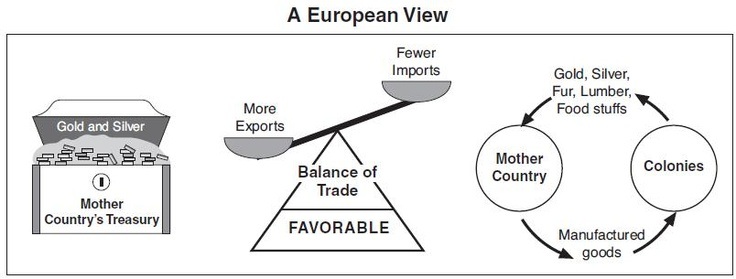
What is mercantilism?
A system where a mother countries gains money and power from natural resources that come from its colonies.
where colonies trade gold and silver with each other.
Wars that start over money.
Plantation colonies trading slaves for money.

True or False? Great Britain wanted to create wealth by importing more goods than it exported.
True
False

Which term means a good to sold another country?
Import
Export

EXPORTS of the 13 colonies included:
Manufactured goods
Raw Materials
Slaves
Gold
The Navigational Acts of 1651 included (choose all that apply:
Goods and provisions could only travel on Colonial ships
Goods and provisions could only travel on English ships
No taxes were placed on rum
All ships carrying Colonial goods had to be inspected

Mercantilism is when
Raw materials were bought cheaply by the colony and sold as refined materials to the 'Mother Country'
Raw materials were bought cheaply by the 'Mother Country' and sold as refined materials to the colony
When merchants sold their goods for high prices to working class citizens
When working class citizens were forced to sell their products to make profits


Raw materials are used to make the things we make ourselves or buy in stores. Those things are:___________.
raw materials
manufactured goods
natural resources
from the earth


The impact of mercantilism was that
The rate of slavery in the Americas went down
Trade was limited in the Atlantic
The Colony grew wealthy
The Mother Country grew wealthy
Which term means a good to sold another country?
Import
Export
EXPORTS of the 13 colonies included:
Manufactured goods
Raw Materials
Slaves
Gold
True or False? Great Britain wanted to create wealth by importing more goods than it exported.
True
False
The Navigation Acts were passes to ...
to ensure that Great Britain obtained the maximum profits in trade with her colonies and with other European countries.
control shipping between England and their colonies
ensure regulations on ships were being followed.
require all sailors to swear allegiance to the crown.


Which colonial region was famous for industry such as shipbuilding?
New England
Middle
Southern
New Jersey

The land masses of North America, Central America, and South America
Canada
Great Britian
East Indies
The Americas
What is one reason Europeans wanted to travel to America?
to build wealth
to conquer Indians
to colonize France
to find potatoes
Why did the rulers of Spain want a shorter route to the East Indies?
to practice fighting wars
to study a different culture
to send away their prisoners
to reach Asia faster for spices
Explorers hoped to find a Northwest Passage that would lead them
across the ice of the the North Pole.
down the entire length of the Mississippi River.
through North America to Asia.
into the interior where they could find gold.
Which of the following is the primary reason that European rulers became interest in trans-Atlantic exploration beginning in the 15th century?
They were curious about whether or not the world was round.
They were seeking an oversea trade route to Asia.
They wanted to become allies with Western Hemisphere natives.
They were looking to relocate their European empires to a new continent.
What was the primary purpose of the Spanish colonies there were established in North America in the early 1500s?
To foster friendship between Spaniards and Native Americans
To establish religious freedom for Spaniards fleeing Europe
To grow crops for Spain
To find gold and to spread Christianity

Which of the following was a primary reason France sought to colonize North America?
To create communities founded on religious tolerance
to profit from trading furs and other goods
to create joint ventures with other European powers
to reduce overpopulation in Europe
What country established the Colony of Roanoke?
Spain
England
France
Portugal
The French needed good relations with the Indians because...?
The Indians had lots of gold
The Indians trapped the animals to provide the furs


The first colony settled was _________________ in 1607.
Jamestown
Plymouth
Georgia
Anne Hutchinson
The __________________ colony was founded on religious freedom.
Jamestown
New Netherland
Plymouth
Mayflower Compact
The ____________________________ was a set of self-governing rules for the settlers in Plymouth.
William Penn
Theocracy
Jamestown
Mayflower Compact
________________________was a Puritan spiritual advisor and religious reformer who challenged male authority figures in the Massachusetts Bay Colony.
Roger Williams
Anne Hutchinson
Thomas Hooker
Mayflower Compact
In the Massachusetts Bay Colony they ruled with a ______________ government system where priest ruled in the name of God.
Plymouth
William
Georgia
Theocracy
___________________ was the founder of Rhode Island.
Thomas Hooker
William Penn
Roger Williams
Anne Hutchinson
_________________ was the founder of Connecticut.
Roger Williams
Anne Hutchinson
William Penn
Thomas Hooker
________________________________ was located in present day Manhattan, New York.
New Netherland
Georgia
Plymouth
Mayflower Compact
_____________________________ founded Pennsylvania as a place for Quakers to have religious freedom and tolerance.
William Penn
Theocracy
Roger Williams
Anne Hutchinson
___________________ was the last of the 13 colonies to form. It formed for debtor to have a fresh start and served as a buffer for other colonies.
Plymouth
New Netherland
Georgia
Jamestown
The Puritans wanted to ___ the Church of England?
reform
separate from
The Mayflower Compact is similar to what famous U.S. document?
The Constitution
The Declaration of Independence
The Bill of Rights
The Treaty of France
This Key Figure led the Puritans to settle in Massachusetts and created their economic, social and religious policies.
Roger Williams
John Winthrop
Anne Hutchinson
John Smith
A group of separatists that left England to escape religious persecution
Separatists
Puritans
Pilgrims
Quakers
A key figure that established Rhode Island promised that people of all religions were welcome.
John Winthrop
Roger Williams
Anne Hutchinson
John Smith
Who was killed by Indians?
Roger Williams
Anne Hutchinson
This person believed and taught that the government should have no part in the operations of the church.
Roger Williams
Anne Hutchinson
This person made enemies in the English government when he declared that it was wrong for the King of England to take Indian lands without payment to the Indians.
Roger Williams
Anne Hutchinson
Who moved their family and some of their followers to Rhode Island where they started a new colony in 1638?
Roger Willimas
Anne Hutchinson
Who held weekly prayer meetings in their home?
Roger Williams
Anne Hutchinson
Which leader made several treaties with Native Americans?
Ferdinand Magellan
Hernando Cortes
William Penn
Christopher Columbus
Which leader's colony eventually became the state of Pennsylvania?
John Smith
William Penn
John Wise
Roger Williams
Which leader was banished from their church because they believed God was more important than rules?
John Smith
Abigail Adams
Dolly Madison
Anne Hutchinson
Who established the colony of Rhode Island?
Roger Williams
John Wise
Anne Hutchinson
William Penn
Who was known for regularly having religious meetings for women in their home?
Mrs. Chandler
Mrs. Rocha
Anne Hutchinson
Anne of Green Gables
Who is a famous Quaker whose face is featured on a popular breakfast food?
LeBron James
Paul Revere
William Penn
David E. Smith
Who believed that all people should vote, no matter what their religion was?
Thomas Jefferson
Alexander Hamilton
Roger Williams
Anne Hutchinson

