wayground logo

Free Printable Worksheets

Font size

S
M
L
XL
Worksheets

GRADE 09 CPU AND MEMORY

Total questions: 49

Worksheet time: 25mins

Name
Class
Date
1.
CPU stands for...
a)
Central Programming Unit
b)
Centrally Processing Universally
c)
Core Processing Unit
d)
Central Processing Unit
2.
CPU carries out a cycle called___. 
a)
Execute-decote-fetch
b)
Fetch-decode-execute
c)
Fetch-execute-decode
d)
Decode-execute-fetch
3.

What type of memory is RAM?

a)

Temporary memory

b)

1 and 3 are correct answers

c)

Permanent storage

d)

All of the above

4.
What does ROM stand for?
a)
Random Only Memory
b)
Random Only Memory
c)
Rapid Only Machine
d)
Read Only Memory
5.
Which transfer is faster
a)
data between the cache and the CPU
b)
data between the RAM and cache
c)
data between the RAM and CPU
d)
data between the hard drive and CPU
6.
CPU Cache is located on
a)
The CPU
b)
The RAM
c)
The hard drive
d)
The motherboard
7.
Cache is used to make the computer faster
a)
TRUE
b)
FALSE
8.
RAM is non-volatile memory
a)
True
b)
False
9.

What is processor speed measured in?

a)

Hertz

b)

Watts

c)

Amps

d)

Volts

10.
What does RAM stand for?
a)
Random Access Memory
b)
Random Area Machine
c)
Real Access Machine
d)
Rapid Access Memory
11.
Identify this computer part.
a)
CPU
b)
hard disk drive
c)
RAM module
d)
motherboard
12.
What is the purpose of the CPU?
a)
To process all the data and instructions.
b)
To turn the computer on.
c)
To create PowerPoint presentations.
d)
To provide power to the computer.
13.

The CPU fetches instructions from.... and executes those instructions.

a)

Memory

b)

ALU

c)

ROM

d)

Input Device

14.
Which of the following is a job of the control unit?
a)
To start up the computer
b)
To manage the fetch decode execute cycle
c)
To create presentations
d)
To carry out calcul
15.
Which of the following is an example of 'main memory'.
a)
Hard Drive
b)
USB Drive
c)
RAM
d)
ROM
16.
How does clock speed affect computer performance?
a)
The higher the clock speed the slower the computer will run.
b)
It improves the amount you can store on the computer.
c)
The higher the clock speed the better the performance.
d)
It will make loading program slower
17.
Without a CPU the computer would not work.
a)
true
b)
FALSE
18.
ALU stands for
a)
Arithmetic Logic unit 
b)
Arithmetic Legal unit 
c)
Anti Logic unit 
d)
Arithmetic Logic undo
19.
The CPU needs access to the main memory and Cache memory
a)
true
b)
FALSE
20.
RAM is within the CPU
a)
true
b)
FALSE
21.

Describe the tasks that the control unit carries out

a)

Fetches the data/instructions, decodes it and sends the signals via buses to the hardware components.

b)

Carries out calculations and comparisons, to see if one value is larger than another.

22.
It consists of two parts: 
Arithmetic part and Logic part
a)
RAM
b)
Clock speed
c)
ALU
d)
Cache
23.

Select everything that is true about a CPU?

a)

CPU is the brain of a computer

b)

It processes all of the data

c)

It stores data long term

d)

It processes all of the instructions

e)

Otherwise called OS or operating system

24.

Select the correct part...


Does ALL the calculations

a)

Control Unit

b)

The ALU

c)

The Cache

d)

The Clock

25.

Select the correct part...


Completes simple addition, multiplication, division and subtraction.

a)

Control Unit

b)

The ALU

c)

The Cache

d)

The Clock

26.
ALU stands for
a)
Arithmetic Logic unit 
b)
Arithmetic Legal unit 
c)
Anti Logic unit 
d)
Arithmetic Logic undo
27.
Which two main components make up a CPU
a)
Control unit and Processing unit
b)
Control unit and RAM
c)
Control unit and Arithmetic Logic unit 
d)
Flash storage and Arithmetic Logic unit 
28.

What is a storage device?

a)

A device which allows you to type information into a computer

b)

A device which allows you see information.

c)

A hardware device which allows you to store data / information.

d)

A device which helps you to communicate

29.

What is the main purpose of the CPU?

a)

To carry out all the processing and calculations

b)

To turn the computer on and off

c)

To store information on the computer

d)

To make the computer run slower

30.

What is the main function of the CPU?

a)

To carry out processing and calculations

b)

To carry out the fetch, decode, execute cycle

c)

To allow you to play games

d)

To monitor how fast the computer is running

31.

What is the clock speed of the CPU?

a)

It is the number of times the CPU can carry out the fetch decode execute cycle per second.

b)

It is how many cores the CPU has

c)

It is a small amount of very fast memory built into the CPU

d)

It tell the time on the CPU.

32.

What is the purpose of RAM?

a)

To hold data and instructions that are currently being used

b)

To store information on a computer permenently

33.

True or False:

NOT gates can only have one input

a)

True

b)

False

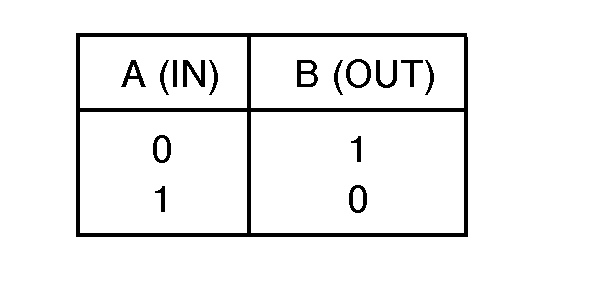
34.

What type of logic gate is this table showing?

a)

AND

b)

OR

c)

NOT

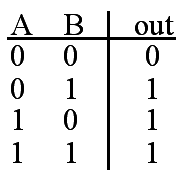
35.

What type of logic gate is this table showing?

a)

AND

b)

OR

c)

NOT

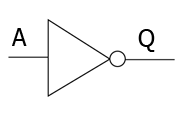
36.

Which logic gate is this?

a)

AND

b)

OR

c)

NOT

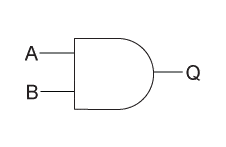
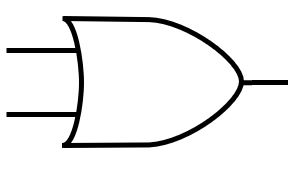
37.

Which logic gate is this?

a)

AND

b)

OR

c)

NOT

38.

Which logic gate is this?

a)

AND

b)

NOT

c)

OR

39.

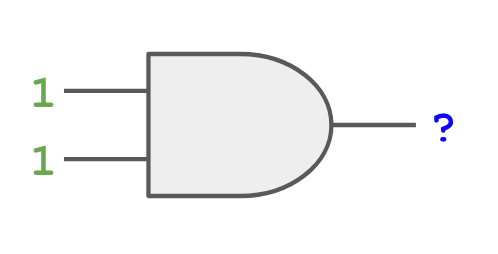
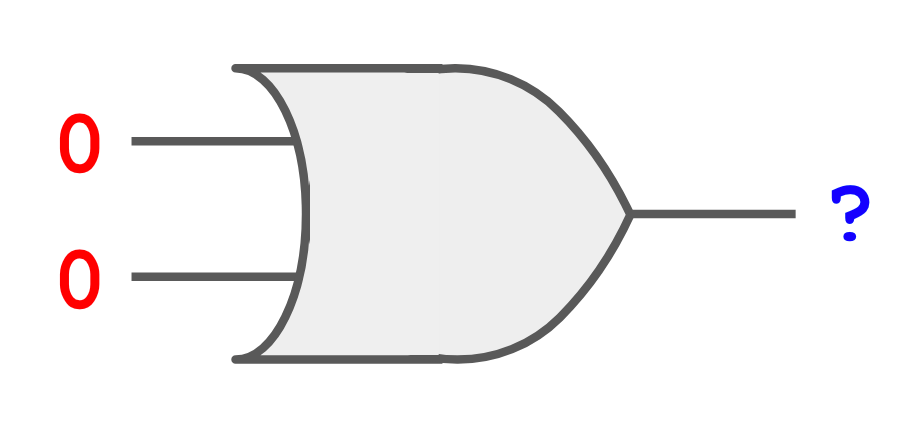
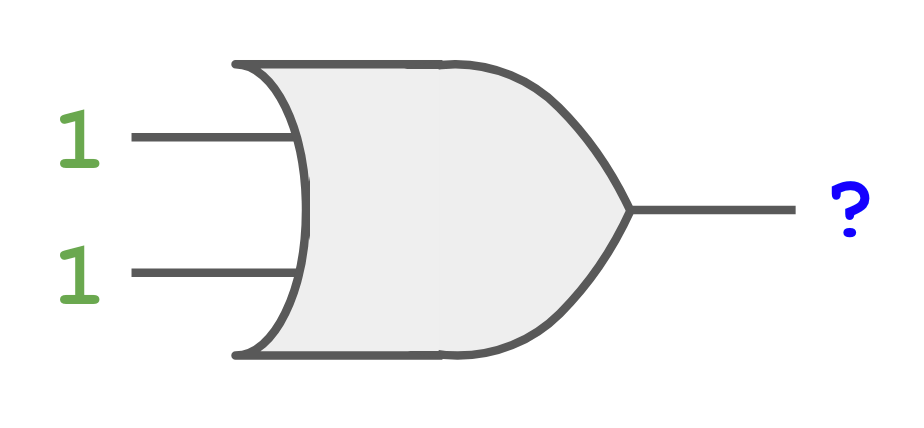
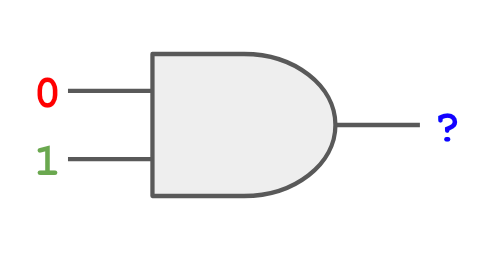
What will this gate's output be?

a)

0

b)

1

40.

What will this gate's output be?

a)

0

b)

1

41.

What will this gate's output be?

a)

0

b)

1

42.

What will this gate's output be?

a)

0

b)

1

43.

How many different combinations of 1 and 0 are possible with 2 bits?

a)

2

b)

4

c)

6

d)

8

44.

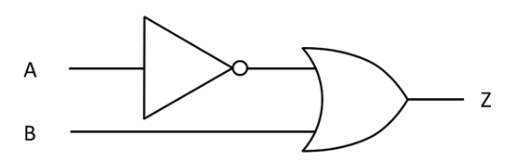
What is the Logic Expression for this circuit?

a)

Z = NOT (A AND B)

b)

Z = NOT (A OR B)

c)

Z = (NOT A) AND B

d)

Z = (NOT A) OR B

45.

True or False:

NOT gates output the opposite of the input

a)

True

b)

False

46.
What is the output of an OR gate if the inputs are 1 and 0?
a)
0
b)
1
c)
OFF
d)
2
47.
An OR gate has
a)
Two inputs and one output
b)
One input and one output
c)
One input and two outputs
d)
Two inputs and two outputs
48.
What is the output of a NOT gate if the inputs is 0?
a)
1
b)
0
c)
OFF
d)
2
49.
What gate is this table for?
a)
AND
b)
OR
c)
NOT
d)
NOR