
NEW
Font size
 Worksheets
US History TEST Topic 1 (21-22)
Total questions: 26
Worksheet time: 52mins


The business practice described above eventually led to the enactment of legislation that —
guaranteed public access to corporate records
protected consumers by prohibiting monopolies
protected domestic industries from foreign competition
required reciprocity agreements between state governments
How did Andrew Carnegie contribute to civic and social life in the United States?
By promoting spiritual and moral values in public schools.
By supporting conservative ideals in federal legislation and foreign policy.
By establishing philanthropic organizations dedicated to education and the arts.
By creating a charitable foundation to end hunger
Which benefit resulted from the introduction of the Bessemer steel process?
Mechanical reapers to replace horse-drawn reapers
Stronger and cheaper material for railroads and bridges
Transistors for radios
Electric lightbulb
Which application of a new technology can attributed to an invention of Thomas Edison?
Refrigerated railroad cars allowed food to be transported long distances
Light bulbs made it efficient for factory workers to work at night
Diesel engines were used in production of airplanes
Sonar technology was used to track submarines


One way the U.S. government responded to the problems caused by the conditions in this list was by —
passing the Interstate Commerce Act
implementing the silver standard for currency
creating federal jobs program for the unemployed
establishing a new tax on capital gains

How did the expansion of railroad transportation most benefit farmers in the United States?
By raising the consumer price of agricultural products
By increasing the variety of locally grown crops
By providing farmers with affordable access to distant markets

Which result completes this diagram?
Ratification of a suffrage amendment
Building of the transcontinental railroad
Passing of prohibition legislation
Expansion of labor unions
The Knights of Labor and the American Federation of Labor developed in response to the —
increased need to protect worker interests
decreased power of political machines
increased demand for skilled workers
decreased profitability of the agricultural sector
Which of the following occurred between 1865 and 1900 as a result of the rapid industrialization of the United States?
Social and economic class divisions began to disappear
Concerns about air pollution led to stricter environmental regulations
Union membership increased as workers sought better pay and conditions
Factory owners introduced wage-equality policies for women in the workplace

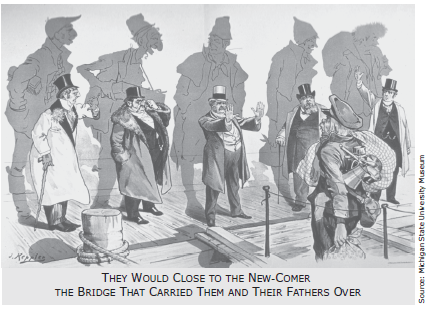
During the late nineteenth century, many Irish immigrants were discriminated against for being —
opposed to machine politics
loyal to the United Kingdom
conscientious objectors
Roman Catholics

A high school teacher wrote these bullet points on the whiteboard. What was most likely the topic of discussion?
Reasons for immigration to the United States
Principles of social Darwinism
Objectives of the Grange movement
Goals of U.S. assimilation policies
The Chinese Exclusion Act of 1882 was primarily a response to
increased U.S. presence in China
competition for jobs on the West Coast
rapid population growth in the Northeast
China's actions during the Boxer Rebellion


Which factor prompted the Americanization movement of the early twentieth century?
The increasing numbers of immigrants from Eastern and Southern Europe
The strengthening of Jim Crow laws in the southern United States
The rising tensions between the United States and the Soviet Union
The growing concern about environmental issues in the western United States

In 1895 the Department of Street Cleaning in New York City created a permanent group of sanitation workers known as the White Wings. This image shows the White Wings at work in 1896.
Increased urban population
The passage of labor laws
Decreased regulation of urban rail systems
The establishment of immigration quotas

Which demographic change in the United States is most associated with this transformation?
Increased property values in rural areas
Increased life expectancies in urban areas
Increased birth rates in rural areas
Increased migration to urban areas
Which example best defines a historical era?
A piece of landmark legislation
A genre of music and food specific to a region of a country
A collection of art by a world renowned artist
A period of time characterized by certain political, social, or economic events
Which of these is the best definition of an era?
A period of time identified by political, economic, or social trends
A series of various changes over many years
A series of events unified by individual or organized protests
A period of time lasting between 10 and 15 years
Which of the following best characterizes the Gilded Age?
The discovery of goldfields in the West led to an increase in the amount of money issued for circulation.
Industrialists used their connection with corrupt government officials for material gain and political power
In the Deep South a sharp increase in immigration brought a boom in construction and industry
Small, family-owned farms were bought and consolidated to form large agricultural corporations

