wayground logo

Free Printable Worksheets

Font size

S
M
L
XL
Worksheets

Phase Change and Triple Point

Total questions: 23

Worksheet time: 28mins

Name
Class
Date
1.
What state of matter is X?
a)
solid 
b)
liquid
c)
gas
d)
supercritical fluid
2.
What is point A?
a)
triple point
b)
critical point
c)
equilibrium point
d)
normal melting point
3.
Water exists as a _____________ at 700 mmHg and 50 °C.
a)
solid
b)
liquid
c)
gas
d)
supercritical fluid
4.
What phase change(s) may occur at pressures below 4.58 mmHg?
a)
sublimation/deposition
b)
melting/freezing
c)
all phase changes are possible at these pressures
d)
vaporization/condensation
5.
Water exists as a _____________ at 3 mmHg and 50 °C.
a)
solid
b)
liquid
c)
gas
d)
supercritical fluid
6.
Which statement is true for carbon dioxide at -60 °C?
a)
All three phases are possible.
b)
It can exist as a solid or a gas, depending on pressure.
c)
It is a solid.
d)
With enough pressure it can be melted.
7.
Which phase change increases the molecule's freedom of movement?
a)
Melting
b)
Freezing
c)
Condensing
8.
Describe the substance between letters D and E. 
a)
Gas
b)
Liquid
c)
Melting
d)
Evaporating
9.

The melting point of the sample is

a)

-60 ºC

b)

-100 ºC

c)

60 ºC

d)

100 ºC

10.

Given the heating curve of a solid being heated at a constant rate, what is the boiling point of this substance?

a)

20°C

b)

50°C

c)

110°C

d)

170°C

11.

Given the heating curve for water, during which line segment could I find water in both the solid and liquid phase at the same time?

a)

AB

b)

BC

c)

CD

d)

DE

e)

EF

12.

This curve indicates what about the heat energy?

a)

Heat energy is being added or absorbed

b)

Heat energy is being released

13.

In which region(s) of the graph would the substance be melting?

a)

No melting occurs on this graph

b)

Region C-E

c)

Region E-G

d)

Region G-I

e)

Region I-K

14.

What is the freezing point of the substance?

a)

0oC

b)

60oC

c)

120oC

d)

180oC

15.

What is it called when a solid turns directly into a gas?

a)
Sublimation
b)
Condensation
c)
Liquid
16.

Where on the graph are phase changes taking place?

a)

1

b)

2

c)

3

d)

4

e)

5

17.
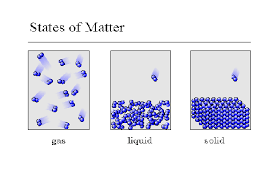
In a solid, the particles
a)
vibrate in place
b)
slide past one another
c)
overcome the strong attraction
18.
At higher temperatures
a)
particles in an object have less energy
b)
particles in an object move faster
c)
a gas contracts
19.

What state of matter is pictured?

a)

Solid

b)

Liquid

c)

Gas

d)

Plasma

20.
What happens to particles when they are heated?
a)
They speed up and spread out
b)
They slow down and compress
c)
They stop moving
d)
They move closer together and speed up
21.

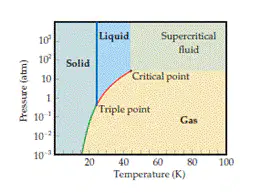
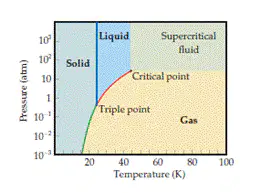
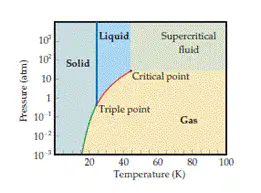
What is the boiling point temperature when the pressure is 10 atm?

a)

15 Kelvin

b)

25 Kelvin

c)

40 Kelvin

d)

45 Kelvin

22.

You have the substance at a pressure of 10 atm and a temperature of 35 degrees K, then lower the temperature to 5 degrees K. What do you observe happening to the substance?

a)

Melting

b)

Freezing

c)

Boiling

d)

Condensing

23.

Could you boil the substance at a temperature of 20 degrees K?

a)

Yes

b)

No

c)

There is not enough information to tell.

d)

If you change the pressure.