
 Worksheets
IB-A.1.6 to A.1.8 Motion SUVAT
Total questions: 20
Worksheet time: 12mins
Choose the option which is NOT TRUE about using 'suvat' equations.
only linear motion and changing mass
only linear motion and constant acceleration
constant acceleration and no air resistance
What does area under acceleration-time graph represents?
∆velocity
∆speed
∆displacement
∆distance
A body moves in a straight line. In order for the equations for uniformly accelerated motion to be applied, which condition must be true?
A constant net force acts on the body of fixed mass.
A constant net force acts on the body.
The body falls towards the surface of a planet.
The body has an initial velocity of zero.

What is the graph for velocity-time graph?
Negative slope linear, starting positive ending negative area.
Positive slope linear, starting positve ending negative area.
Negative slope linear, starting negative ending positive area.
Negative slope linear, starting positive ending negative area.


Match the description to the graph:
"The car is traveling at a constant speed."


The area under a velocity-time graph represents (a) .

Calculate the acceleration in section A
(a)

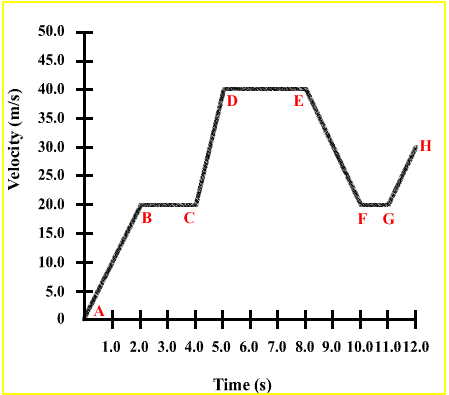
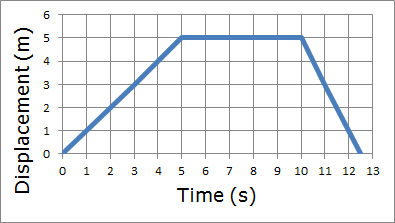
A cyclist travelling at a speed of 4.2 m s-1 accelerates at 1.1 m s-2. In a time of 7.4 s, the distance travelled is (2 sf)
(a)
A freely falling object on Earth has a speed of 5.0 m s-1. After falling a further 20 m, its speed it
15 m s-1
20 m s-1
25 m s-1
45 m s-1
A bus is travelling at a speed of 9.0 m s-1. It then accelerates at a rate of 0.75 m s-2 for a time of 8.0 s. What therefore is its final speed? ( answer 2 SF no UNits)
(a)
A student is asked to solve the following problem:
An object is thrown upwards with a speed of 25 m s-1. How high will it be when the speed is 12 m s-1 ?
Which equation will allow the problem to be solved in a SINGLE calculation?
s=ut+21at2
s=2(u+v)t
v=u+at
v2=u2+2as
THINK CAREFULLY ABOUT THIS ONE. DRAW A DIAGRAM TO HELP YOU..!
A building has 5 floors. The windows on successive floors are separated by the same vertical distance. A brick is dropped from a window on each floor at the same time. The bricks should hit the ground at
decreasing time intervals
equal time intervals
increasing time intervals
the same time
A lunar landing module is descending to the Moon’s surface at a steady velocity of 10.0 m s-1. At a height of 120 m a small object falls from its landing gear. Assuming that the Moon’s gravitational acceleration is 1.60 m s-2, at what speed, in m s-1 does the object strike the Moon? (do not type the units - 2 SF ONLY)
(a)
The highway code assumes a car with its brakes fully on as an acceleration of -6.7m/s2. Find the distance a car would take to stop if it's initial speed is 30 miles per hour (13.4 m/s)
6.0m
13.4m
15.4m
22m
A bird is migrating. It covers a distance of 4km and is constantly acceleration, a bit of a super bird. If it starts from 2m/s, and accelerates at 0.008m/s, what is it's final velocity
(a)

