Worksheets
Topic 9: Transport in Animal
Total questions: 20
Worksheet time: 32mins
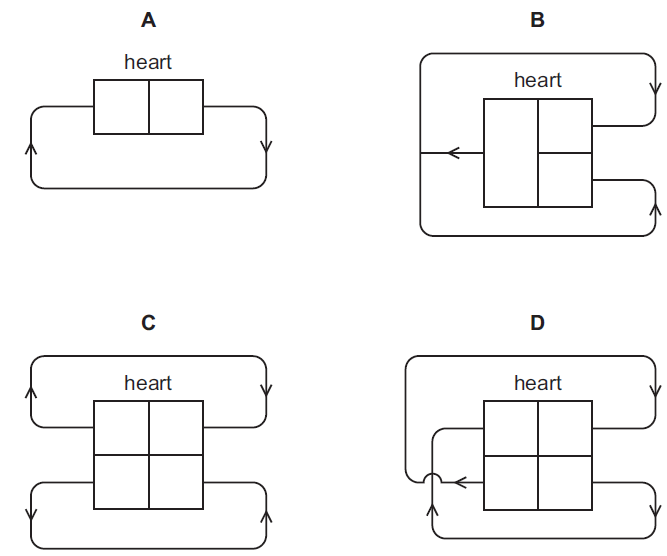
Which diagram shows the human double circulatory system?
A
B
C
D
How often must a blood cell in the renal artery pass through the heart before it again reaches the renal artery?
once
twice
three times
four times
Which type of cell is found in the greatest numbers in blood?
Red blood cell
White blood cell
Platelets
Protein
What happens to breathing and heart rate during exercise?
Breathing rate increases and heart rate decreases
They both increase
They both decrease
Why is the left wall of the heart have a thicker layer of muscle than the right side?
To stop the blood flowing backwards
To push the blood with more force at high pressure so it goes to all body cells.
To push the blood at high pressure to the lungs.
What do platelets do?
They stick together and make fibres that make scabs (blood clots) that stop pathogens entering the blood or stop you bleeding to death.
They form your immune system and destroy pathogens.
They carry oxygen around the body attached to haemoglobin.
What other names are given to red blood cells and also white blood cells?
Lymphocytes (red blood cells) and phagocytes and erythrocytes (white blood cells).
Erythrocytes (red blood cells) and phagocytes and lymphocytes (white blood cells).
Phagocyctes (red blood cells) and lymphocytes and erythrocytes (white blood cells).
What do phagocytes do?
Engulf (surround) microbes and digest them.
Produce antibodies.
Release a toxin that kills pathogens.
Why do arteries have a thick muscle layer?
To provide energy for the blood vessel.
To prevent the blood flowing backwards.
To help withstand the high pressure blood, also to contract to control blood flow.
List the structures in the circulatory system the blood travels through from vena cava to aorta.
Vena cava, lungs, pulmonary vein, left atrium, left ventricle, aorta, right atrium, right ventricle, pulmonary artery,
Vena cava, left atrium, right ventricle, pulmonary vein lungs, pulmonary artery, right atrium, left ventricle, aorta
Vena cava, right atrium, right ventricle, pulmonary artery, lungs, pulmonary vein, left atrium, left ventricle, aorta
Why do veins and the heart have valves?
To stop the backflow of blood
To contract to push the blood under high pressure
To cause the pulse
What type of blood vessel surround alveoli and other tissues in the body?
Capillaries
Arteries
Veins