
 Worksheets
Enzymes
Total questions: 15
Worksheet time: 14mins
Name
Class
Date
1.
Enzymes are an example of
a)
Lipids
b)
Carbohydrate
c)
Protein
d)
Nucleic Acid
2.
What is the purpose of an enzyme?
a)
give permission for the reaction
b)
raise activation energy
c)
speed up reactions
d)
control how many reactions occur
3.
Enzymes are capable of increasing the rate of a chemical reaction within a living cell. Enzymes accomplish this through which of the following means?
a)
reducing the number of products
b)
reducing the activation energy
c)
increasing the temperature of the cell
d)
increasing the concentration of reactants
4.
What 3 letters do enzymes typically end in?
a)
-ose
b)
-ase
c)
-ese
d)
-tic
5.
After the enzyme and substrate bind together and perform the reaction, what does the substrate become?
a)
a substrate
b)
an enzyme
c)
a product
d)
an active site
6.
In a chemical reaction, bonds are broken and new bonds are formed that create new substances. The bonds that are broken are called what?
a)
Reactants
b)
Products
c)
Atoms
d)
Catalysts
7.
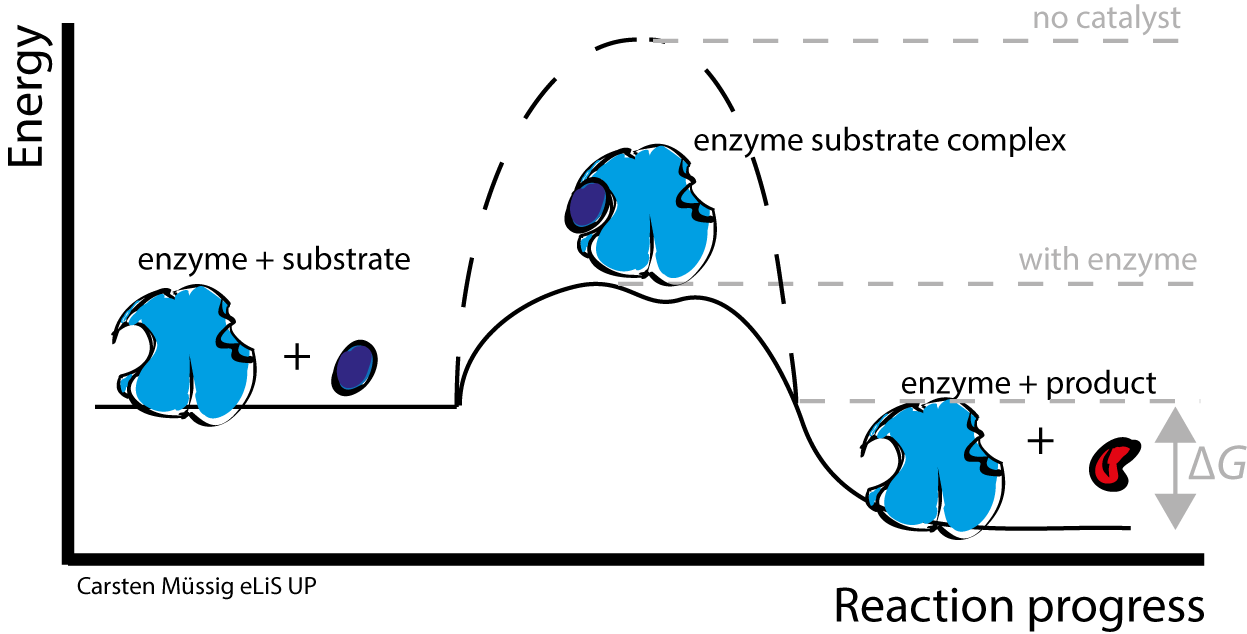
An enzyme speeds up a reaction by
a)
lowering the activation energy.
b)
raising the activation energy.
c)
releasing energy.
d)
absorbing energy.
8.
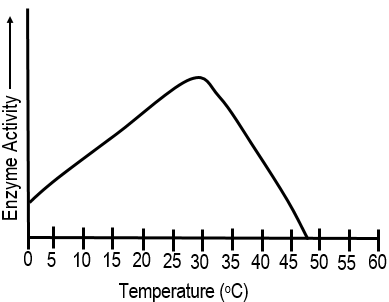
Based on the graph, what is the optimal temperature for this enzyme?
a)
15oC
b)
40oC
c)
30oC
d)
35oC
9.
What is a substance called if it speeds up a chemical reaction?
a)
reusable
b)
catalyst
c)
specific
d)
fragile
10.
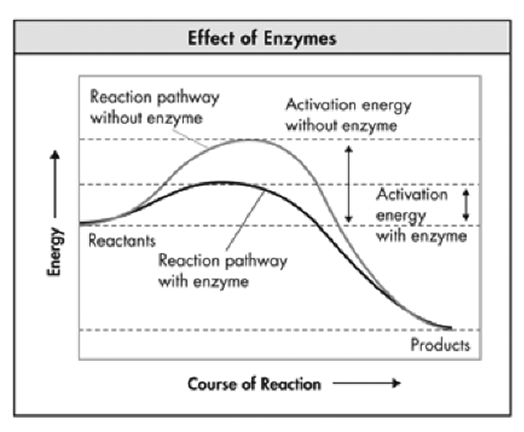
The graph shows how enzymes affect reactions in cells. Which statement best summarizes the information shown in the graph?
a)
Enzymes increase the energy of the reactants.
b)
Enzymes decrease the energy level of the products.
c)
Enzyme decrease the activation energy of the reaction.
d)
Enzymes reverse the direction of the reaction.
11.
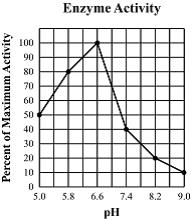
Which of the following conclusions can be drawn from this graph?
a)
The optimum pH of the enzyme is 6.6.
b)
The optimum pH of the enzyme is 5.8
c)
The enzyme’s activity increases as pH increases 5.0 to 9.0
d)
The enzyme’s activity is greater around pH of 8.0 .
12.
What happens when enzymes are heated to a high temperature?
a)
The enzymes die.
b)
The shapes of the enzyme are altered denature
c)
The enzymes' amino acid sequence changes.
d)
The enzymes remain the same
13.
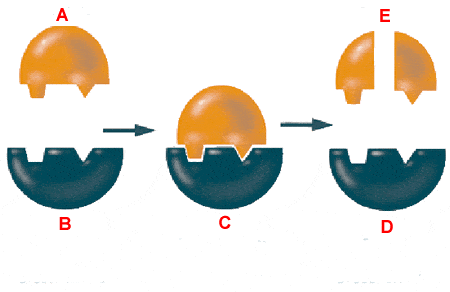
Enzymes catalyze reactions by ___________ Activation Energy.
a)
Increasing
b)
Decreasing
14.
How does temperature effect the reaction rate?
a)
Increased temperature increases the reaction rate
b)
Decreased temperature increases the reaction rate
c)
Increased temperature decreases the reaction rate
d)
Decreased temperature decreases the reaction rate
15.

A student is investigating how reaction rate changes over a range of enzyme concentration. The student uses excess reactants. Which of the following graphs best represents the relationship between enzyme concentration and reaction rate?
a)
a.
b)
b.
c)
c.
d)
d.
100 %

