Wayground logo

Free Printable Worksheets

Font size

S
M
L
XL
Worksheets

Unit 2: Linear Motion Exam Review

Total questions: 82

Worksheet time: 3hrs 19mins

Name
Class
Date
1.

What value will you get if you calculate the gradient of a v-t graph

a)

acceleration

b)

velocity

c)

deceleration

d)

displacement

2.

Describe this graph

a)

object move to left

b)

constant acceleration

c)

increasing displacement

d)

zero acceleration

3.

Describe this graph

a)

constant acceleration

b)

constant deceleration

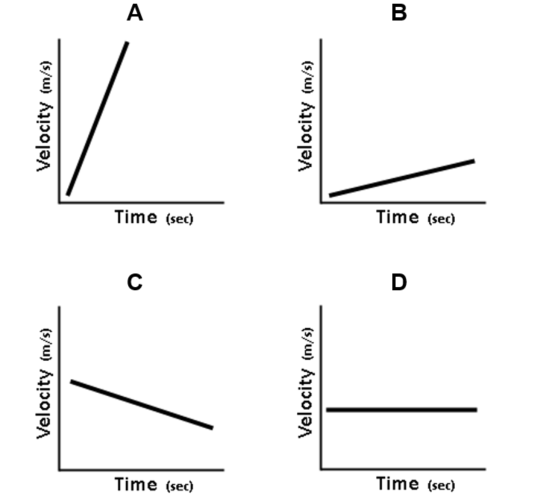
c)

object move to the left

d)

constant velocity

4.

What is the similar graph with above graph?

a)
b)
c)
5.

describe this graph

a)

zero acceleration

b)

deceleration to right

c)

deceleration to left

d)

acceleration to right

6.

Which a-t graph represent above graph?

a)
b)
c)
7.

How can we find distance traveled?

a)

calculate area under v-t graph

b)

calculate area under a-t graph

c)

calculate area under s-t graph

8.
What does the slope of a distance-time graph represent?
a)
Displacement
b)
Distance
c)
Velocity
d)
Time
9.
Which of the following is a unit of acceleration?
a)
km/s
b)
meters
c)
m/s2
d)
seconds
10.
When will something accelerate?
a)
Only when its speed changes
b)
Only when its direction changes
c)
When both its speed and/or direction changes
d)
When it moves at a steady speed
11.
What is the equation for acceleration?
a)
a = d/t
b)
a = t/d
c)
a = (vf - vi)/t
d)
a = t/(vf - vi)
12.
Suppose you INCREASE your walking speed from 1 m/s to 7 m/s in a time of 2 seconds. What is your acceleration?
a)
-3 m/s2
b)
3 m/s2
c)
-4 m/s2
d)
4 m/s2
13.
Suppose a dog DECREASES its running speed from 8 m/s to 2 m/s in a time of 2 seconds. What is its acceleration?
a)
-3 m/s2
b)
3 m/s2
c)
-5 m/s2
d)
5 m/s2
14.
During what interval is the car's velocity zero?
a)
A
b)
B
c)
C
d)
D
15.
During what interval(s) is the car's velocity positive?
a)
A
b)
A & E
c)
A, C, & E
d)
B & D
16.
During what interval is the car's velocity negative?
a)
A
b)
B
c)
C
d)
D
17.
During what interval is the car's velocity the greatest?
a)
A
b)
B
c)
D
d)
D
18.
During what interval is the car accelerating?
a)
A
b)
B
c)
C
d)
D
19.
Which of the following lines shows the object is moving back?
a)
A
b)
B
c)
C
d)
D
20.
Which object is traveling faster? 
a)
B
b)
D
21.
What is the best way to describe the speed of object C?
a)
Fast
b)
Moving backwards
c)
Not Moving
d)
Slow
22.
The slope of any position verses time graph is equal to the objects?
a)
distance
b)
time
c)
acceleration
d)
speed
23.
What is happening in this graph from point B to C?
a)
The object is going down a hill.
b)
The object is returning to its starting location.
c)
The object is slowing down.
d)
The object is staying still.
24.
Calculate the speed of the object using this graph.
a)
Speed = 5 m/s
b)
Speed = 50 m/s
c)
Speed = 2 m/s
d)
Speed = 3 m/s
25.
Calculate the speed of object A.
a)
2 m/s
b)
.5 m/s
c)
3 m/s
d)
6 m/s
26.
Calculate the speed of object B.
a)
6 m/s
b)
2 m/s
c)
1 m/s
d)
4 m/s
27.
In this position vs time graph, describe the object's motion between 1 and 3 seconds.
a)
Stopped
b)
Slowing down
c)
Constant speed
d)
Speeding up
28.

Instantaneous rate of change of displacement is a definition of

a)

Instantaneous velocity

b)

Instantaneous acceleration

c)

Instantaneous displacement

d)

velocity

29.
You run from your house to a friend's house that is 3 km away. You then walk home. The distance you traveled is 6 km. What is your displacement? 
a)
6  km
b)
0 km
30.
A _________ quantity is completely described by magnitude alone. A _________ quantity is
completely described by a magnitude with a direction.
a)
vector, scalar
b)
scalar, vector
31.
Speed is a __________ quantity and velocity is a __________ quantity.
a)
scalar, vector
b)
vector, scalar
32.
The fastest trains are magnetically levitated above the rails to avoid friction (and are therefore called
MagLev trains...cool, huh?). The fastest trains travel about 250 km in a half an hour. What is their
average speed in km/hour?
a)
250 km/hr
b)
500 km/hr
c)
125 km/hr
33.
A hummingbird averages a speed of about 45 km/hour (Cool facts: They visit up to 1000 flowers per day, and reach maximum speed, while diving, up to 160 km/hour!). Ruby-throated hummingbirds take a non-stop trip across Gulf of Mexico in which they fly for 18 hours straight! How far is the trip across the Gulf of Mexico at their average speed?
a)
810 km
b)
2.5 km
c)
3.6 km
d)
360 km
34.
An object is NOT accelerating if it is moving
a)
in a circle
b)
at constant velocity 
c)
at increasing speed
d)
only as influenced by gravity
35.
A car slows down from +32 m/s to +8 m/s in 4 s. The acceleration is 
a)
6 m/s/s opposite the motion
b)
2m/s/s in the direction of motion
c)
8 m/s/s opposite the motion
36.
An airplane accelerates down a runway at 3.20 m/s/s
for 8 s until it finally lifts off the ground.
Determine the velocity at take-off.
a)
0.4 m/s
b)
25.6 m/s
c)
2.5 m/s
37.
An airplane accelerates down a runway at 3.20 m/s/s for 8 s until it finally lifts off the ground.  The velocity of 25.6 m/s at liftoff is 
a)
instantaneous 
b)
average
38.
What is this graph representing?
a)
Constant Speed
b)
Acceleration (speeding up)
c)
Deceleration (slowing down)
d)
No motion
39.
At 60 seconds, how far had this object traveled? 
a)
0 m
b)
10 m
c)
20 m
d)
40 m
40.
Which graph represents zero acceleration (constant velocity)?
a)
A
b)
B
c)
C
d)
D
41.
What is happening at D?
a)
Stationary
b)
Accelerating
c)
Fast steady speed; moving away from the starting position
d)
Slower steady speed; moving away from the starting position
42.
What is happening at A?
a)
Stationary
b)
Accelerating
c)
Slower steady speed; moving away from the starting position
d)
Steady speed; returning to start position
43.
Which runner won the race?
a)
A
b)
B
c)
C
44.

A car is traveling to the right with a speed of 29​​m/s when the rider slams on the accelerator to pass another car. The car passes in 110 m with constant acceleration and reaches a speed of 34m/s. We want to find the acceleration of the car as it sped up. What equation should you choose?

a)

v=vo+at

b)

d=vot+1/2at2

c)

v2=vo2+2ad

d)

d=1/2(v+vo)t

45.
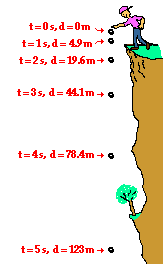
What happens to the velocity of a ball as it is dropped off a cliff? 
a)
It decreases at a uniform rate 
b)
It increases at a uniform rate 
c)
It is constant 
d)
It increases at a non-uniform rate
46.
A boat travels 12.0 m while it reduces its velocity from 9.5 m/s to 5.5 m/s. What is the magnitude of the boat’s acceleration while it travels the 12.0 m?
a)
1.3 m/s2
b)
2.5 m/s2
c)
3.0 m/s2
d)
7.5 m/s2
47.

Kinematic equation can only be used when you have a constant ....

a)

Position

b)

Velocity

c)

Acceleration

d)

Time

48.

The unit we use to measure acceleration is ___.

a)

m/s

b)

m

c)

s

d)

m/s2

49.

A ball is dropped from a building. How fast is it traveling after falling for 1.77 s? (Hint: It's a free falling object)

a)

14.76 m/s

b)

17.35 m/s

c)

18.91 m/s

d)

20.03 m/s

50.

A car starts from rest and accelerates uniformly over a time of 5.21 seconds for a distance of 110 m. Determine the acceleration of the car. Choose the appropriate equation.

a)

v=vo+at

b)

d=vot+1/2at2

c)

v2=vo2+2ad

d)

d=1/2(v+vo)t

51.

Rocket-powered sleds are used to test the human response to acceleration. If a rocket-powered sled is accelerated to a speed of 444 m/s in 1.83 seconds, then what is the distance that the sled travels?

Choose the appropriate equation.

a)

v=vo+at

b)

d=vot+1/2at2

c)

v2=vo2+2ad

d)

d=1/2(v+vo)t

52.

If Michael Jordan has a vertical leap of 1.29 m, then what is his takeoff speed if his acceleration is -9.8 m/s2 and his velocity at the top of his leap i 0 m/s?

a)

v=vo+at

b)

d=vot+1/2at2

c)

v2=vo2+2ad

d)

d=1/2(v+vo)t

53.

An engineer is designing the runway for an airport. Of the planes that will use the airport, the lowest acceleration rate is likely to be 3 m/s2. The takeoff speed for this plane will be 65 m/s. All airplanes will start from rest. Assuming this minimum acceleration, what is the minimum allowed length for the runway?

a)

v=vo+at

b)

d=vot+1/2at2

c)

v2=vo2+2ad

d)

d=1/2(v+vo)t

54.

The unit we use to measure speed is ___.

a)

m/s

b)

m

c)

s

d)

m/s2

55.

The unit we use to measure distance is ___.

a)

m/s

b)

m

c)

s

d)

m/s2

56.

A car is traveling to the right with a speed of 29 ​​m/s when the rider slams on the accelerator to pass another car. The car passes in 110 m with constant acceleration and reaches a speed of 34 m/s. We want to find the acceleration of the car as it sped up. What equation should you choose?

a)

v=vo+at

b)

d=vot+1/2at2

c)

v2=vo2+2ad

d)

d=1/2(v+vo)t

57.

*A boat travels 12.0 m while it reduces its velocity from 9.5 m/s to 5.5 m/s. What is the magnitude of the boat’s acceleration while it travels the 12.0 m?

a)

1.3 m/s2

b)

2.5 m/s2

c)

3.0 m/s2

d)

7.5 m/s2

58.

A car starts from rest and accelerates uniformly over a time of 5.21 seconds for a distance of 110 m. Determine the acceleration of the car. Choose the appropriate equation.

a)

v=vo+at

b)

d=vot+1/2at2

c)

v2=vo2+2ad

d)

d=1/2(v+vo)t

59.

*A golf ball starts with a speed of 2 m/s and slows at a constant rate of 0.5 m/s2, what is its velocity after 2 s?

a)

0 m/s

b)

0.5 m/s

c)

1 m/s

d)

1.5 m/s

60.

*How long would it take a car, starting from rest and accelerating uniformly in a straight line at 5 m/s2, to cover a distance of 200 m?

a)

9.0s

b)

10.5s

c)

12.0s

d)

15.5s

61.

*A golf ball accelerates off a tee at 15 m/s2, changing its velocity from 0 m/s to 50 m/s down the fairway. How long did it take the golf ball to accelerate?

a)

750 seconds

b)

35 seconds

c)

0.3 seconds

d)

3.3 seconds

62.

*Sam jumped from a plane. His acceleration was -9.8 m/s2. He hit the ground in 30 seconds. What was his velocity just before he hit the ground?

a)

294 m/s

b)

0.32 m/s

c)

-294 m/s

d)

3.1 m/s

63.

*A dog basks in the sun when he sees a squirrel and bolts after it. If the dog accelerates at +1.6 m/s/s, how far does he run in 3 seconds?

a)

4.8 meters

b)

45 meters

c)

1.6 meters

d)

7.2 meters

64.

*An object with an initial velocity of 3.50 m/s moves east along a straight and level path. The object then undergoes a constant acceleration of 1.80 m/s2 east for a period of 5.00 s. How far does the object move while it is accelerating?

a)

6.30 m

b)

17.5 m

c)

27.2 m

d)

40.0 m

65.

Solve for "a" given v = v0 + at

a)

a = (v0-v)/t

b)

a = (v-v0)/t

c)

a = t/(v-v0)

d)

a = t/(v0-v)

66.

*The speed of an object undergoing constant acceleration increases from 8.0 m/s to 16.0 m/s in 10 s. How far does the object travel during the 10 seconds?

a)

360 m

b)

160 m

c)

120 m

d)

80. m

67.

*A car accelerates uniformly from rest at 3.2 m/s2. When the car has traveled a distance of 40. m, its speed will be

a)

8.0 m/s

b)

12.5 m/s

c)

16 m/s

d)

128 m/s

68.

*How long will it take a running horse to travel 260 m and attain a speed of 12 m/s from rest?

a)

1200 seconds

b)

1.2 hours

c)

43 minutes

d)

43 seconds

69.

If an object starts from rest, what is its initial velocity?

a)

Depends on the problem

b)

0

c)

-9.8m/s2

d)

Always positive

70.

A car is traveling to the right with a speed of 29​​m/s when the rider slams on the accelerator to pass another car. The car passes in 110 m with constant acceleration and reaches a speed of 34m/s. We want to find the acceleration of the car as it sped up. What equation should you choose?

a)

v=vo+at

b)

d=vot+1/2at2

c)

v2=vo2+2ad

d)

d=1/2(v+vo)t

71.

A car is traveling to the right with a speed of 29​​m/s when the rider slams on the accelerator to pass another car. The car passes in 110 m with constant acceleration and reaches a speed of 34m/s. We want to find the acceleration of the car as it sped up. What equation should you choose?

a)

v=vo+at

b)

d=vot+1/2at2

c)

v2=vo2+2ad

d)

d=1/2(v+vo)t

72.
We can use SOH-CAH-TOA for...
a)
Any triangle ever
b)
Non-right triangles only
c)
Right Triangles only
d)
Never
73.
The ratio in a right triangle of adjacent to hypotenuse is _____
a)
sine
b)
cosine
c)
tangent
d)
inverse cosine
74.
The ratio in a right triangle of opposite to adjacent side is _____
a)
sine
b)
cosine
c)
tangent
d)
inverse cosine
75.
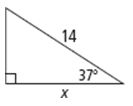
Choose the correct ratio.
a)
sin(37)=x/14
b)
cos(37)=x/14
c)
tan(37)=x/14
d)
sin(37)=14/x
76.
What would you use to solve for a?
a)
sin
b)
cos
c)
tan
d)
Pythagorean theorem
77.
Find the length of side w.
a)
21.4 cm
b)
18.0 cm
c)
36.5 cm
d)
43.6 cm
78.
What is the cosine of angle P?
a)
p/q
b)
q/r
c)
p/r
d)
r/q
79.
Find the measure of the missing angle.
a)
64o
b)
26o
c)
61o
d)
.008o
80.
Find the measure of the missing angle.
a)
49o
b)
50o
c)
41o
d)
33o
81.
Solve for the missing angle
a)
50
b)
0.053
c)
36.9
d)
95
82.
a)
20.35
b)
12.72
c)
14.99
d)
21.83